



June 30, 2026 By The Scale Rankings

| SEO typically takes 3-6 months to show measurable improvements, while significant traffic and revenue growth often takes 6-12 months. Established websites may see ranking movement within 6-10 weeks, whereas new or highly competitive sites need a longer time. The exact timeline depends on factors like your website's authority, competition, technical SEO, content quality, backlinks, and consistency. |
That's the honest answer. But what do those months look like, and how fast do you move through them? It depends entirely on six factors specific to your site. This guide breaks all of them down, gives you a realistic month-by-month timeline, and shows you exactly what to track at each stage.
At The Scale Rankings, we've managed SEO campaigns across local businesses, ecommerce stores, SaaS companies, and enterprise brands. Those who understand the timeline before they start are the ones who stick with it long enough to win.
TL;DR: How Soon Can You Expect SEO Results
|
SEO doesn't rank your pages instantly. For the same reason, you can't become a trusted expert overnight. Google's entire job is to surface the most credible, helpful result for every search query. Trust is something that is measured over time, not in a single crawl.
When you publish a new page or make SEO improvements, Google has to:
This is why you can do everything right and still not see traffic for 60 to 90 days. The work isn't failing, it's being evaluated.
There's a second reason also. SEO is a compound investment. A single blog post or technical fix rarely works on its own. What moves rankings is a pattern of consistent improvement across content, technical health, and authority. Google observes this kind of pattern over time.
“The Scale Rankings case study: When we took on an Illinois-based healthcare client in early 2024, they had a clean site but zero blog content and a Domain Rating of 22. Within 90 days of our content and link-building programme, they had 12 pages indexed and ranking on pages 2-3. By month 8, organic traffic had grown by 245%, and three pages were in the top 5. The first 90 days felt like nothing was happening. It wasn't; it was compounding silently.”
No two SEO timelines are identical. Here are the 6 variables with the most impact on how fast you will see results.
An established domain with years of crawl history, an existing backlink profile, and indexed content will respond to SEO changes faster than a brand-new domain. Google has a baseline of trust for older domains that it doesn't extend to sites registered 6 months ago.
The gap between these two starting points can mean a difference of 3 to 6 months in the timeline. If your site already ranks on page 2 or 3 for target keywords, optimization can move those rankings to page 1 significantly faster than building visibility from scratch.
What this means for you: If your site is established (2+ years old, 50+ pages indexed), expect results on the shorter end of any range. If you're new, budget for 9 to 12 months before judging the strategy.
"How long does SEO take?" has a very different answer depending on whether you're trying to rank for "plumber in Wilmington, NC" versus "best CRM software."
Local and niche keywords with low competition can see page-1 movement in 60 to 90 days. National keywords in competitive verticals like SEO, finance, healthcare, and legal can take 12 to 24 months of sustained effort to crack page 1. The businesses already on page 1 for those terms have been building authority for years, and Google doesn't hand that over quickly.
| Competition Level | Expected Timeline |
| Local/low competition | 2-4 months |
| Medium competition | 4-8 months |
| High competition (national) | 8-18 months |
| Very high (finance, healthcare, SaaS) | 12-24+ months |
A technically broken site suppresses all your other SEO efforts. Crawl errors, duplicate content from missing canonical tags, slow page speed, JavaScript rendering issues, and poor mobile usability all slow Google's ability to understand and rank your pages.
Technical fixes are the fastest category of SEO work to show results. This often takes 2 to 6 weeks because you're removing active barriers that are suppressing your existing performance. A technically sound site gets significantly more value from content and link building than a technically broken one.
Key technical factors that affect the timeline:
Google cannot rank pages that don't exist. This sounds obvious, but it's the most common reason sites with strong authority still get zero organic traffic. They have service pages and no informational content to capture search demand at the top of the funnel.
Topical authority is the signal that your site is a genuine expert on a subject. It is built through a cluster of interconnected content covering a topic from multiple angles. A single pillar page with five to eight supporting posts covering sub-topics will outrank an isolated service page every time, even when the service page has more backlinks.
Content quality also affects how quickly you rank. Pages that answer the searcher's question completely, in an answer-first format, with original data and expert authorship, will climb faster than generic AI-spun content with no unique perspective.
Your backlink profile is one of Google's strongest trust signals, and it's also one of the hardest things to build quickly. Dofollow links from authoritative, relevant domains pass PageRank. The underlying currency of SEO authority.
Sites with strong backlink profiles (Domain Rating 50+, with quality editorial links from industry publications) rank new content significantly faster than sites with weak or spam-heavy profiles. If 78% of your backlinks are nofollow directory listings, they pass no PageRank regardless of volume. What matters is the number and quality of genuine editorial dofollow links.
Benchmarks for dofollow ratio:
SEO that runs in three months of effort, then six months of nothing. It produces inconsistent and backsliding results. Google rewards sites that demonstrate ongoing improvement and fresh content signals. A business publishing two quality posts per month and building five to ten editorial links per month will consistently outperform a business that runs intensive campaigns followed by dormant periods.
The investment level also matters. A site investing $3,000 per month in SEO moves more slowly than one investing $15,000 per month, simply because of the volume of work completed in a given period. That said, doubling the SEO budget does not halve the timeline. Google's evaluation cycle is its own clock, independent of how fast you publish.
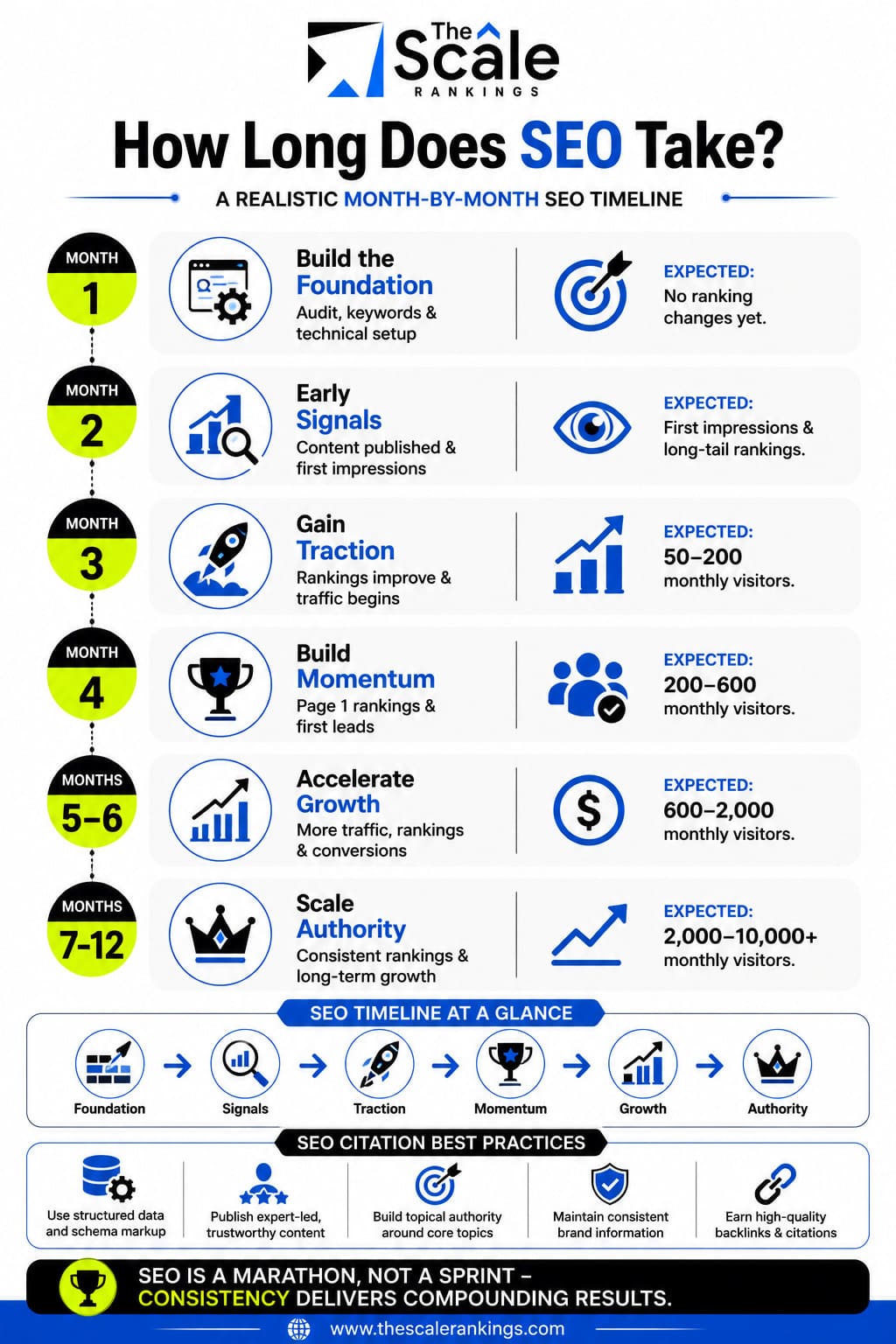
This is the pattern we see consistently across client engagements at The Scale Rankings. Your experience may vary based on the six factors above, but the shape of the journey is remarkably consistent.
Everything happening in month 1 is invisible in Google Analytics, and that's by design. This month is entirely about laying infrastructure.
What's happening:
What to track: GSC coverage report for new indexing errors; baseline keyword position report for all target terms.
Realistic expectation: Zero ranking changes. This is normal. Do not panic.
Google begins recrawling the technical improvements. First content pieces are published. Search Console starts showing impressions - pages are appearing in search, but not yet getting clicks.
What's happening:
What to track: GSC "Performance" tab - impressions are the early signal. A page gaining impressions on keywords you've targeted means Google is considering it. Click-through rate (CTR) will be low initially - under 2% is normal at this stage.
Realistic expectation: 0–50 new organic visitors per month. You may see a few long-tail keyword rankings appear at positions 20–50. These are early signals of the right direction.
Some pages begin ranking on pages 2 and 3 for long-tail queries. If technical fixes were significant, you may see a bump in existing page rankings. Content published in month 2 begins appearing in search results.
What to track: Keyword positions for your target terms (not just impressions). Any position improvement - even from position 45 to position 22 - is meaningful progress. Watch for pages entering the top 20.
Realistic expectation: 50–200 new organic visitors per month. 2–4 keywords entering positions 11–30. For established domains with good authority, some long-tail posts may already crack page 1.
The Scale Rankings note: For a client with Domain Rating 64+ (like thescalerankings.com itself, once content is in place), page 1 appearances for long-tail keywords can begin as early as weeks 6–8. Authority compresses the timeline significantly.
This is the month when most business owners almost quit. Results are visible but modest. It's easy to compare these numbers to paid ads and feel discouraged. Don't.
What's actually happening is that Google has gathered enough data on your site's improvement pattern to begin rewarding it more broadly. Rankings stabilise and start climbing for more competitive terms.
What to track: Page-1 rankings for long-tail keywords. Organic CTR (improving to 3–6% range). Organic traffic trend line - it should be consistently up-and-to-the-right now, even if slowly.
Realistic expectation: 200–600 organic visitors per month. First page-1 rankings for less competitive terms. Early enquiries or conversions from organic traffic.
By month 6, a well-executed SEO strategy produces measurable ROI. Pillar pages begin ranking for their head terms. Spoke posts pull consistent long-tail traffic that internal links up to service pages.
What to track: Organic conversions - contact form submissions, phone calls, demo requests, purchases from organic traffic. This is the KPI that justifies the investment to leadership. Also track: organic traffic as a percentage of total site traffic.
Realistic expectation: 600–2,000 organic visitors per month. Multiple page-1 rankings. First consistent organic leads or sales. The rate of growth should be accelerating - not plateauing.
This is where SEO becomes your most cost-efficient marketing channel. Every new post you publish now benefits from the topical authority already established. Every link you earn strengthens rankings across your entire domain, not just the target page.
Organic traffic compounds month over month. Rankings for competitive head terms - terms your competitors have been targeting for years - begin to move.
Realistic expectation at month 12: 2,000–10,000+ organic visitors per month (varies enormously by industry and starting position). Strong page-1 presence across 20+ keywords. Organic is becoming the #1 or #2 traffic source for the business.
The timeline varies meaningfully depending on the type of business and the scope of SEO required.
Local SEO is the fastest-moving category. Google Business Profile optimization, local citation building, and locally-targeted content can produce map pack movement within 2 to 4 weeks. Review acquisition and local link building compound over 30 to 90 days.
Why it moves faster: there's less competition, geographic relevance is a strong signal, and GBP optimization alone can produce significant visibility without waiting for long content evaluation cycles.
Realistic target: First map pack appearances in weeks 3-6. Consistent local organic traffic by month 3-4.
Ecommerce SEO has a longer baseline because it involves product pages, category pages, and blog content - three different content types with different optimization needs and evaluation timelines.
The fastest ecommerce wins come from technical fixes (product schema, page speed, canonical issues on faceted navigation) and targeting long-tail transactional keywords. Category page optimization is the highest-leverage activity, as category pages typically attract the highest-volume commercial queries.
Realistic target: First transactional keyword rankings by month 2–3. Meaningful revenue attribution from organic by month 6–9. After our technical fixes and content programme, e-commerce clients typically see 150%+ organic traffic growth within 8 months.
Service businesses competing nationally - marketing agencies, law firms, SaaS companies, consultancies - operate in the most competitive keyword environments. These are also the industries where every competing business is investing heavily in SEO, meaning your competitors have years of authority to overcome.
The compound content + authority approach is non-negotiable at this level. A service business cannot rank nationally on service pages alone - it requires pillar pages, supporting content clusters, and a consistent editorial link-building programme running in parallel.
Realistic target: First national keyword appearances by month 3–4. Page-1 visibility for primary commercial terms by month 9–12. Organic lead generation is becoming a reliable channel by month 12.
Enterprise SEO at scale - thousands of pages, multiple stakeholder sign-offs, technical complexity, highly competitive global keywords - operates on the longest timeline. The evaluation cycle is the same, but the execution cycle is longer because every change requires approval, development resources, and cross-team coordination.
Prioritisation is the critical skill at this level: identifying the changes with the highest expected ROI and getting them live first, rather than working through a complete audit sequentially.
This is the most common objection to SEO investment: "With paid ads, I can see results tomorrow." That's true. But here's what the comparison actually looks like over 24 months:
| Timeline | Paid Ads | SEO |
| Day 1 | Traffic starts immediately | No traffic yet |
| Month 1 | Traffic flowing, cost accumulating | Foundation building |
| Month 3 | Traffic maintained at ongoing cost | First organic results |
| Month 6 | Traffic maintained at ongoing cost | 600–2,000 visitors/month |
| Month 12 | Traffic maintained at ongoing cost | 2,000–10,000 visitors/month |
| Month 24 | Traffic maintained at ongoing cost | Compounding growth, lower cost-per-acquisition |
| If budget stops | Traffic stops immediately | Rankings persist for months to years |
SEO's compounding nature means it eventually drives traffic at a fraction of the cost per click of paid ads. The businesses that combine both - paid ads for immediate pipeline, SEO for long-term authority - consistently outperform those that rely on either alone.
The question is not "SEO or PPC." It's "how soon can we start building the asset that keeps paying after the ad budget turns off?"
You cannot force Google to rank you faster - but you can remove the friction that slows the evaluation process.
Fix technical issues first. Site speed improvements, canonical fixes, and crawl error resolution can show ranking impact within 2 to 6 weeks - faster than any other category of SEO work. A technically broken site suppresses everything else you do.
Target long-tail keywords first. High-volume head terms ("SEO agency") take 12+ months to crack. Long-tail variants ("SEO agency for ecommerce startups in Atlanta") can rank in 4 to 8 weeks. Build early traffic and trust with long-tail, then compete for head terms as authority grows.
Publish consistently, not in bursts. Two quality posts per week, sustained for six months, outperform ten posts in one week followed by three months of silence. Consistency is a signal to Google that the site is actively maintained.
Build editorial links in parallel with content. Content and links work better together than either works alone. Start link outreach (guest posts, HARO, podcast appearances) during month 1, not after traffic fails to appear.
Optimize existing pages before writing new ones. Pages already in positions 8–20 are your fastest wins. A 200-word addition covering a missed sub-topic, combined with a refreshed meta title, can move a page from position 15 to position 4 in weeks.
Use internal links aggressively. Every new piece of content you publish should trigger a review of existing pages that can link to it. An orphan page with no internal links takes 3x longer to rank than a well-linked page. This is free and can be done the day you publish.
The most common mistake is waiting for traffic to validate the strategy. Traffic is a lagging indicator - it typically arrives 4 to 8 weeks after the underlying ranking movements that caused it. Here are the signals to watch in Search Console from month 1:
Impressions are growing. Impressions mean Google is showing your pages in search results. If impressions are climbing - even with low CTR - your pages are being evaluated and considered. This is the earliest positive signal.
The average position is decreasing. In Google Search Console, a lower average position number means you're ranking higher. Going from 45.2 to 31.7 is progress. Going from 11.2 to 8.4 is approaching page-1 territory.
New keywords are appearing. Check the "Queries" tab monthly. New keywords appearing - even at positions 30–50 - mean Google is discovering and associating your content with relevant searches.
Pages are being indexed. The Coverage report shows how many of your pages are indexed. A growing indexed page count, with declining indexing errors, is a healthy signal.
Referring domains are growing. New dofollow backlinks from relevant domains can compress your ranking timeline. Track your referring domain count in Ahrefs or Semrush monthly.
Not all slow results are normal. These are the signals that something is actually wrong - not just "SEO taking time."
Impressions are flat after 90 days. If your pages are not appearing in search results at all after three months of publishing, there may be an indexing issue - a noindex tag, robots.txt block, or canonical pointing to a different URL.
You had traffic and then lost it suddenly. A sudden traffic drop is typically a Google algorithm update, a manual action penalty, or a technical change that broke something. Check Google Search Console's Manual Actions report and the Coverage report immediately.
Rankings are not moving after 6 months. If positions have not improved for any target keywords after six months of consistent effort, the strategy needs reassessment - typically keyword targeting (too competitive), content quality (not matching search intent), or link profile (not building domain authority).
Your domain has a manual action. Check Search Console's "Security and Manual Actions" report. A manual penalty for unnatural links, spammy content, or deceptive practices explains zero results regardless of effort - it must be resolved before any SEO can work.
Traffic comes, but doesn't convert. If you're getting organic traffic but zero enquiries or purchases, the issue is usually targeting the wrong keywords (informational traffic with no buying intent reaching commercial pages) or poor page conversion - not an SEO failure per se, but a strategy mismatch that needs fixing.
The businesses that win at SEO are not the ones that started with the best website. They're the ones that started earliest and stayed consistent.
Every month you delay is a month your competitors spend compounding their authority. The SEO that ranks you consistently 12 months from now has to start today.
The Scale Rankings works with businesses across local, e-commerce, and national campaigns. This builds the content, technical foundation, and link authority needed to rank and stay ranked.
Get a free SEO audit → See how we've helped businesses like yours → Talk to our team →
The Scale Rankings is your go-to partner for all things SEO. We focus on crafting personalized SEO strategies that deliver real results, from boosting your rankings to increasing organic traffic. With our expertise in on-page SEO, off-page SEO, and technical SEO, we ensure your brand stands out in the digital crowd.
The Scale Rankings ensures to make sure your audience finds exactly what they’re looking for. As one of the best search engine optimization (SEO) companies, we dig into the core of your business, crafting strategies that hit home across industries. Our services include:
 Let’s Chat
Need help with your next SEO project? Our experts are here to help. Reach out to us for a free consultation or more information.
 +1 877 33 SCALE
 [email protected]
 1870 The Exchange SE Ste 220 PMB 47489, Atlanta, GA 30339-2171



 Local SEO
 E-Commerce SEO
 International SEO
 SEO Consulting
 Conversion Rate Optimization
 Content Marketing
 Content Strategy
 Website Content
 Answer Engine Optimization
 Amazon SEO
 Generative Engine Optimization
 AI Citation Building
 Entity SEO