



August 4, 2026 By The Scale Rankings

| Building an SEO strategy for a small business starts with a technical foundation. Then it moves to keyword research, on-page optimization, and local SEO. From there, publish strong content, earn backlinks, and optimize for AI search. Track results every month and refine what works. That is how search turns into steady organic traffic, leads, and growth. |
Small business SEO strategy now rests on three pillars.
Your goal is content that Google ranks, answer boxes quote, and AI assistants recommend. Good SEO organizes your site so search engines and AI assistants understand what you do, then point local customers your way.
| Step | What You Do | Time to Results |
| Technical Foundation | Make sure Google can crawl, index, and understand your site | Days to weeks |
| Keyword Research | Find what customers actually search through long-tail | 1-2 weeks to set up |
| On-Page SEO | Match every page to search intent | 2-6 weeks for movement |
| Local SEO | Google Business Profile, local keywords, reviews | 30-60 days for map pack |
| SEO Content Strategy | Publish topically focused content consistently | 3-6 months, compounding |
| Authority Building | Earn backlinks and brand mentions from trusted sources | 3-12 months |
| AI Search Visibility | Optimize for AI Overviews, ChatGPT, and Perplexity | 6-10 weeks for first citations |
| Track & Iterate | Measure, adjust, compound | Ongoing |
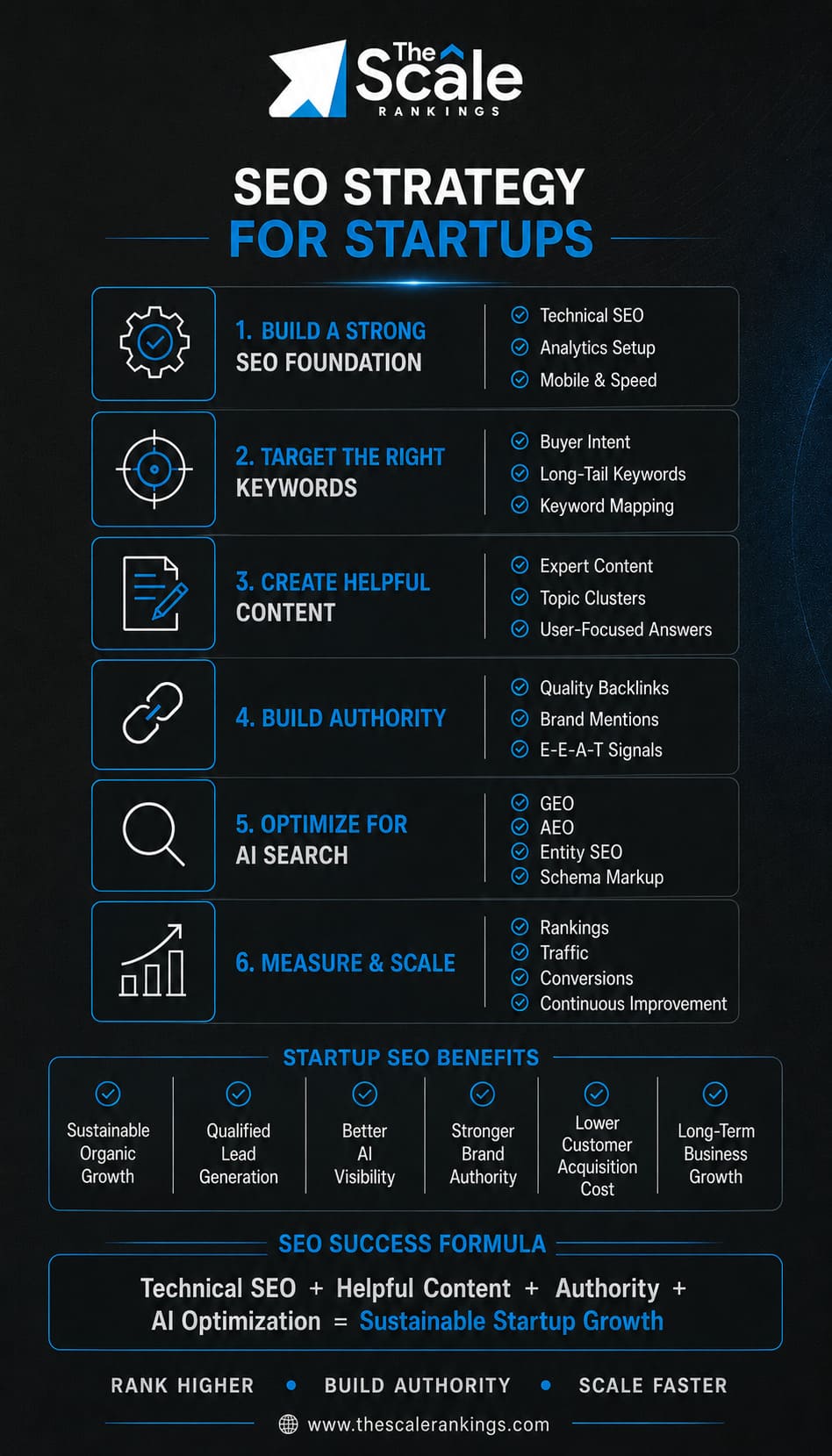
Small businesses win on local relevance. Big brands publish generic national content. You can publish street-level details they will never bother with.
Organic rankings compound. Once a page ranks, it brings traffic and leads with no extra ad spend. Paid ads stop the moment your budget stops. Your SEO work runs around the clock.
Every technical fix, improved page, and useful answer builds on the last. Over months, that becomes a steady stream of buyers. Target hyper-local search intent and long-tail keywords to outrank big brands in your area. Affordable SEO techniques let you capture high-intent traffic month after month. Post local photos, service updates, and neighborhood news as they happen. Name exact streets, neighborhoods, and the problems your local customers actually have. Reviews from real local customers and consistent address details push you higher in map results.
Search has moved toward AI answers and zero-click summaries. Modern SEO best practices for small businesses cover both. Win traditional search and AI recommendations together, and the SEO strategy for your business keeps compounding.
Each step you take to build an SEO strategy makes the next one work harder. Start with the technical foundation and move through the stages in order. Treat this Search Engine Optimization (SEO) guide as a build order, not a menu.
Technical SEO makes sure search engines can find, crawl, and read your site. A slow or broken site struggles to rank no matter how good the writing is.
Long-tail keywords are the 3-to-5-word phrases customers type when they are close to buying. They face less competition and rank faster than broad terms.
Using high-volume keywords is one of the most common reasons small business SEO campaigns stall.
Matching intent lets you build pages that turn readers into clients. Once your core keywords are set, apply them to your site structure. That is how you create an SEO strategy grounded in real search behavior.
On-page SEO tells search engines what each page is about. Weak titles, missing headings, and vague copy force algorithms to guess, and guessing costs you rankings.
Apply these fixes to your homepage, service pages, about page, and blog posts.
These website SEO tips lift search visibility and reader experience together. Every page performs better as a result.
Local SEO strategies deliver the fastest high-intent traffic for any business with a service area. Your Google Business Profile does most of the work.
Claim, verify, and complete your profile first. A fully optimized profile can lift your map pack rankings in 30 to 60 days. That puts you in front of buyers searching for your services right now.
A complete profile is the starting point, not the finish line. Search engines cross-check your business details across the web. Matching information builds trust and improves local rankings.
Consistent listings and real reviews build the local trust that map rankings run on. A specialist can handle the Local SEO services setup for you.
A topic cluster is one in-depth pillar page supported by several related articles. Depth on one subject beats scattered posts across many.
SEO strategies for small business websites work best when you cover a single topic thoroughly. Scattered posts rarely compound. Clusters do, which is why they anchor every strong SEO content strategy.
Each supporting article feeds authority to the pillar. Over time, the whole cluster ranks more easily, because every page holds up the others. Content Marketing services can help you.
Backlinks remain one of the strongest trust signals in search. AI models also scan brand mentions to decide who to cite.
Start with verified profiles on Google Business Profile, Yelp, the BBB, Clutch, and directories in your industry. These listings confirm your business is real and active. They also help customers find you outside Google.
Real links from real sites build the domain trust that search engines and AI models respect. An SEO services company can run this outreach for you.
GEO and AEO make your content easy for AI systems to read, quote, and recommend. Both matter now that AI answers sit above the traditional results.
Our experts analysed the trend that Google AI Overviews now appear in about 26% of US searches, and in nearly 39% of informational searches. Many people get their answer without clicking anything. More than 45% of people use AI search tools to find businesses. A mention inside an AI answer builds instant trust, and those visitors convert up to 4.4 times more often.
AI search does not work like a list of ten blue links. It writes one answer. So your content has to be easy to read and easy to quote.
Make your content extractable
Build entity trust
GEO and AEO together keep your brand visible as search shifts. An effective SEO strategy now covers both.
Set up tracking before you change anything. Without a baseline, you cannot prove what worked.
You do not need dozens of metrics. Three numbers tell you whether the strategy is working.
Review these monthly, not daily. SEO moves gradually, and monthly snapshots make the trend obvious. Google Search Console is free and covers most of this. Check impressions, clicks, average position, and page coverage every week.
Once a month, ask ChatGPT and Perplexity your top 5 service terms. Screenshot the answers to see whether they cite your brand. Regular reviews show you which pages convert, so you can put more effort there.
Most small businesses see early ranking movement in 3 to 6 months, and steady leads between months 6 and 12. Technical and local fixes show up fastest.
| Timeline | Milestone | What Drives It | What You Get |
| Month 1-2 | Technical fixes + GBP live | Site speed, crawling, indexing, Google Business Profile setup | The fastest early wins, especially local map visibility |
| Month 2-4 | Initial ranking movement | On-page SEO updates and targeted long-tail content | Long-tail keywords start climbing and bring early organic traffic |
| Month 3-6 | Visible traffic growth | Topic cluster expansion, internal linking, first link outreach | Your first clear jump in organic traffic and engagement |
| Month 6-12 | Consistent organic leads | Domain authority compounding, AI citations becoming consistent | A steady flow of qualified leads and measurable growth |
| Month 12-24 | Competitive keyword dominance | Broad topic authority, strong backlink profile, wide search coverage | Long-term compounding growth and market leadership |
Your pace depends on competition, site history, and content quality. The pattern holds even when the dates shift. Keep publishing, keep fixing, and rankings, traffic, and leads climb together.
Hire help when the work outgrows your calendar. Most owners handle the basics fine, then stall on technical SEO, link building, and consistency.
Owners can try building an SEO strategy for a small business on their own. Technical updates, content publishing, local citations, and link building each take real time every week.
Most owners start with basic SEO for small business tasks, then hit a ceiling as the site grows. Bring in an agency when:
Look for an agency built around long-term growth rather than quick fixes. The right partner improves your search visibility, strengthens your online presence, and brings in qualified customers month after month.
TSR is a growth-focused SEO agency for small businesses based in the USA. We run the full framework: technical foundation, keyword research, on-page optimization, local SEO, content strategy, authority building, AI search visibility, and monthly performance reporting.
The Scale Rankings is your go-to partner for all things SEO. We focus on crafting personalized SEO strategies that deliver real results, from boosting your rankings to increasing organic traffic. With our expertise in on-page SEO, off-page SEO, and technical SEO, we ensure your brand stands out in the digital crowd.
The Scale Rankings ensures to make sure your audience finds exactly what they’re looking for. As one of the best search engine optimization (SEO) companies, we dig into the core of your business, crafting strategies that hit home across industries. Our services include:
 Let’s Chat
Need help with your next SEO project? Our experts are here to help. Reach out to us for a free consultation or more information.
 +1 877 33 SCALE
 [email protected]
 1870 The Exchange SE Ste 220 PMB 47489, Atlanta, GA 30339-2171




 Local SEO
 E-Commerce SEO
 International SEO
 SEO Consulting
 Conversion Rate Optimization
 Content Marketing
 Content Strategy
 Website Content
 Answer Engine Optimization
 Amazon SEO
 Generative Engine Optimization
 AI Citation Building
 Entity SEO