



March 27, 2026 By The Scale Rankings

Imagine asking questions to AI and getting answers within seconds. No websites, no scrolling. Just complete, personalized answers.
That’s how people are searching today. But you don’t need to panic about how your business will survive this era. Because Large Language Model SEO (LLM SEO) is here to help you.
In this guide, you’ll learn what is Large Language Model SEO, why it matters, and how to adapt before your competitors get there first.
Large Language Model SEO (LLM SEO) is the practice of optimizing content so it shows up in AI-driven responses.
Search used to mean competing for rankings. But now it’s about being chosen by AI. Large Language Model SEO makes sure your content shows up when people ask ChatGPT, Claude, Gemini, Perplexity, or Google’s AI mode for answers.
You got clicks with search engine optimization. But LLM SEO vs. traditional SEO? LLM SEO gives you visibility in zero-click environments where users never skip the AI interface. You’re not just chasing traffic anymore. You’re training AI to mention your name whenever it delivers answers.
But what if your content is not optimized for LLMs? Then your brand won’t be noticed. It will be left out of the conversations your audience is having with machines every day.
Large Language Model Optimization is the process of how an AI search engine represents your content to the user. They make sure the facts are correct, the brand voice is clear, and your message doesn’t get lost in paraphrasing. You gain more than visibility and trust. And in an AI-driven world, trust is what keeps customers coming back.
So how do you differentiate the thin line between LLM SEO vs LLMO? Check this: LLM SEO is about ‘being seen’. But Large Language Model Optimization strategies are about being seen the ‘right way’.
Imagine showing up in a conversation but being misquoted. Sounds off, right? That’s what happens when AI pulls your content without clear optimization. You run the risk of being misquoted or overshadowed without LLMO.
Generative Engine Optimization (GEO) is the practice of optimizing content to be recognized and cited by AI-powered generative engines as a reliable source for answers.
LLM SEO vs LLMO are crucial, but they’re only part of a larger movement. AI engines go beyond search and create full answers, reports, or even recommendations. That’s how the optimization scope expands. And this is where Generative Engine Optimization enters.
According to BrightEdge, 58% of marketers report measurable traffic loss from AI platforms like ChatGPT and Perplexity. That’s not a side effect. That’s the new reality.
GEO is about widening your lens. Instead of asking, “How do I rank on Google?” the question becomes, “How do I appear across every AI-driven answer?” The brands answering that question build digital resilience for the future.
It’s easy to get lost with all these acronyms. Marketers often compare LLM SEO vs. AI SEO optimization with traditional SEO. But here’s the truth. They’re related but not the same. Think of them as overlapping layers of visibility. Check the differences below in the table:
| Feature | Traditional SEO | AI SEO | LLM SEO |
| Goal | Rank higher on search engine result pages (SERPs) | Optimize for AI algorithms & tools | Try SEO for large language models (LLMs) |
| Output | Click-through links | Improved AI-based visibility | Direct citations in AI answers |
| Metrics | Search engine rankings | AI visibility tracking | Presence in zero-click searches |
| Techniques | Backlinks, keywords, and on-page | AI-driven keyword clustering, semantic search | LLM SEO strategies, structured data, and LLM SEO tool usage |
| Platforms | Google/Bing | AI-driven platforms & AI SEO Tool dashboards | LLMs (ChatGPT, Claude, Gemini) & Google’s AI Overviews |
Wait…You can’t pick just one. Because if you want your SEO strategy to win, you must blend all three. Now you know that traditional SEO was built for search engines. Keywords, backlinks, and meta tags help satisfy algorithms like Google’s. But SEO for LLM? It’s meant for machines that generate answers, not rankings. Traditional SEO brings people to your site. But LLM SEO puts your expertise directly into the AI’s voice.
To prove this, Semrush & Datos Study shows that 13.14% of US queries triggered Google’s AI Overviews (AIOs) in March 2025, up from 6.49% in January.
This shows how fast all these layers are blending. You lose organic search without traditional SEO. You miss algorithm shifts without AI SEO. But you disappear from AI conversations entirely without LLM SEO. AI SEO strategies blend tech with creativity.
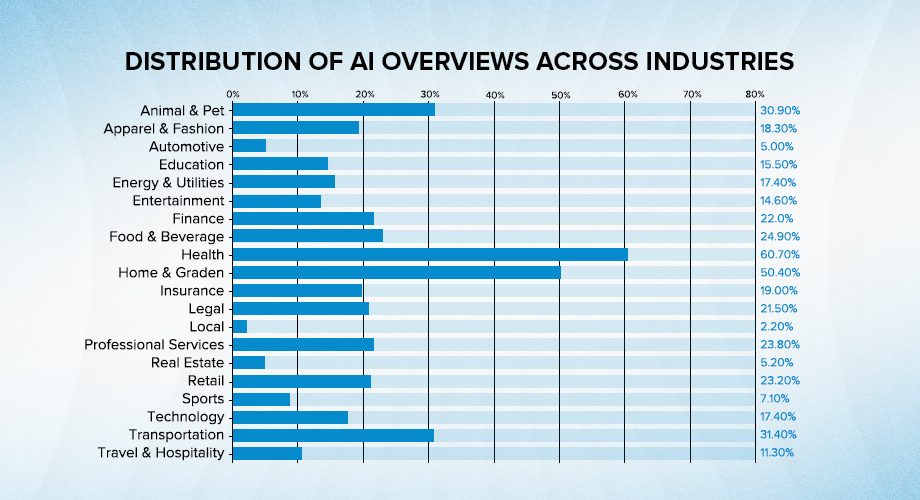
Google’s AI Overviews (AIOs) have changed the way people search. Users don’t need to scroll anymore. They just see AI-written answers at the top of results pages. Check out the data below:
Source: NP Digital
The above data shows that AI overviews now dominate searches in industries like Health, Home & Garden, and others. But it barely appears in Local industries (2.2%). Google’s LLMs pull mainly from top-ranking pages. So a solid SEO plan remains key. LLMs aren’t replacing SEO. They’re making it more important.
This impact is undeniable. You’re missing a massive portion of your audience if you’re not included in Google’s AI Overviews (AIOs). LLM SEO isn’t about extra visibility. It’s about survival in a search led by AI-generated summaries. The best SEO methods focus on clarity and trust.
Want AI to choose you? Check the strategies below!
Best practices for LLM SEO aren’t shortcuts. They’re the plans that keep your efforts aligned. The margin for error is very small with LLMs. So use these practices to make sure your content is ready to be part of the answer.
The clearer and more useful your content, the higher your odds of being included. Remember: LLMs reward clarity, consistency, and authority. Do that, and see your visibility just grow. Your business will stabilize.
AI SEO strategies are changing the rules of visibility. Including LLM Optimization (LLMO) in your SEO strategy makes your brand show up in answers. It helps your business stay relevant, discoverable, and credible in the age of AI.
The top benefits include:
The real benefit of LLMO is simple. It positions your brand as the answer that people and AI are looking for. Work on your LLMO to strengthen authority, drive intent-rich traffic, and future-proof your brand. Remember, content ranks better with advanced SEO techniques.
As AI reshapes how people search, businesses need the right tools to stay visible in LLM-powered answers. From tracking brand mentions in ChatGPT to optimizing content for Gemini and Perplexity, these tools give you the edge to stand out in the AI-driven search landscape.
1. Otterly.ai - Tracks how your brand appears in AI search responses and shows where competitors are being mentioned. Great for monitoring visibility.
2. Semrush AI SEO Toolkit - Offers dashboards and features focused on AI search visibility. This helps you optimize content so LLMs favor it.
3. Ahrefs - Brand Radar / AI Visibility tracking tools help you see where your brand is being cited or mentioned in AI overviews and prompts. You analyze the competitor gap.
4. Geoptie - It is one of the newer platforms that focuses on generative engine optimization (GEO). Offers tools & dashboards to improve brand visibility in LLM-powered responses.
5. Rank Prompt - Built around AI visibility tracking. It tracks where your brand appears in AI outputs and helps with prompt and content structure. This shows you up more often in LLM answers.
These 5 tools go beyond traditional SEO. They help you understand how AI platforms interpret, surface, and trust your content. By adopting them early, you can improve your visibility, credibility, and position yourself as the go-to answer in the era of LLM search.
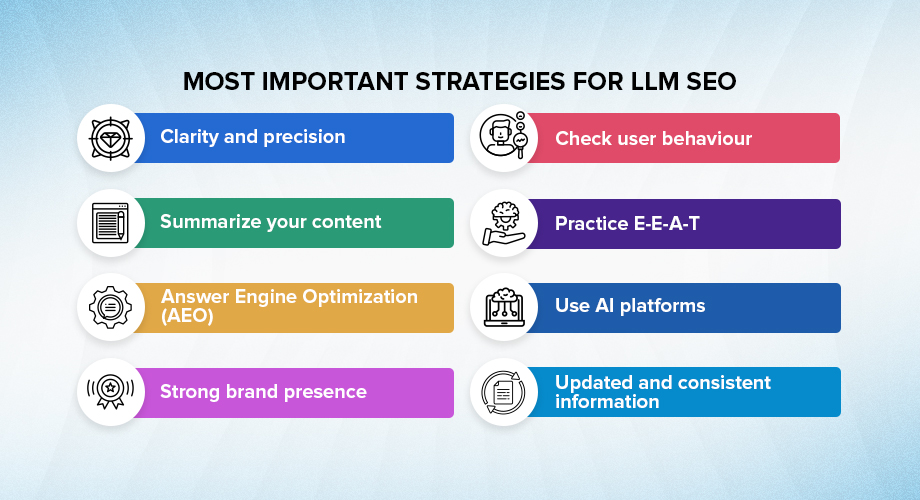
Knowing the risks is one thing. Beating them requires action. The good news? AI models are predictable in their content selection. If you align with those patterns, you increase your odds of being included.
These aren’t tricks to win the system. They’re building blocks of credibility. And credibility is what AI values most when deciding who gets included in its answers.
Let’s move a step further in our Large Language Model SEO (LLM SEO) guide. Every innovation brings roadblocks. With SEO for LLM, the challenges aren’t just technical; they’re structural. Because here you’re not just competing with other websites, you’re competing with the AI itself.
LLM SEO can be challenging. It shifts the focus from ranking factors to creating authoritative, contextually clear, and prompt-friendly content. It deals with reduced attribution and traffic. It’s less about clicks and more about being the trusted source AI wants to surface.
Strategies give direction. Execution drives results. Optimizing content for LLMs is less about reinventing your site. It’s more about reshaping how your content is packaged for machines. LLM SEO is about clarity, trust, and structure. Here’s how to align your content with the way AI answers questions.
Think of it as training AI to read your website fluently. You’ll be pulled into AI-driven platforms consistently with more structured, current, and varied answers. Treat LLMs like your smartest reader. Keep it clear, trustworthy, and structured.
Source: Search Engine Land
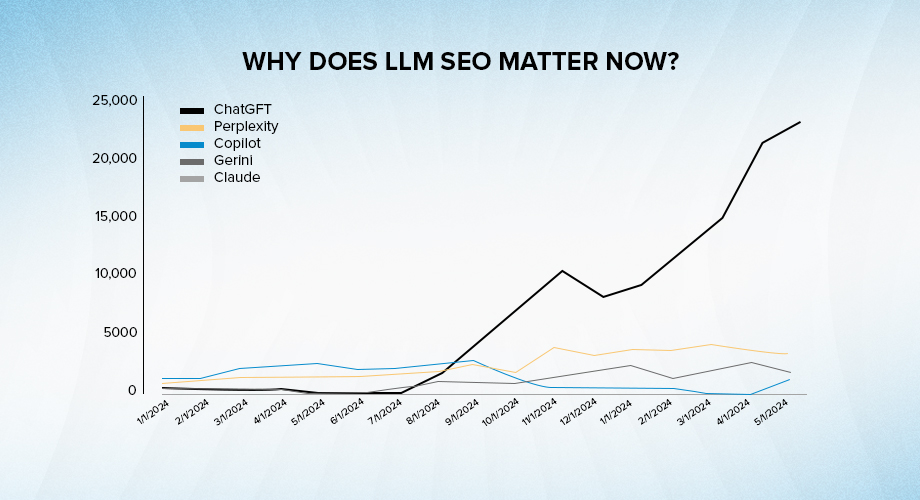
LLM SEO trends reveal where AI search is heading. This graph shows how quickly LLM adoption is accelerating. ChatGPT sessions increased from mid-2024 onward. It outpaced rivals like Perplexity, Copilot, Gemini, and Claude. The takeaway? Users are shifting their search and information-gathering habits toward AI assistants.
As LLMs become people’s go-to for answers, businesses can’t ignore SEO that aligns with how these models surface and cite content. Waiting means losing. But early adoption gives an advantage. Businesses that adopt LLM SEO plans now will secure visibility. Others scramble to catch up. Timing is very important in LLM SEO.
Don’t mistake urgency for hype. It’s real and measurable!
The idea of optimizing for AI might sound overwhelming. But its implementation is more straightforward than it seems. Just start small, prove value, and then scale. You need to shift from keywords to answers as AI assistants reshape search.
The steps include:
LLM SEO is about becoming the trusted answer AI delivers. Clear, structured, and authoritative content is the way forward. By making small, consistent improvements, your business builds a presence across platforms. It makes sure AI doesn’t just talk about your industry. It also talks about you.
Traditional analytics won’t tell you the full story. Businesses need new ways to track their impact. LLMs don’t send clear referral data. So tracking traffic requires a mix of smart signals.
Here’s how you can track your LLM performance:
Marketers invest in SEO for AI platforms. That’s how the strategy becomes clear and visible in AI dashboards. Remember, tracking isn’t just about numbers. It’s about spotting where you’re gaining ground and doubling down.
This question is trending all across the internet. Sounds dramatic, right? But the truth is more practical. SEO isn’t dead. It’s evolving.
Traditional SEO is still a necessity. People continue to use Google, and rankings also drive traffic. But now SEO has 2 new branches - AI SEO and LLM SEO. They shape the future of what’s really “search everywhere optimization.”
AI referrals grew nearly 10x year-over-year, while traditional search traffic dropped 21% according to Ahrefs. That’s proof. SEO isn’t disappearing. It’s just splitting into multiple channels.
So the ‘is SEO dead’ question can be answered as ‘NO, SEO isn’t dead’. It grew up. And LLM SEO optimization is becoming mandatory in 2025. It helps you appear in AI-driven answers. You own visibility across both search and AI platforms using it.
We’re entering a new chapter in SEO. It’s shaped by AI, where clarity and authority matter the most. You must adapt to a new kind of SEO as AI has transformed search. This SEO is built on clarity, trust, and structured content.
The future will require:
LLM SEO is about alignment. Your content must be clear, consistent, and credible. That’s how AI will amplify your brand. So you must position yourself as the trusted answers AI delivers. SEO for AI platforms shapes your future visibility.
Large Language Models (LLMs) are transforming the way people search for information. Traditional SEO tactics alone can’t keep your brand visible in this new environment. This is where an LLM SEO agency brings the right expertise, tools, and strategies. This helps your content stand out in AI-driven answers.
Key Ways Agencies Help:
Agencies closely track LLM SEO trends. Partnering with the leading SEO agency helps future-proof your brand for the AI era. You get expert guidance on strategies that make your content more discoverable, your brand more trustworthy, and your presence stronger across AI platforms. The right LLM SEO agency ensures your business becomes the answer that customers and AI trust.
The internet is a dialogue that’s mediated by AI. And your brand is either part of that dialogue or absent from it.
You don’t need to panic. It’s steady action. Just start by restructuring your most valuable pages with FAQs, schema markup, and credible citations. Help AI learn about you. Then expand, track your mentions across AI platforms to measure progress.
The future trends of SEO are already here. AI-driven platforms, semantic search, zero-click answers. You become digitally visible if you adapt LLM SEO, LLMO, and GEO strategies.
Is your brand a part of the response when your customers ask AI for answers? If not, you need an expert who can help you. Get proven strategies with The Scale Rankings. Just tap into an affordable SEO company and reap the benefits now!
The Scale Rankings is your go-to partner for all things SEO. We focus on crafting personalized SEO strategies that deliver real results, from boosting your rankings to increasing organic traffic. With our expertise in on-page SEO, off-page SEO, and technical SEO, we ensure your brand stands out in the digital crowd.
The Scale Rankings ensures to make sure your audience finds exactly what they’re looking for. As one of the best search engine optimization (SEO) companies, we dig into the core of your business, crafting strategies that hit home across industries. Our services include:
 Let’s Chat
Need help with your next SEO project? Our experts are here to help. Reach out to us for a free consultation or more information.
 +1 877 33 SCALE
 [email protected]
 1870 The Exchange SE Ste 220 PMB 47489, Atlanta, GA 30339-2171




 Local SEO
 E-Commerce SEO
 International SEO
 SEO Consulting
 Conversion Rate Optimization
 Content Marketing
 Content Strategy
 Website Content
 Answer Engine Optimization
 Amazon SEO
 Generative Engine Optimization
 AI Citation Building
 Entity SEO