



July 10, 2026 By The Scale Rankings

Your startup needs SEO because it brings free, targeted traffic to your website. Unlike paid advertising that stops working when you stop paying, SEO keeps bringing visitors month after month. Here's what makes SEO necessary for your startup:
Paid ads can drain your limited budget quickly. SEO for startup business models offers a more sustainable path to growth. You invest time and effort upfront, then enjoy the results for months or years.
Because of these differences, SEO startup founders should not compare their early results to a company that has been active online for years. Progress in startup SEO builds slowly at first, then speeds up.
Search engines find, analyze, and organize web content using software called crawlers. In 2026, engines like Google use traditional algorithms alongside AI models to understand the meaning behind your words, delivering either a direct conversational answer or a list of helpful websites that perfectly match the user's intent.
Search engines give people the best possible answers to their questions. Google uses "crawlers" (also called spiders or bots) that visit websites constantly. These crawlers read your content, look at your images, check your links, and gather information about every page.
Then Google stores this information in a massive database called an index. When someone searches, Google quickly scans its index to find the most relevant, helpful pages.
Google ranks pages based on hundreds of factors. Some of the most important ones include:
Understanding these basics helps you make smarter decisions about your website.
Every day, roughly 250,000 new websites launch into the digital space. For a startup, this emerges a cut throat competition. While tech giants pour millions into out-bidding you for market share, your strongest survival tool is an algorithm. Relevance and right strategy can be your hyper-growth engine to form the foundation of your SEO startup strategy.
Keywords are the words and phrases people type into search engines. Finding the right keywords means understanding what your potential customers are searching for.
Start by thinking like your customer. What problems do they have? What questions do they ask? What words do they use to describe those problems?
For example, if your startup sells a budget-friendly project management tool for small teams, your customers aren't just searching for your brand name. They are searching for their problems:
Each of these is a keyword opportunity.
Keyword Research Tools
You can find keywords using free and paid tools. Google's Keyword Planner is free and shows you how many people search for specific terms. Other tools like Ubersuggest, Ahrefs, and SEMrush provide more detailed data.
Look for keywords with these qualities:
Long-tail keywords work especially well for startups. These are longer, more specific phrases like "affordable organic dog food for puppies." They have less competition and attract highly targeted visitors.
On-page SEO refers to everything you can control directly on your website. These elements tell search engines what your page is about.
Title Tags
Your title tag appears as the clickable headline in search results. It should include your target keyword and make people want to click.
Keep title tags under 60 characters so they don't get cut off in search results.
Meta Descriptions
The meta description is the short text that appears under your title in search results. It doesn't directly affect rankings, but it influences whether people click on your result. Write compelling descriptions that include your keyword and explain what value you offer. Keep them under 160 characters.
Header Tags
Headers (H1, H2, H3, etc.) organize your content and help search engines understand your page structure. Your H1 should include your main keyword and clearly state what the page is about. Use H2s and H3s to break content into scannable sections. This makes reading easier for visitors and helps search engines grasp your content hierarchy.
URL Structure
Clean, descriptive URLs help both users and search engines.
Include your target keyword in URLs when it makes sense naturally.
Image Optimization
Images make your content more engaging, but they need optimization. Large image files slow down your site, which hurts rankings. Compress images before uploading them. Use descriptive file names like "organic-dog-food-bowl.jpg" instead of "IMG_12345.jpg." Add alt text to every image. Alt text describes the image for people who can't see it and helps search engines understand your visuals.
Technical SEO ensures search engines can properly crawl and index your website. These behind-the-scenes elements matter more than many startups realize.
Site Speed
Your website needs to load fast. Google considers page speed a ranking factor, and visitors abandon slow sites quickly. Test your speed using Google PageSpeed Insights. This free tool shows exactly what's slowing you down and how to fix it.
In 2026, Google relies heavily on INP (Interaction to Next Paint) as a primary Core Web Vital. So watch your responsiveness (INP). Ensure that when a user clicks a button or menu on their phone, the website reacts instantly without a frustrating delay.
Common speed improvements include:
More than half of all web traffic comes from mobile devices. Google uses mobile-first indexing, meaning it primarily looks at your mobile site when ranking you. Your site must work perfectly on phones and tablets. Text should be readable without zooming. Buttons should be easy to tap. Navigation should work smoothly. Test your mobile experience using Google's Mobile-Friendly Test tool.
SSL Certificate
An SSL certificate encrypts data between your website and visitors. Sites with SSL show "https://" in the URL and display a padlock icon. Google gives preference to secure sites. Most hosting providers offer free SSL certificates. If yours doesn't, switch to one that does.
XML Sitemap
A sitemap lists all the important pages on your website. It helps search engines find and crawl your content efficiently. Most website platforms can generate sitemaps automatically. Submit your sitemap to Google Search Console so Google knows it exists.
Robots.txt File
This file tells search engines which parts of your site to crawl and which to ignore. You can block crawlers from accessing certain pages like admin areas or duplicate content. Most startups can use a simple robots.txt file. Just make sure you're not accidentally blocking important pages.
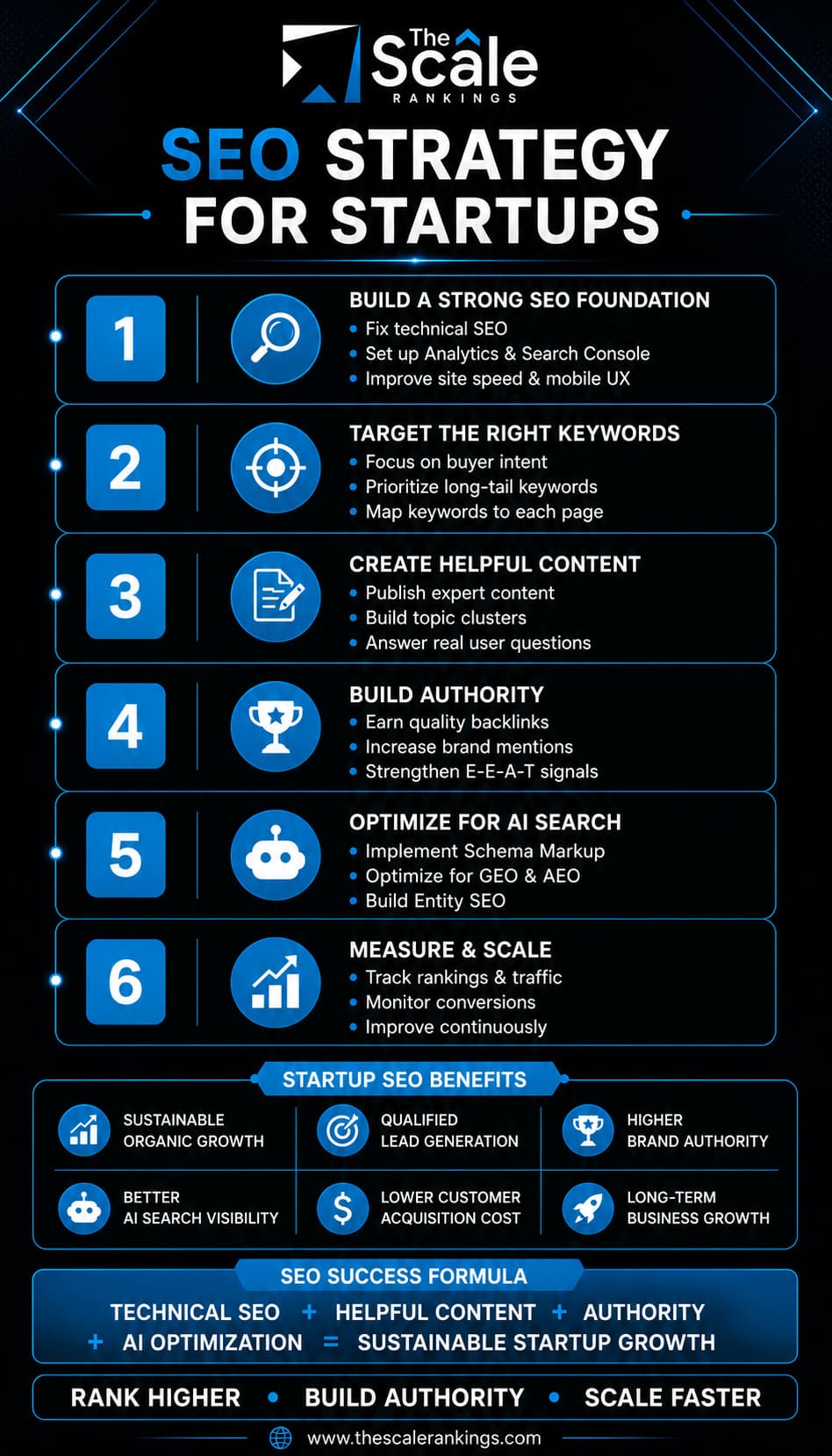
Now that you understand the basics, let's explore proven SEO strategies for startups that deliver real results.
Do not use AI tools to generate entire blog posts and paste them directly onto your site. Google and AI search engines look for original insights and firsthand experience (known as E-E-A-T). Instead, use AI as your collaborative assistant:
Blog Posts
Blogging remains one of the most effective SEO strategies for small business growth. Each blog post targets specific keywords and attracts potential customers.
Write about topics your audience cares about. Answer their questions. Share your expertise. Solve their problems.
For the organic dog food example, you might write posts like:
Aim for comprehensive content. Google tends to rank longer, more thorough articles higher than short, surface-level pieces. Shoot for at least 1,500 words when covering important topics.
Update Content Regularly
Search engines love fresh content. Regularly update your existing pages to keep them current and relevant. Add new information. Update statistics. Refresh examples. This signals to Google that your content remains valuable and accurate.
Content Quality Matters More Than Quantity
Don't rush to publish dozens of mediocre articles. One excellent, well-researched piece outperforms ten shallow posts. Focus on creating genuinely helpful content. Answer questions completely. Provide actionable advice. Back up claims with evidence.
Backlinks are links from other websites to yours. They act like votes of confidence. When respected sites link to you, search engines view your site as more trustworthy and authoritative. Quality matters far more than quantity. One link from a respected industry website beats 100 links from random, low-quality sites.
How to Earn Backlinks
You can't usually buy legitimate backlinks (Google penalizes this). Instead, you earn them by creating content worth linking to.
Here are strategies that work:
Guest Posting
Write articles for other websites in your industry. Include a link back to your site in your author bio or within the content where relevant. Choose reputable sites with engaged audiences. One guest post on a quality site delivers more value than dozens on unknown blogs.
Create Link-Worthy Resources
Develop content that naturally attracts links. This might include:
Connect with other business owners, bloggers, and journalists in your industry. Genuine relationships often lead to natural link opportunities.
Engage with their content. Share their posts. Offer value without expecting anything in return. When you build real connections, links follow naturally.
Broken Link Building
Find broken links on other websites. Reach out and suggest your content as a replacement. This helps the website owner fix their site while earning you a backlink.
Tools like Ahrefs and SEMrush can help identify broken link opportunities.
If your startup serves a specific geographic area, SEO for small business success requires local seo optimization.
Google Business Profile
Claim and optimize your Google Business Profile (formerly Google My Business). This free listing appears in local search results and Google Maps.
Complete every section of your profile:
Encourage customers to leave reviews on your Google Business Profile. Positive reviews improve your visibility in local results and build trust with potential customers.
Local Citations
Citations are mentions of your business name, address, and phone number on other websites. These listings help Google verify your business information.
Get listed on:
Make sure your business information matches exactly across all listings. Inconsistent information confuses search engines and can hurt your rankings.
Local Content
Create content that mentions your location and serves local searchers. This might include:
Your website must deliver an excellent experience on mobile devices. This goes beyond just being mobile-friendly.
Responsive Design
Use responsive design that automatically adapts your layout to different screen sizes. Your site should look great and function perfectly whether someone visits on a phone, tablet, or desktop.
Touch-Friendly Elements
Make buttons and links large enough to tap easily. Space them apart so users don't accidentally tap the wrong element.
Simplified Navigation
Mobile screens have limited space. Simplify your navigation menu for mobile users. Use a hamburger menu (three horizontal lines) that expands when tapped.
Fast Mobile Loading
Mobile users often have slower connections than desktop users. Optimize aggressively for mobile speed. Minimize image sizes. Reduce unnecessary code. Enable compression. Every second matters.
Learning from mistakes saves you time and frustration. Avoid these common errors that hold startups back.
SEO isn't just about pleasing search engines. You need to create an excellent experience for human visitors.
Google tracks user behavior signals. If people click your result but immediately return to search results (called "pogo-sticking"), Google interprets this as a sign your page didn't satisfy their needs.
Focus on:
When visitors stay on your site, read your content, and explore multiple pages, Google notices. These positive signals boost your rankings.
Some startups make the mistake of cramming keywords into their content unnaturally. This practice, called keyword stuffing, lowers your rankings.
Bad example: "Looking for organic dog food? Our organic dog food company sells organic dog food made with organic ingredients. Buy organic dog food from our organic dog food store today."
This reads terribly and Google penalizes it. Instead, use keywords naturally. Write for humans first. Include your target keywords where they fit logically, but prioritize readability and value.
Not Tracking Results
You can't improve what you don't measure. Many startups implement startup SEO tactics without tracking whether they're working.
Set up Google Analytics to track website traffic. Use Google Search Console to monitor search performance. These free tools show you:
Review your data regularly. Identify what's working and do more of it. Find what's not working and adjust your approach.
Expecting Instant Results
SEO takes time. You won't rank #1 for competitive keywords overnight. This isn't a flaw in your strategy - it's simply how SEO works. Most startups start seeing meaningful results within 3-6 months. Competitive industries might take longer.
Stay consistent. Keep creating quality content. Build relationships and earn backlinks. Optimize your technical SEO. Results compound over time.
Copying Competitors
Your startup has unique strengths, audiences, and opportunities. Looking at what competitors do can provide insights. But directly copying their strategy rarely works. Your SEO for startup business approach should reflect your specific situation.
Study competitors to understand the landscape. Then forge your own path based on what makes your business special.
You now understand the fundamentals of SEO for startups. You know about keywords, content, backlinks, technical optimization, and common mistakes. But understanding and implementing are different challenges.
Many startup founders feel overwhelmed trying to handle SEO alongside product development, fundraising, hiring, and a thousand other responsibilities. You wear multiple hats already. Adding SEO expertise to your skill set takes time you might not have.
The learning curve is steep. SEO rules change frequently. What worked last year might not work now. Staying current requires constant attention.
You could spend months learning SEO through trial and error. Or you could partner with experts who already know what works.
This doesn't mean you lack capability. It means you're strategic about where you invest your limited time and energy.
The fundamentals of SEO are simple, but keeping up with technical site health, building high-authority backlinks, and optimizing your pages so they get cited by 2026 AI search engines takes massive amounts of time.
As a founder, your time is best spent building your product and talking to users.
At The Scale Rankings, we take the guesswork out of the equation. We combine timeless SEO technical foundations with modern, AI-powered optimization to ensure your startup gets noticed by both human buyers and AI search engines.
Ready to scale your organic growth without wasting months on trial and error? Let’s chat about your startup’s SEO strategy today
Not all SEO agency for startups options deliver equal value. The right partner understands startup challenges specifically.
Look for an agency that:
At The Scale Rankings, the approach centers on sustainable growth tailored to your startup's unique needs. The strategies combine proven SEO fundamentals with cutting-edge techniques, including AI-powered optimization that identifies opportunities human analysis might miss.
The focus is driving qualified traffic that converts into customers. Every strategy decision connects back to your business objectives. You get expert guidance without giving up control. You understand what's happening and why. You see transparent reporting that shows real results.
Your business needs SEO for startups approach that actually makes a meaningful impact. This means combining technical excellence with content that resonates and relationship building that earns quality backlinks.
Whether you're just launching or trying to scale past your first customers, the right SEO partner removes uncertainty from the process. You gain confidence knowing experts are handling one of your most important growth channels.
You have two paths forward.
The second path doesn't make you less capable. It just makes you more strategic. This means recognizing that your unique value lies in building your product and serving customers, not becoming an SEO expert.
When you partner with the right team, you multiply your capabilities. You gain skills and experience that would take years to develop independently.
Your competitors are already optimizing their search presence. Every month you wait is a month they solidify their rankings while you remain invisible to potential customers searching for what you offer.
The Scale Rankings is your go-to partner for all things SEO. We focus on crafting personalized SEO strategies that deliver real results, from boosting your rankings to increasing organic traffic. With our expertise in on-page SEO, off-page SEO, and technical SEO, we ensure your brand stands out in the digital crowd.
The Scale Rankings ensures to make sure your audience finds exactly what they’re looking for. As one of the best search engine optimization (SEO) companies, we dig into the core of your business, crafting strategies that hit home across industries. Our services include:
 Let’s Chat
Need help with your next SEO project? Our experts are here to help. Reach out to us for a free consultation or more information.
 +1 877 33 SCALE
 [email protected]
 1870 The Exchange SE Ste 220 PMB 47489, Atlanta, GA 30339-2171



 Local SEO
 E-Commerce SEO
 International SEO
 SEO Consulting
 Conversion Rate Optimization
 Content Marketing
 Content Strategy
 Website Content
 Answer Engine Optimization
 Amazon SEO
 Generative Engine Optimization
 AI Citation Building
 Entity SEO