



June 29, 2026 By The Scale Rankings

| Search engine optimization (SEO) is the process of improving a website so that it ranks higher in organic search results on platforms like Google, Bing, or Yahoo. |
SEO is the simplest strategy, even for beginners. Start with the basics, build consistently, and treat it as an investment in visibility that grows over time rather than a cost you are trying to minimize.
This beginner's SEO guide cuts through that. You will get a clear, practical understanding of what search engine optimization (SEO) is, how it works, and what steps to take when you are ready to begin. Just find what you actually need to know in 2026.
Most people have heard of SEO. Far fewer understand what it actually involves on a practical level, and that gap is where costly assumptions tend to form.
SEO is the ongoing process of making your website more visible in organic, unpaid search results. Unlike running a paid ad, where your placement disappears the moment your budget does, good SEO builds a position that holds and grows over time.
To understand how SEO works, you need a basic understanding of what search engines do. When you type a query into Google, the search engine does not browse the internet in real time. It looks through an index it has already built by crawling websites continuously using automated programs called bots or spiders. These bots follow links, read content, and report back. Google then uses complex ranking algorithms to decide which pages best answer a given query and in what order to present them.
Your job, through SEO, is to make your website easy for bots to crawl, easy for algorithms to evaluate, and genuinely useful for the people who land on it. Those three goals map directly onto the three core areas that underline the importance of SEO.
SEO best practices are commonly built around three core pillars. Understanding what each one covers helps you see why SEO is not a single task but a system of coordinated efforts. This SEO beginner's guide shows you all the 3 pillars below:
On-page SEO refers to everything you do directly on your website pages to make them more relevant and readable for both search engines and users.
Here’s a quick checklist you can follow:
On-page SEO is the most visible layer of the work and is usually where beginners start. This includes how you use your target keywords in titles, headings, and body content, how your pages are structured, whether your meta descriptions are clear, how you use internal links to connect related content, and whether your images have descriptive alt text.
SEO for off-page covers what happens outside your website that influences how search engines perceive your authority and trustworthiness. The biggest factor here is backlinks, which are links from other websites pointing to yours. When a credible, relevant website links to your content, search engines treat it as a signal that your site is worth referencing.
You can do this by:
Remember, off-page SEO also includes brand mentions, social signals, and digital PR efforts. You have less direct control over this layer, but you can influence it through the quality of content you produce and the outreach you do.
SEO for technical foundation is something on which everything else rests. It covers your page load speed, mobile-friendliness, crawlability, site architecture, structured data markup, secure connections (HTTPS), and how well your sitemap and robots.txt files are configured.
To ensure this,
A site with great content and strong backlinks can still struggle to rank if technical issues are preventing search engines from properly accessing or understanding its pages.
All three types work together to give maximum benefits of SEO for business. Neglecting any one of them creates a ceiling on what the other two can achieve. The next section explains why putting this system in place is worth your time and budget.
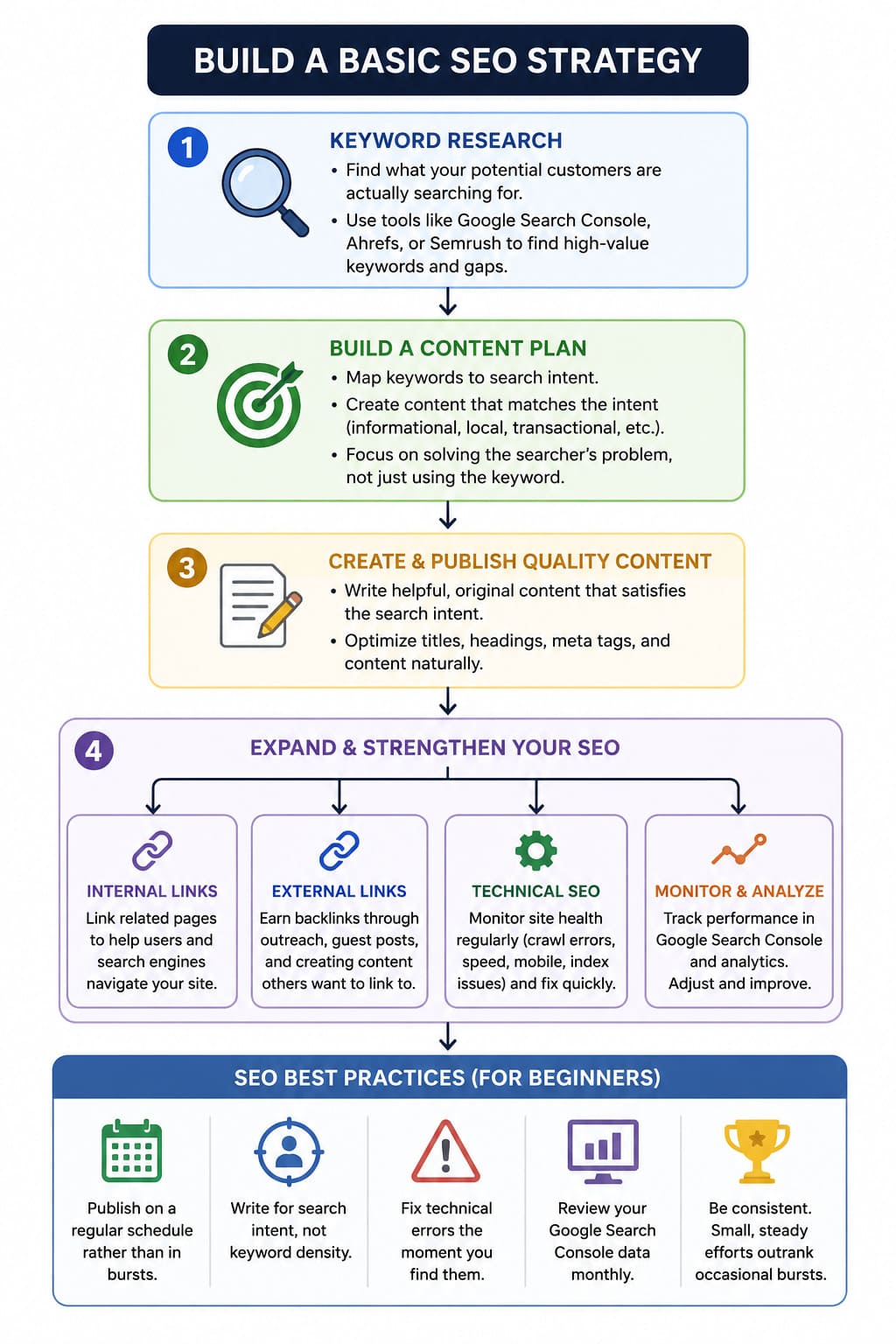
Start with keyword research. Before you write a single word of content or change a single meta tag, you need to know what your potential customers are actually typing into Google. Not what you think they are typing. What they are actually typing. Those two things are often different. A plumber might assume people search "emergency plumbing services," when the higher-volume term in their city is "burst pipe repair near me." Tools like Google Search Console, Ahrefs, or Semrush surface that gap and show you exactly where to focus in your SEO marketing strategies.
From those keywords, you use search engine optimization techniques to build a full content plan. Each piece of content you create should target a specific search intent, the actual reason someone is searching for a term. Someone searching "how to fix a leaking tap" wants instructions. Someone searching for "plumber in Austin" wants to hire someone. The content you create needs to match that intent, not just include the keyword. Search engines are sophisticated enough now to tell the difference, and they reward pages that actually satisfy the reason behind the search.
Once your content foundation is in place, the SEO strategy expands outward. You build internal links between related pages to help both users and search engines navigate your site. You work on earning external links through outreach, guest contributions, or creating content so useful that others reference it naturally. You monitor your technical health regularly, so crawl errors or speed issues do not quietly chip away at rankings you have already earned.
Publish on a regular schedule rather than in bursts, write for search intent rather than keyword density, fix technical errors the moment you find them, and review your Google Search Console data monthly. These habits sound basic, but the businesses that follow these SEO optimization tips outrank the ones that treat SEO as an occasional project.
Search has changed more in the past two years than in the decade before it. AI in SEO has shifted the landscape in two significant ways.
Notably, there is a growing layer of optimization called Generative Engine Optimization (GEO) or Answer Engine Optimization (AEO). But what does this mean? It’s about making your content visible and citable in AI-generated answers, whether in Google's AI Overviews, ChatGPT browsing responses, or Perplexity results. Building a strong AI SEO strategy for this environment comes down to writing for your reader first, with genuine depth and accuracy, and the signals follow.
Consistent execution of the right fundamentals is what produced those numbers. Nothing more complicated than that. If you want to achieve results like this, a reputed search engine optimization agency like The Scale Rankings can help you. Our team helps businesses across industries to build SEO strategies that are structured, transparent, and tied to measurable outcomes. Each of our affordable SEO services is built around what your specific website actually needs. Whether you are starting from scratch or trying to fix what is not working, the team brings the process that gets you found. Connect Now!
The Scale Rankings is your go-to partner for all things SEO. We focus on crafting personalized SEO strategies that deliver real results, from boosting your rankings to increasing organic traffic. With our expertise in on-page SEO, off-page SEO, and technical SEO, we ensure your brand stands out in the digital crowd.
The Scale Rankings ensures to make sure your audience finds exactly what they’re looking for. As one of the best search engine optimization (SEO) companies, we dig into the core of your business, crafting strategies that hit home across industries. Our services include:
 Let’s Chat
Need help with your next SEO project? Our experts are here to help. Reach out to us for a free consultation or more information.
 +1 877 33 SCALE
 [email protected]
 1870 The Exchange SE Ste 220 PMB 47489, Atlanta, GA 30339-2171




 Local SEO
 E-Commerce SEO
 International SEO
 SEO Consulting
 Conversion Rate Optimization
 Content Marketing
 Content Strategy
 Website Content
 Answer Engine Optimization
 Amazon SEO
 Generative Engine Optimization
 AI Citation Building
 Entity SEO