



May 25, 2026 By The Scale Rankings

| The future of SEO with AI requires structuring content, authority signals, and technical SEO so AI-powered search engines can understand, trust, summarize, and recommend your content. |
Terms like GEO, AEO, and SGE are suddenly everywhere in every SEO conversation. The future of SEO with AI gets stronger with every search you run. The question isn't whether AI will change SEO…Because it already has! So are you changing with it?
This guide breaks down exactly what's shifting, why it matters, and most importantly…what you can do about it. Whether you're a freelance blogger, a digital agency, a SaaS team, or a business owner trying to understand AI, there's something here for you!
See what businesses should focus on now to stay visible across generative search engines and conversational platforms:
|
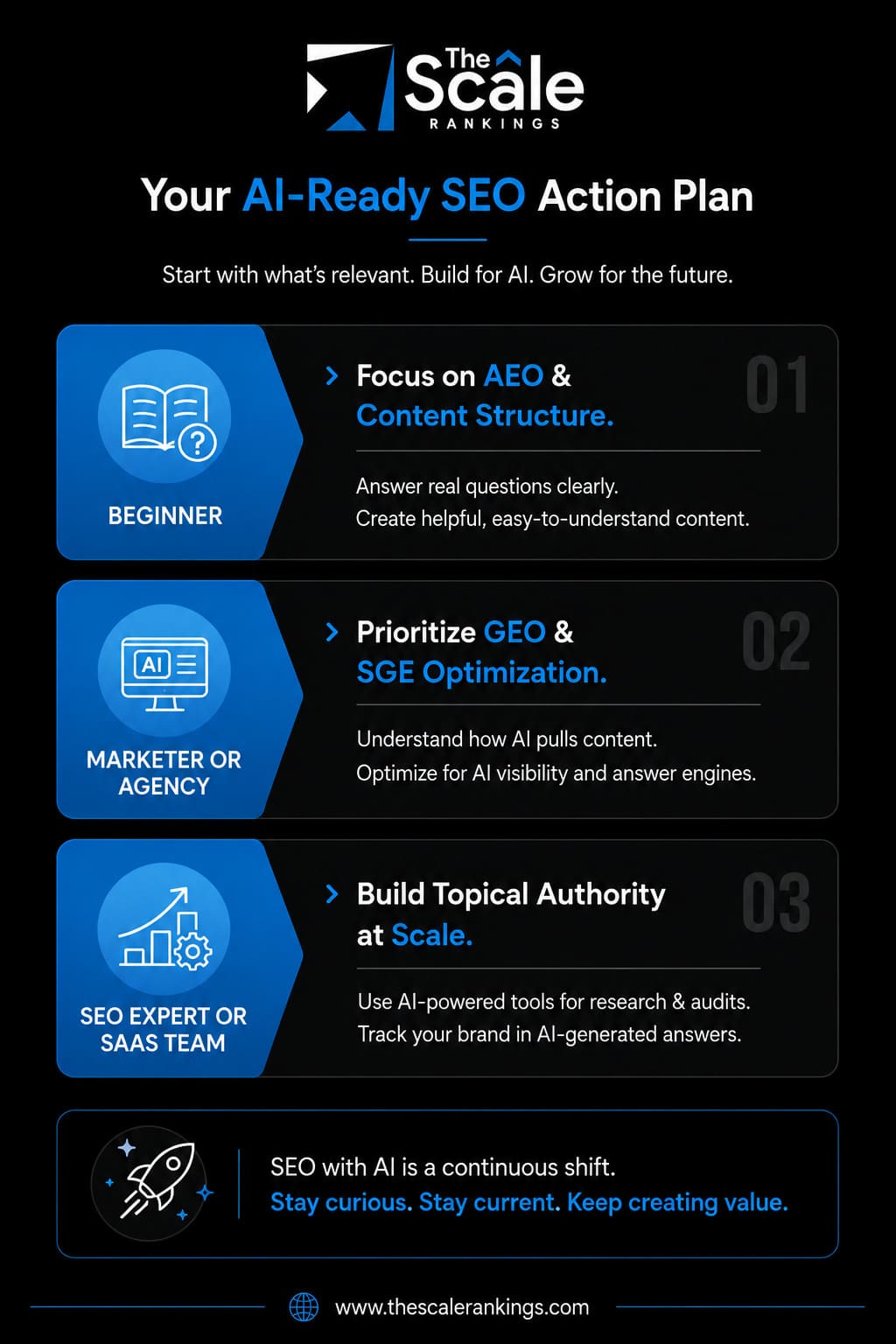
Let's zoom out for a second and look at where things are heading. These aren't speculative; these are the latest AI SEO trends actively shaping strategies for 2026 and beyond.
The latest SEO trends worth tracking right now:
| SEO Trend | What’s Happening | How to Prepare |
| Zero-Click Searches | AI-generated answers and featured snippets are reducing the number of users clicking through to websites. | Optimize for featured snippets, structured data, and concise answer-focused content. |
| E-E-A-T Signals | Google prioritizes Experience, Expertise, Authoritativeness, and Trustworthiness more than ever. | Publish expert-led content, showcase credentials, add author bios, and use trustworthy sources. |
| Voice & Conversational Search | Users increasingly search using full questions and natural language queries. | Focus on long-tail keywords, FAQs, and conversational content formats. |
| Multimodal Search | Search engines now combine text, images, videos, and other media in results. | Optimize images and videos with proper metadata, captions, and SEO-friendly descriptions. |
Being aware of the latest AI search trends is one thing. Adjusting your strategy to match them is another. The brands winning right now are doing both.
The future of SEO is being shaped by AI, automation, and changing search behaviors. Businesses that fail to evolve risk losing visibility in an increasingly competitive online space. The good news? With these strategies, you future-proof your SEO efforts. Here you go:
Users changed their search preferences in the past few years. And AI is the reason. Adobe Analytics mentioned that 73% of users said AI became their primary product research tool. This shows that consumers are increasingly using AI instead of search engines for shopping and research
The same old search engine optimization (SEO) tricks might not work anymore. AI-powered search engines are trained to understand what someone actually wants. Think twice- Am I the most trustworthy source for it?
Our industry specialists recommend that “You must start every piece of content with a clear answer to a specific question. Add a direct, useful answer within the first 100 words.” The future of SEO with AI is more about being the source that AI tools reference, summarize, and recommend. Understanding that intent shift is the first strategic move you can make.
Generative Engine Optimization (GEO) refers to optimizing your content for AI-powered generative search engines. It can be for Google's AI Overviews, Perplexity, or ChatGPT. Generative engine optimization strategies can help you appear in the answer.
Some generative engine optimization strategies for you are:
The businesses already applying generative engine optimization strategies are quietly gaining momentum.
Answer Engine Optimization (AEO) helps your content become the direct answer to user questions. It focuses on short, clear answers that AI tools, voice assistants, and search engines can easily display.
Best AEO practice includes:
Google's featured snippets, People Also Ask boxes, and AI summaries all pull content that follows this pattern. Our experts recommend creating dedicated Q&A sections on your landing pages and blog posts. Structure each answer like you're explaining it to a busy person who has ten seconds. Be direct, be clear, be useful.
The future of SEO with AI rewards content that AI models trust enough to quote, summarize, or cite in their answers. That kind of content is original, specific, structured, and backed by real expertise. Broad, surface-level content that covers "everything about X in 500 words" is getting less traction every month. AI engines are getting smarter about recognizing depth.
Think about AI search optimization from the model's perspective. When it scans a page, it's looking for clarity, credibility, and coverage. Does the page answer the question directly? Does it cite sources? Is it structured in a way that makes the key information easy to extract? These are the signals that drive AI search optimization performance.
One practical approach- Publish original research, data, case studies, or expert commentary that doesn't exist anywhere else. When you're the only source of a specific insight, you become un-citable to avoid.
AI-powered SEO tools have gotten genuinely impressive. They can audit your site, suggest content gaps, analyze competitor strategies, cluster keywords by intent, and even generate content briefs in seconds. Used well, AI-powered SEO tools can save you hours each week and surface insights you'd never catch manually.
But here's the trap most teams fall into: they let the tools do all the thinking. They generate keyword lists, produce AI content at scale, publish it without review, and wonder why nothing ranks. AI SEO optimization doesn't mean outsourcing your strategy to a chatbot. It means using intelligent tools to work smarter while you bring the expertise, judgment, and originality.
“Our experts recommend using AI tools for research, auditing, and ideation. But keeping the editorial voice, the strategic decisions, and the quality control firmly in human hands. That combination is what actually performs.”
Some of the most effective uses of AI-powered SEO tools right now include: identifying content gaps against top competitors, analyzing search intent patterns at scale, spotting technical SEO issues across large sites, and clustering long-tail queries into content pillars.
If you haven't paid attention to Google Search Generative Experience (SGE) yet, now is the time. Google's AI Overviews (formerly SGE) now appear at the top of many search results. Summarize answers before the user ever sees a traditional blue link.
Google Search Generative Experience (SGE) pulls content from pages it considers authoritative, well-structured, and directly relevant to the query. Getting featured there doesn't require tricks. It requires genuinely good content that answers real questions with specificity and clarity. Think of it as Google saying: "We trust this source enough to put it front and center."
Here's what helps your content show up in SGE:
The future of SEO in generative search means that zero-click answers are more common. But appearing inside those answers is the new first-page ranking. Optimize for that.
There's one of the most consistent patterns in how AI and the future of SEO play out. Generalist sites are losing ground, and specialist sites are gaining it. Covering a wide range of loosely related topics used to work. It's working less and less.
Topical authority means becoming the most comprehensive, credible, and interconnected source on a specific subject. It's about covering your niche so thoroughly that both search engines and AI tools associate your domain with that topic. That's the SEO strategy for AI era: depth over breadth, quality over quantity.
The practical approach for building topical authority:
AI and the future of SEO reward brands that commit to one thing deeply. Pick your niche. Own it.
With so much shifting so fast, it's no surprise that businesses are turning to specialists. An agency combines traditional SEO expertise with a working knowledge of how AI models evaluate, rank, and reference content.
But a professional AI SEO agency like The Scale Rankings can help you map your content strategy to how generative search engines actually assess authority, trust, and relevance. That's a meaningful difference when the rules are changing this quickly.
That said, the SEO fundamentals still hold regardless of who's executing the work. Useful, well-structured content. Real topical authority. A clean technical foundation. The tools evolve, the tactics shift, but those three things remain constant.
The Scale Rankings is your go-to partner for all things SEO. We focus on crafting personalized SEO strategies that deliver real results, from boosting your rankings to increasing organic traffic. With our expertise in on-page SEO, off-page SEO, and technical SEO, we ensure your brand stands out in the digital crowd.
The Scale Rankings ensures to make sure your audience finds exactly what they’re looking for. As one of the best search engine optimization (SEO) companies, we dig into the core of your business, crafting strategies that hit home across industries. Our services include:
 Let’s Chat
Need help with your next SEO project? Our experts are here to help. Reach out to us for a free consultation or more information.
 +1 877 33 SCALE
 [email protected]
 1870 The Exchange SE Ste 220 PMB 47489, Atlanta, GA 30339-2171




 Local SEO
 E-Commerce SEO
 International SEO
 SEO Consulting
 Conversion Rate Optimization
 Content Marketing
 Content Strategy
 Website Content
 Answer Engine Optimization
 Amazon SEO
 Generative Engine Optimization
 AI Citation Building
 Entity SEO