



May 20, 2026 By The Scale Rankings

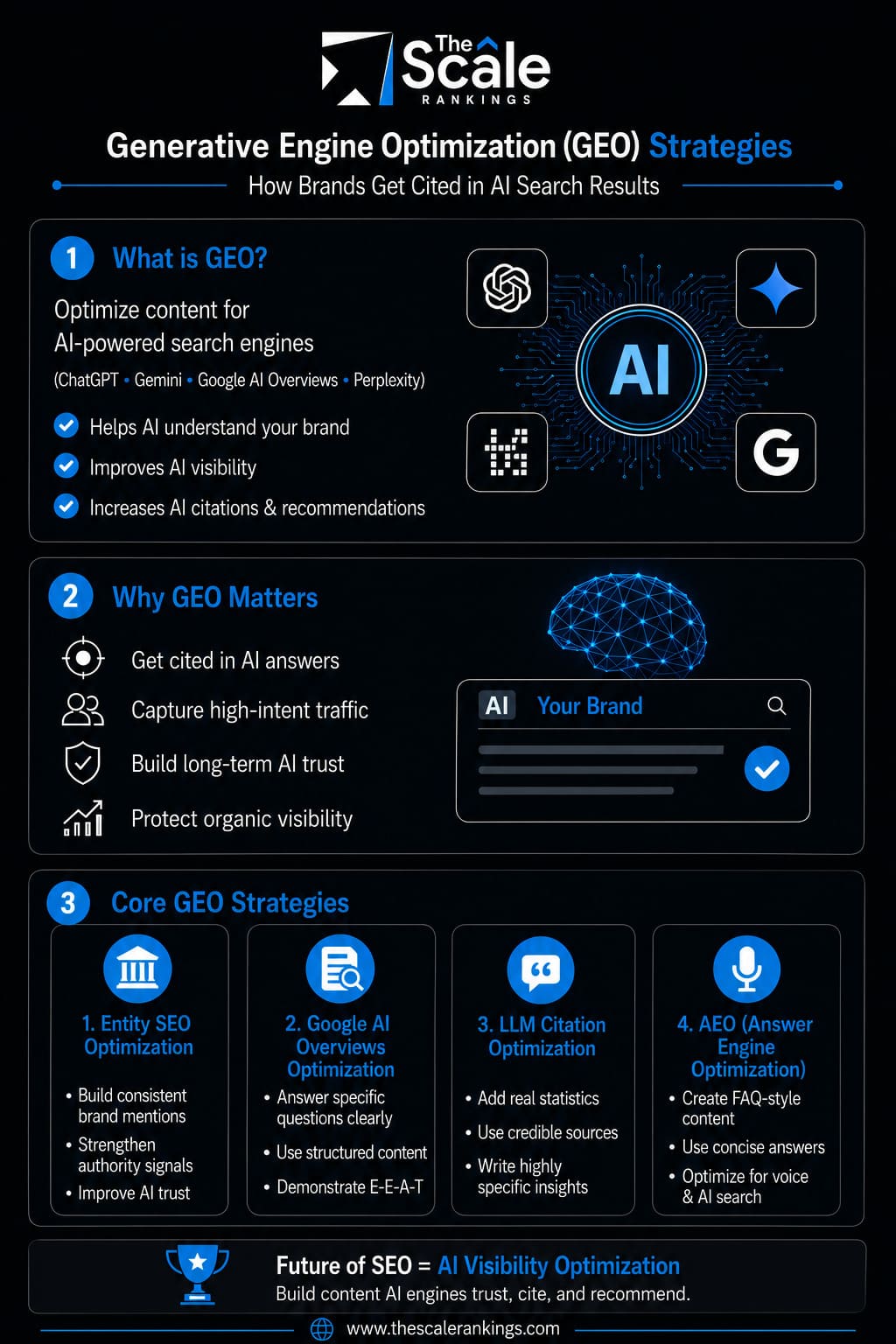
| Generative Engine Optimization (GEO) Strategies include optimizing your content for AI-powered search engines like ChatGPT, Gemini, and Google AI Overviews. This helps your brand become a trusted source that AI tools cite and recommend. |
A massive shift is happening right now in digital marketing. Generative AI engines are taking over traditional search. For businesses, this change brings a brutal reality.
Simply said, generative engine optimization (GEO) is the process of making your content worthy enough. Why? To help AI search engines pick it up and use it when answering someone's question. This blog covers the key GEO strategies businesses need to improve visibility, authority, and AI-driven search presence.
Learn effective GEO strategies that help websites align with AI-generated search responses through:
|
According to Gartner, traditional search engine volume is projected to decline by 25% by 2026 because users are increasingly relying on AI chatbots and virtual agents for answers. This shift is exactly why businesses now need strong generative engine optimization strategies. So here are the key reasons you need generative engine optimization best practices:
A GEO strategy is a shield for your business right now. AI engines scan across the internet to see if you are legitimate. They heavily rely on Reddit, Quora, industry forums, and review sites (like G2 or Trustpilot). They read, synthesize, and recommend.
The algorithms and user behavior have shifted permanently. Building a dedicated GEO strategy ensures that your brand remains relevant, authoritative, and visible in the age of artificial intelligence.
Alright, what does a beginner actually do to apply generative engine optimization strategies? The good news? You don't need to rebuild your entire website. You need to write better, smarter content. These habits applied with AI search engine optimization in mind can greatly benefit you. Check out the strategies below:
AI doesn't just understand keywords. It understands entities. This means it knows who and what things are. A person, a brand, a concept, or a place. Entity SEO optimization is about making sure your brand is clearly, consistently, and authoritatively defined across the web so AI can confidently say "yes, this source is legit."
Say you run a small marketing consultancy. If your brand name only shows up on your own website, AI has very little confidence in who you are. But if you're mentioned in industry publications, have a Google Knowledge Panel, and your team members are cited in relevant articles. Suddenly, AI recognizes you as a real, trustworthy entity in your space. That recognition translates directly into generative search citations.
The Scale Rankings experts recommend auditing where and how your brand appears online before anything else. Fix the foundation before building on top of it.
You've probably noticed those AI-generated boxes at the top of Google search results. That's Google's AI Overviews (previously called SGE or Search Generative Experience). And those little source citations you see next to the AI summary? That's prime real estate. This Google SGE optimization guide will help you understand how to earn a spot there.
The biggest thing to understand: Google's AI Overviews pull content that directly answers the query, not content that just contains the keyword. So instead of writing a page titled "Email Marketing Tips," write one that answers "What email marketing strategies work best for small ecommerce businesses in 2025?" Specific, question-based content wins.
AI SEO optimization for Google also means keeping your E-E-A-T strong. That's Experience, Expertise, Authoritativeness, and Trustworthiness. It is Google's checklist for deciding if your content deserves to be surfaced. Real author bios, original data, and a consistent publishing history all signal that you're the real deal.
Have you ever wondered why some websites always show up when you ask ChatGPT something, and others never do? That's LLM citation optimization, and it comes down to one thing: specificity. AI models, whether it's ChatGPT, Claude, or Gemini, are trained to prefer sources that make clear, verifiable, well-supported claims.
Here's an example that makes it obvious:
The first sentence is the kind of thing anyone might say. The second one sounds like a source worth citing. That gap, that's what AI citations optimization strategies are designed to close. Every time you replace a vague claim with a specific, sourced one, you make your content more citable.
Generative AI search engine optimization really just means writing like a credible expert, not a content farm. Clear definitions, real data, original takes- that's the formula.
AEO optimization stands for Answer Engine Optimization. If you're not familiar with it, think of it as the tactical sibling of GEO. It covers how AI perceives your entire content footprint. But the AEO strategy zooms in to make your content the direct answer to a specific query.
AEO is why FAQ sections work so well. It's why "how to" articles tend to get featured in voice search results. When someone asks Siri or Alexa a question, those tools are pulling from AEO-optimized content. And guess what? The same content that wins in voice search tends to win in generative AI citations too.
Our experts recommend building at least a few pages of pure Q&A content on your site. Write the question, answer it in two or three sentences, and move on. This format is incredibly easy for AI to parse and quote, which is exactly the point of an AEO strategy.
There are generative engine optimization tools that can help you figure out where you're showing up, where you're missing, and what to fix. Most of them, you might already have access to. A few worth using right now are:
| Tool / Platform | How does it help? | What to Do? |
Perplexity AI
| Shows which websites AI pulls information from for niche searches | Search your target topic and see if your site appears in sources |
| ChatGPT & Claude (Web Browsing) | Reveals whether AI assistants mention or cite your website | Ask customer-style questions and compare your site vs competitors |
| Google Rich Results Test | Tests whether your schema markup is readable by Google | Paste your URL and check for schema errors |
| Ahrefs / SEMrush | Tracks backlinks, authority, and SEO trust signals | Analyze domain authority and backlink quality |
| Google Search Console | Monitors how your pages perform in search | Check impressions, clicks, and indexed pages |
| Google Trends | Finds rising search topics and intent shifts | Search industry keywords and compare trends |
The future of SEO with AI is going to bring much more sophisticated GEO dashboards. But right now, regular manual testing with these tools tells you a lot. Don't wait for a perfect tool. Start learning from the already available SEO strategy for AI.
This is the one everyone wants to know. How do you actually get cited in AI search results? Let's use an example. Say you write a detailed guide on "how to set up email automation for a small business." You include a real statistic, you structure it with clear H2s, you answer the most common follow-up questions, and you keep it updated.
Six months later, someone asks Perplexity, "How do I set up email automation?" Your guide comes up. Cited. That's methodical AI citations optimization strategies at work.
Here's what actually moves the needle when you want to get cited in AI search results:
Consistency is everything here. One great article helps. Fifty great articles? Now you're building real authority.
While the core concepts of Generative Engine Optimization are straightforward, executing them consistently is where the real challenge lies. AI search engines are not static. Their algorithms update without warning, their data sources shift, and tracking whether your brand is being recommended inside a private user chat is incredibly difficult compared to tracking a traditional Google ranking page.
Managing this on your own can quickly become overwhelming because:
You don't have to navigate this digital shift alone. A generative AI search engine optimization agency like The Scale Rankings can track these algorithmic changes daily for you. The goal is to help you bridge the gap between traditional search and the new era of AI.
The experts at our data-driven SEO agency work with you to audit your current AI visibility, clean up your technical site structure, and refine your content so that LLMs easily find, trust, and cite your business. Let's figure out the best generative engine optimization services to grow your visibility together.
The Scale Rankings is your go-to partner for all things SEO. We focus on crafting personalized SEO strategies that deliver real results, from boosting your rankings to increasing organic traffic. With our expertise in on-page SEO, off-page SEO, and technical SEO, we ensure your brand stands out in the digital crowd.
The Scale Rankings ensures to make sure your audience finds exactly what they’re looking for. As one of the best search engine optimization (SEO) companies, we dig into the core of your business, crafting strategies that hit home across industries. Our services include:
 Let’s Chat
Need help with your next SEO project? Our experts are here to help. Reach out to us for a free consultation or more information.
 +1 877 33 SCALE
 [email protected]
 1870 The Exchange SE Ste 220 PMB 47489, Atlanta, GA 30339-2171




 Local SEO
 E-Commerce SEO
 International SEO
 SEO Consulting
 Conversion Rate Optimization
 Content Marketing
 Content Strategy
 Website Content
 Answer Engine Optimization
 Amazon SEO
 Generative Engine Optimization
 AI Citation Building
 Entity SEO