



May 13, 2026 By The Scale Rankings

| Brands searching for how to appear in AI search results must build entity authority, publish structured AI-friendly content, implement schema markup, and earn trusted third-party citations. |
The traditional search funnel is broken. Users want immediate answers, so they consult ChatGPT, Perplexity, or Google AI search first. This creates a massive blind spot for standard marketing campaigns. If an algorithm does not recommend your service in its chat output, the user buys from the competitor it cited. Mastering how to appear in AI search results is the only way to intercept these high-intent leads.
Referral traffic from AI platforms grew over the past year. Visitors arriving from these interfaces show distinct commercial intent. They convert multiple times better than standard organic search traffic. Simultaneously, Semrush reported that SERPs with Ads + AI Overviews Grew by Over 394% in 2025. Businesses focusing on AI search visibility are seeing higher conversion rates because users arriving from AI-generated summaries already display high purchase intent.
Capturing this highly profitable AI referral traffic requires specific technical adjustments. Establishing consistent AI search visibility depends on building trust with language models. Understanding the underlying technology helps clarify the necessary steps.
Traditional search engines operate like massive index catalogs. Crawlers fetch documents, sort them by keywords, and evaluate backlink profiles to determine rankings.
| User Query → Live Semantic Search → RAG Extracts Sources → Model Writes & Cites |
This explains how AI search works practically. Traditional rank tracking measures static positions. Answer engines evaluate source credibility dynamically.
Mastering generative engine optimization means providing clear, machine-readable facts. For professional implementation of these extraction pipelines, review our specialized Generative Engine Optimization (GEO) Services. Diagnosing existing visibility drop-offs is the logical starting point.
Companies asking how to appear in AI search results should first understand how retrieval systems prioritize factual clarity over traditional keyword repetition.
High rankings on traditional search engine pages do not guarantee inclusion in chat interfaces. Many companies experience standard traffic, but…remain absent from machine summaries. If you are evaluating why your website appears in AI search conversations remains inconsistent, examine these five specific variables:
Language models rely on distinct entity mapping. If your business lacks coverage across established third-party platforms, algorithms treat the brand as unverified. Better entity SEO helps search systems connect your business with verified digital references.
Essential answers hidden within lengthy paragraphs rarely get cited. Scrapers operate on strict processing budgets and prioritize clearly isolated statements.
Bots look for corroborating evidence across the web. If trusted industry hubs, review platforms, or major publications omit your brand, models avoid citing you. This is where AI citation building becomes critical for long-term trust.
Algorithms treat consistent branded search volume as a primary AI trust signal. Minimal search demand suggests low external recognition.
Failing to implement a specific schema leaves crawlers guessing about context. Clear, structured data translates text into definitive facts.
Identifying these disconnects helps correct underlying crawl issues. Resolving these fundamental gaps allows you to implement effective growth tactics and improve how you appear in AI search results consistently.
Securing steady citations during zero-click search interactions requires systematic adjustments. You must validate your entity, restructure web content, and acquire authoritative mentions. Implementing these eight strategies establishes your domain as a primary machine reference.
Language models organize information around entities. An entity represents a distinct, verifiable concept, organization, or person. Establishing a robust brand entity footprint requires consistent third-party documentation.
Claim and update profiles across trusted digital databases. Maintain active listings on Google Business Profile, LinkedIn, Crunchbase, and specialized directory hubs. Ensure your company name, physical address, contact details, and primary descriptions match exactly across every domain.
This uniform presence directly supports knowledge graph optimization. When bots encounter identical facts corroborated across dozens of distinct root domains, they map the business securely. Verified entities receive priority placement during generation cycles.
Brands attempting to show up in AI search systems must maintain identical business information across every public-facing directory and review platform.
Focusing exclusively on exact-match keywords yields diminishing returns. Publishing semantically rich content requires addressing complete topical clusters. Users submit highly specific, conversational search queries to chat interfaces. Content must reflect these natural phrasing patterns.
Develop comprehensive content silos rather than fragmented blog posts. Cover subtopics thoroughly to build clear topical authority.
Formatting determines extraction success. To produce functional AI-ready content, place direct answers in the first two sentences of every section. Eliminate introductory preamble. If a section explains how to optimize for AI search results, provide the exact step-by-step methodology immediately. Offer supporting context and examples afterward.
Brands that want to rank in ChatGPT interfaces must focus on clarity, semantic coverage, and structured explanations instead of shallow keyword targeting.
Scrapers evaluate layout formatting to identify definitive answers quickly. Mastering content structuring for AI requires designing highly scannable page architectures.
Implementing these AI Citations Optimization Strategies helps bots identify extractable answers much faster during live retrieval.
Standard link-building passes authority for ranking algorithms. Earning placements in chat interfaces requires dedicated AI citation building. A citation occurs when a credible domain references your brand within relevant text passages. Hyperlinks remain optional for machine validation.
Models train on established publishing portals. They crawl articles published on Forbes, Search Engine Journal, Reddit, and highly moderated niche forums. A positive brand mention inside an active industry discussion signals immediate relevance to extraction engines.
Target specific inclusions within external listicles and software roundups. Models cross-reference these lists when evaluating user prompts. For managed placement campaigns, explore how our dedicated AI Citation Building Services secure verified external references.
Businesses pursuing AI SEO for citation growth often prioritize high-authority mentions instead of focusing only on traditional backlink acquisition. Consistent AI citations for a website strengthen machine trust and improve citation frequency across answer platforms.
Structured data provides explicit context to machine readers. Properly structured data optimization injects verified data points straight into processing queues.
Standard tools simplify implementation. Using tools like Rank Math or Yoast handles basic schema markup for AI deployment cleanly. Validate output syntax regularly using Google’s Rich Results Test tool. Businesses investing in LLM citation optimization often see extraction accuracy once structured data frameworks are fully deployed.
Generative engine optimization focuses specifically on making text easily summarizable by language algorithms. Standard search optimization targets user click behavior. GEO emphasizes language clarity, factual density, and authoritative structuring.
Improving overall AI search visibility through GEO requires embedding distinct data points. Cite specific statistics, proprietary survey findings, and original quotes throughout your text. Models actively look for unique metrics to support generated statements. Providing clear data assets increases citation likelihood significantly. Consult our specialists to design a customized GEO strategy for your digital assets.
An effective AI SEO strategy combines factual clarity, technical accessibility, and citation-worthy data points throughout every major content asset.
Answer engine optimization targets direct answer delivery across search ecosystems. Optimizing for featured snippets and voice search query patterns fulfills basic Answer Engine Optimization (AEO) strategy requirements.
Scrapers frequently pull existing snippet text directly into chat outputs. Frame site content around exact question structures. Maintain high standards for E-E-A-T optimization (Experience, Expertise, Authoritativeness, Trustworthiness). Display clear author bios containing verified credentials on every article. Models prioritize verified experts over uncredited authors. Secure consistent answer box placements using our targeted AEO Services.
Businesses that optimize for AI search results using conversational phrasing are more likely to get cited by AI tools during live query generation.
Content optimization yields zero value if bots encounter access barriers. Implementing technical SEO for AI search ensures continuous data ingestion.
Brands aiming to show up in AI search results consistently should routinely audit crawl permissions and server response performance. Adapting these strategies across distinct platforms requires specific tactical adjustments.
Individual interfaces weigh source variables differently. Achieving broad market coverage requires adjusting your approach based on specific crawler behaviors. The table below displays this well:
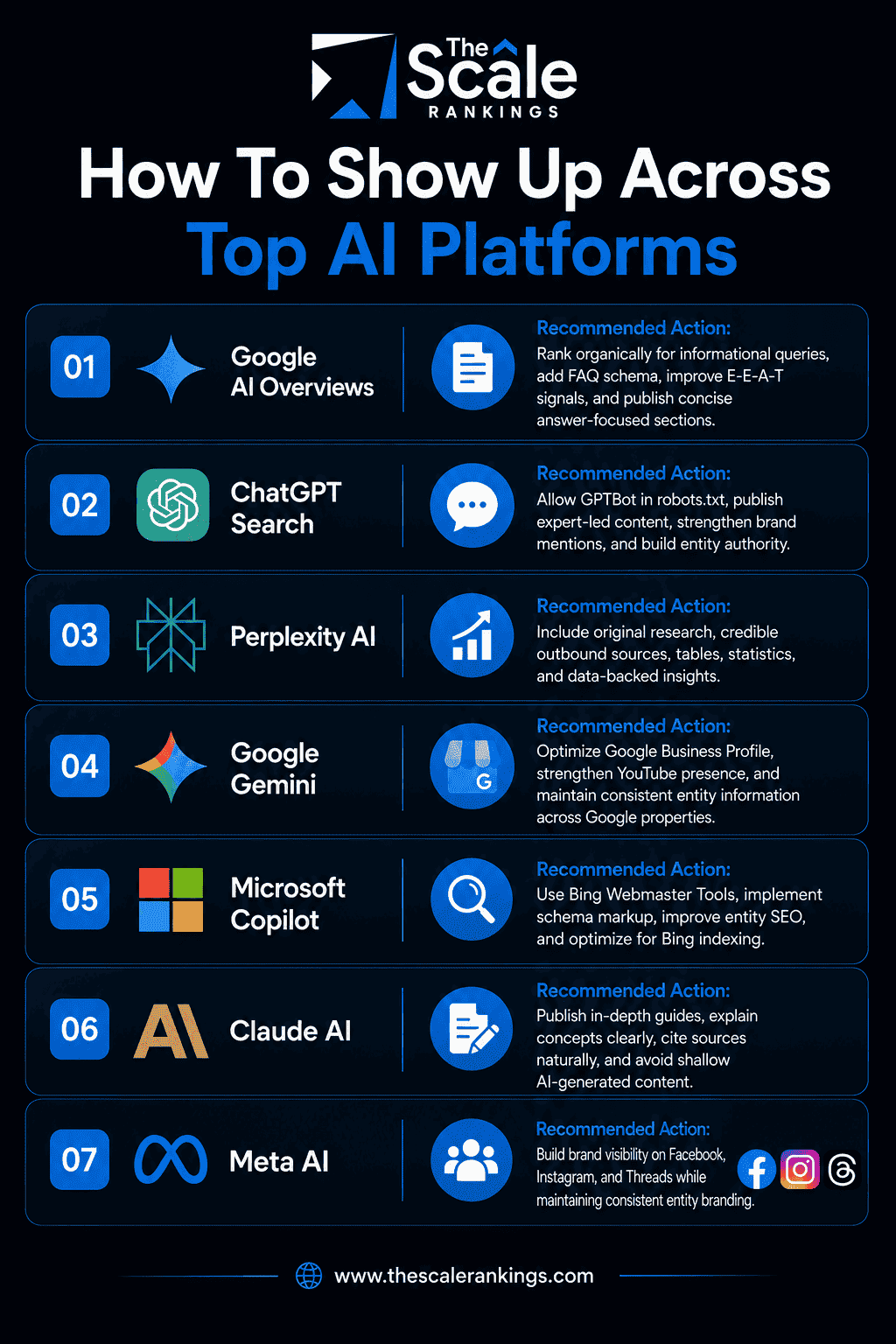
Businesses optimizing for Google AI overviews should focus on concise answers, schema markup, and topical authority. Improving visibility inside ChatGPT search results often depends on expert-led content and stronger off-site brand references.
Learn the strategy: How to rank in ChatGPT
Standard rank tracking software misses chat summary inclusions. Measuring true AI referral traffic and brand presence requires implementing distinct monitoring workflows.
Open clean browser profiles across target platforms. Submit conversational prompts relevant to your core offerings. Document whether your brand receives citation credit. Record specific competitor URLs selected by the model.
Google Search Console displays specific Overview metric data. Access your standard Performance dashboards. Apply custom filters to isolate impressions and click metrics originating directly from generative interface features.
Deploy specialized tracking applications. Platforms like Peec.ai, Enterprise AIO, and the SE Ranking AI Tracker query target prompts automatically. These tools generate trend reports displaying continuous share of voice metrics.
Configure persistent brand alerts using tools like Ahrefs. Track unlinked brand occurrences across digital publications. Tracking how to track brand mentions in ChatGPT interfaces involves monitoring third-party blogs that syndicate model outputs.
Perform comprehensive visibility checks before deploying new content strategies. Record initial mention frequencies. Audit target terms every thirty days to evaluate citation velocity accurately. Analyzing performance improvements clarifies basic strategic differences.
Organizations investing in AI citation optimization services typically combine manual audits with automated visibility tracking tools.
Modern AI search optimization now requires balancing both GEO and traditional SEO frameworks simultaneously. Brands working with an AI citation SEO agency often combine editorial PR campaigns with technical optimization to increase extraction opportunities.
Securing continuous placements takes systematic effort. It requires steady entity validation, clean content structuring, and proactive citation generation. Brands implementing this infrastructure secure highly visible recommendations across answer engines.
The Scale Rankings builds tailored optimization frameworks to ensure your brand receives citations across major processing interfaces. We deliver:
Our team combines technical implementation, AI citation building, and professional SEO services to help brands dominate emerging answer ecosystems.
If your goal is understanding how to appear in AI search results across every major platform, our specialists can build a customized visibility roadmap for your business.
Stop losing high-intent traffic to unoptimized content structures. Let our experts transition your digital assets into primary machine references.
The Scale Rankings is your go-to partner for all things SEO. We focus on crafting personalized SEO strategies that deliver real results, from boosting your rankings to increasing organic traffic. With our expertise in on-page SEO, off-page SEO, and technical SEO, we ensure your brand stands out in the digital crowd.
The Scale Rankings ensures to make sure your audience finds exactly what they’re looking for. As one of the best search engine optimization (SEO) companies, we dig into the core of your business, crafting strategies that hit home across industries. Our services include:
 Let’s Chat
Need help with your next SEO project? Our experts are here to help. Reach out to us for a free consultation or more information.
 +1 877 33 SCALE
 [email protected]
 1870 The Exchange SE Ste 220 PMB 47489, Atlanta, GA 30339-2171




 Local SEO
 E-Commerce SEO
 International SEO
 SEO Consulting
 Conversion Rate Optimization
 Content Marketing
 Content Strategy
 Website Content
 Answer Engine Optimization
 Amazon SEO
 Generative Engine Optimization
 AI Citation Building
 Entity SEO