



July 7, 2026 By The Scale Rankings

| Search engines now work through 5 interconnected stages - crawling, indexing, ranking, SERP assembly, and AI synthesis. They see and understand your content, evaluate it using AI-driven ranking systems and E-E-A-T signals. They then decide how it appears in search results or AI-generated answers. |
Google handles around 8.5 billion searches every single day. Behind each search, a 5-stage machine runs in milliseconds. It discovers content, stores it, scores it against more than 200 signals, assembles a results page, and now writes an AI answer on top of it all.
In 2025, being crawled, indexed, and ranked was enough to get seen. In 2026, a layer of AI sits above the results. It rewrites who gets found and who stays invisible.
So, how do search engines work now? This complete search engine guide explains all 5 stages. Understanding the full working of search engine technology is what separates the sites that get found from the ones that disappear.
TL;DR: 5 Stages of Search Engine Working
|
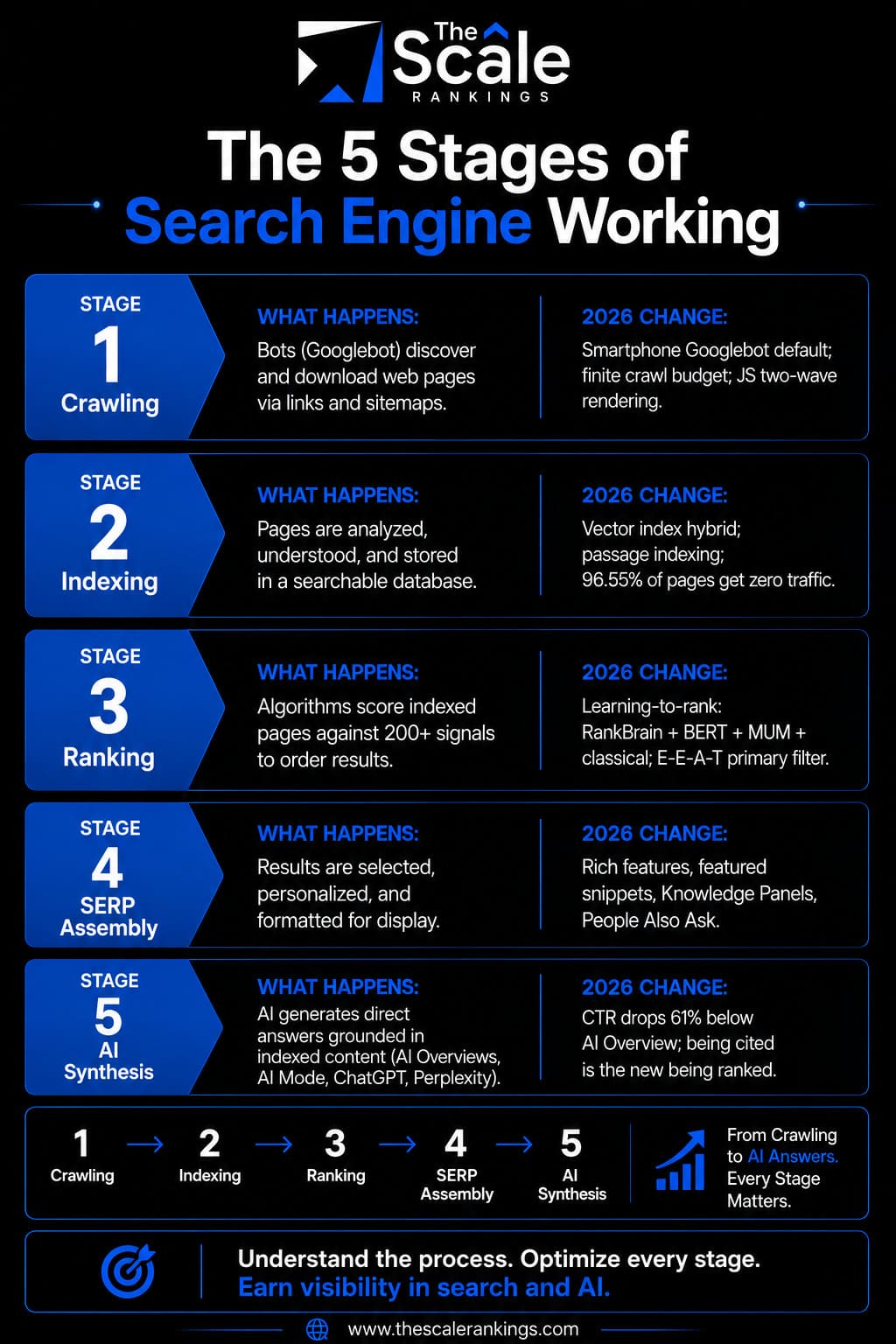
Search in 2026 is smarter, faster, and more AI-driven than ever. Yet the core idea has not changed. Google still finds pages, understands them, and ranks the best for each query. The real difference is that it now reads for meaning and trust, not just matching keywords. Here is a breakdown:
Web crawling is how automated bots browse the internet to find and collect content. These bots are also called crawlers or spiders. Google's main crawler, Googlebot, begins with a list of known web addresses and follows links outward. It moves both wide and deep, discovering brand-new sites while digging into fresh pages on sites it already knows. Every link it follows is another door to open.
Google does not crawl every page endlessly. It sets a "crawl budget," which limits how many pages it visits and how often. Fast, trusted sites with clean internal linking earn a bigger budget. Trimming your server response time by 100 milliseconds can lift crawling by around 15%. Orphaned pages, which have no internal links pointing to them, often get skipped entirely.
To protect your crawl budget, submit an XML sitemap in Google Search Console, add internal links to orphaned pages, fix server errors, remove long redirect chains, and merge thin or duplicate pages.
Since July 2024, Google has indexed the web only through its mobile crawler. There is no separate desktop index anymore. Content hidden on mobile, tucked inside tabs or accordions, still gets crawled but may carry slightly less weight.
JavaScript adds another twist. Google processes JS pages in two waves. First, it reads the raw HTML right away. Then, hours or even days later, it runs the JavaScript to see the rest. If your key content only appears after scripts load, Google may miss it on that first pass. The safe fix is to place your main content in the raw HTML or to use server-side rendering.
One more control sits in your hands: the robots.txt file. This tiny text file lives at the root of your site and tells crawlers which areas to skip. Used well, it steers the crawl budget toward the pages that matter. Used carelessly, it can accidentally hide pages you badly want found, so review it before you assume Google is ignoring you.
Once a page is crawled, the engine studies it and files it in a giant, searchable database called the index. Picture the world's largest library catalogue, except this one understands meaning, not just words. In 2026, Google's index holds hundreds of billions of pages in a hybrid system. One part is a classic inverted index, which maps keywords to the pages that contain them. The other is a vector index, a kind of meaning map that links related ideas even when the exact words differ.
Being crawled does not guarantee a place in the index. Google runs each page through quality gates. Is it original? Is it useful? Does it add enough value to belong? In 2026, the Helpful Content system is built into the core algorithm. So thin, repetitive, or low-value pages are routinely left out. The scale is sobering. Research from Ahrefs found that 96.55% of indexed pages get no organic traffic, and many crawled pages never reach the index at all. Canonical tags matter here too: they tell Google which version of a duplicate page should enter the index, so the copies get left out.
Here is a change many site owners miss. Through passage indexing, Google can now pull and rank a single paragraph on its own, apart from the rest of its page. A long guide can surface as a featured snippet or an AI citation for a narrow question it barely mentions because one passage answered it well.
For writers, this is a gift. Clear section headings, tight paragraphs, and a direct answer in the first line of each section all raise your chances of being pulled at the passage level. Treat every H3 in your content as its own small answer, and lead with the point.
There is no single ranking rule. In 2026, the Google ranking algorithm is really a stack of machine-learning models working together. RankBrain helps with unclear queries. BERT reads natural language and context. MUM handles complex, multi-topic, and multi-language questions. Neural matching connects related concepts without exact keyword overlap. Above them all, "learning-to-rank" models weigh more than 200 signals for every search. Even PageRank, Google's original link-based score, still runs in 2026. But it is now just one signal among dozens rather than the dominant force it once was.
These signals fall into clear groups. The table below shows what carries the most weight today.
| Signal Category | Key Factors | 2026 Weight |
| Content quality | E-E-A-T, depth, originality, freshness | High - helpful-content checks now sit in the core algorithm |
| Authority | Quality backlinks, brand mentions, PR coverage | High - most AI citations come from top-ranking pages |
| Technical performance | Core Web Vitals (INP, LCP, CLS), mobile, speed | Medium-high - user-behaviour signals added |
| Search intent match | The right page format for the query | High - the wrong format caps your ranking |
| User signals | Dwell time, "long clicks", low bounce-back | Medium - growing in weight |
| Entity & structured data | Schema, Knowledge Graph, entity links | Growing - key for AI answer inclusion |
One quality standard now stands above the rest: E-E-A-T. It stands for Experience, Expertise, Authoritativeness, and Trustworthiness. In 2026, the "Experience" part has become Google's front-line defence against the flood of mass-produced AI content. The algorithm favours pages written by people who have genuinely done what they describe. You signal E-E-A-T with named authors, real credentials, original examples, and links to solid primary sources. This is the heart of search engine ranking today: prove real value, or get filtered out.
After ranking, the Google search engine assembles the page you actually see, called the SERP, or search engine results page. In 2026, that page holds far more than ten blue links. What appears depends on the query type, your device, your location, your history, and whether pages offer content that qualifies for rich features.
Here are the features that shape modern search engine results:
Ranking number one means less than it once did when a snippet, a map, or an AI answer sits above you. To claim space, your content has to earn these features, not just a link.
Traditional search engines answer a query by finding and ranking existing pages. AI-powered search adds a new move. Instead of only pointing you to pages, the engine writes a fresh answer built from those pages. That single change rewrites the goal. You are no longer only competing for a ranking spot; you are competing to be the source an AI quotes when it writes its reply.
So, how do AI search engines work compared with the old model? The old way hands you a list of links to sort through yourself. The new way reads several sources for you and delivers one combined answer, usually with citations. Google now runs both at once, which is why your strategy has to cover both.
The practical effect is a squeeze on clicks. When a complete answer sits at the very top of the page, many people never scroll to the links below it. For your site, that means visibility now has two parts: ranking a page, and earning a mention inside the AI answer. Miss the second, and you can rank well yet still lose the customer to a summary that never names you.
Google's AI Overviews are written by its Gemini models (Gemini 3 as of early 2026) and appear at the top of results when Google decides a summary adds value. They use a method called retrieval-augmented generation, or RAG. In plain terms, the AI pulls relevant passages from Google's index, writes a natural answer, and links to its sources beneath it. Getting cited there is the new front page, and click-through rates drop sharply for the links pushed below it.
AI Mode, expanding fast through 2026, is Google's fully conversational search. It uses "query fan-out": it quietly splits your one question into several smaller ones, runs them all at once, and blends the results into a single, source-rich reply. AI Mode shows a 93% zero-click rate, the highest of any format, because users get their answer without leaving the page. Content that wins here is well-organised, well-sourced, and answers several related questions in one place.
ChatGPT Search combines its AI knowledge with live web search to provide up-to-date answers. If you're asking, does ChatGPT use Google to search, the answer is no; it primarily uses Bing's search index for real-time information. Source citations vary by query, and blocking GPTBot in your robots.txt file can limit ChatGPT's ability to access your content, reducing the chances of being cited. While blocking GPTBot hurts SEO only for AI visibility, it does not directly affect Google rankings.
Perplexity finds answers by combining AI with live web search and including source citations in every response. Perplexity AI search relies on trusted news sites, academic research, Reddit, Quora, and other authoritative sources, while giving strong preference to fresh content. Understanding how Perplexity AI search works can help brands improve visibility by publishing updated, credible content and building authority across the web.
For a deeper look, see our guide on getting cited in ChatGPT.
Pull it all together, and four practical SEO implications stand out.
How to check if Google has indexed your website? How to know if search engines can actually find your content? Simple answer - a quick audit can reveal technical issues that may be holding your rankings back. Follow these 6 steps to check your site's health and improve crawlability.
Search for site:yourwebsite.com in Google. If your important pages appear, they're indexed. If you get few or no results, Google may not have indexed your site. That's an issue you should investigate immediately.
Open Google Search Console and go to the Coverage (or Pages) report. Look for pages marked as ‘Excluded’ and review the reason for each exclusion. Some exclusions may prevent valuable pages from appearing in search.
Visit yourwebsite.com/robots.txt and make sure you're not blocking important crawlers. Along with Googlebot, verify that GPTBot, PerplexityBot, and ClaudeBot are allowed for your content to be discoverable in AI-powered search engines.
Run your three most important pages through PageSpeed Insights. Focus on Core Web Vitals, aiming for an LCP under 2.5 seconds and an INP under 200 milliseconds. Faster pages are easier to crawl and provide a better user experience.
Search your top five target keywords on Google. See whether your website is cited in AI Overviews. You may have an AI visibility gap if competitors are featured and you're not.
Use Google's Rich Results Test to check your homepage and key blog posts. Missing or incorrectly structured data can reduce your chances of qualifying for rich search features and AI-generated search experiences.
A basic audit like this can spot many common SEO issues. If your site still struggles to rank or appear in AI search results after these checks, a technical SEO audit is the next step. It helps you identify deeper crawlability, indexing, and content optimization problems.
Understanding how search engines work is the first step. The harder step is building a strategy that covers all five stages, not just the three that most guides stop at.
In 2026, that means five things working together:
This dual-track work is what we do every day at The Scale Rankings, and the results speak for themselves.
The Scale Rankings clients have seen gains in these SEO strategies:
Good search engine optimization (SEO) still drives the foundation, while GEO and AEO protect your SEO search results in the AI era. If you are ready to be seen across every stage, explore our SEO services.
The Scale Rankings is your go-to partner for all things SEO. We focus on crafting personalized SEO strategies that deliver real results, from boosting your rankings to increasing organic traffic. With our expertise in on-page SEO, off-page SEO, and technical SEO, we ensure your brand stands out in the digital crowd.
The Scale Rankings ensures to make sure your audience finds exactly what they’re looking for. As one of the best search engine optimization (SEO) companies, we dig into the core of your business, crafting strategies that hit home across industries. Our services include:
 Let’s Chat
Need help with your next SEO project? Our experts are here to help. Reach out to us for a free consultation or more information.
 +1 877 33 SCALE
 [email protected]
 1870 The Exchange SE Ste 220 PMB 47489, Atlanta, GA 30339-2171



 Local SEO
 E-Commerce SEO
 International SEO
 SEO Consulting
 Conversion Rate Optimization
 Content Marketing
 Content Strategy
 Website Content
 Answer Engine Optimization
 Amazon SEO
 Generative Engine Optimization
 AI Citation Building
 Entity SEO