



May 26, 2026 By The Scale Rankings

| Get featured in AI answers by creating clear, authoritative, and well-structured content that directly answers user questions. Brands that build topical authority, optimize for Answer Engine Optimization (AEO), and maintain consistent credibility signals across the web are more likely to appear in AI-generated search results. |
AI search does not rank pages. It picks sources. This distinction is everything. AI-generated answers influence modern search behavior. So…when someone asks an AI the same question, they get one answer, synthesized from sources the model already decided to trust.
You do not get a second chance. You either get cited, or you do not exist in that moment. AI-generated answers pull from content that is structured, authoritative, and factually consistent across the web. The model is not impressed by your domain authority or your bounce rate. It is asking a much simpler question. “Does this source clearly answer what I am looking for?” “Do enough trusted places on the internet agree that this source knows what it is talking about?”
Here’s what helps content earn visibility across ChatGPT, Gemini, and AI search platforms:
|
Before getting into the how, the why matters. AI models do not surface content randomly. There is a logic to what gets cited, and once you see it, the strategy becomes obvious.
Here is what builds credibility in AI search results:
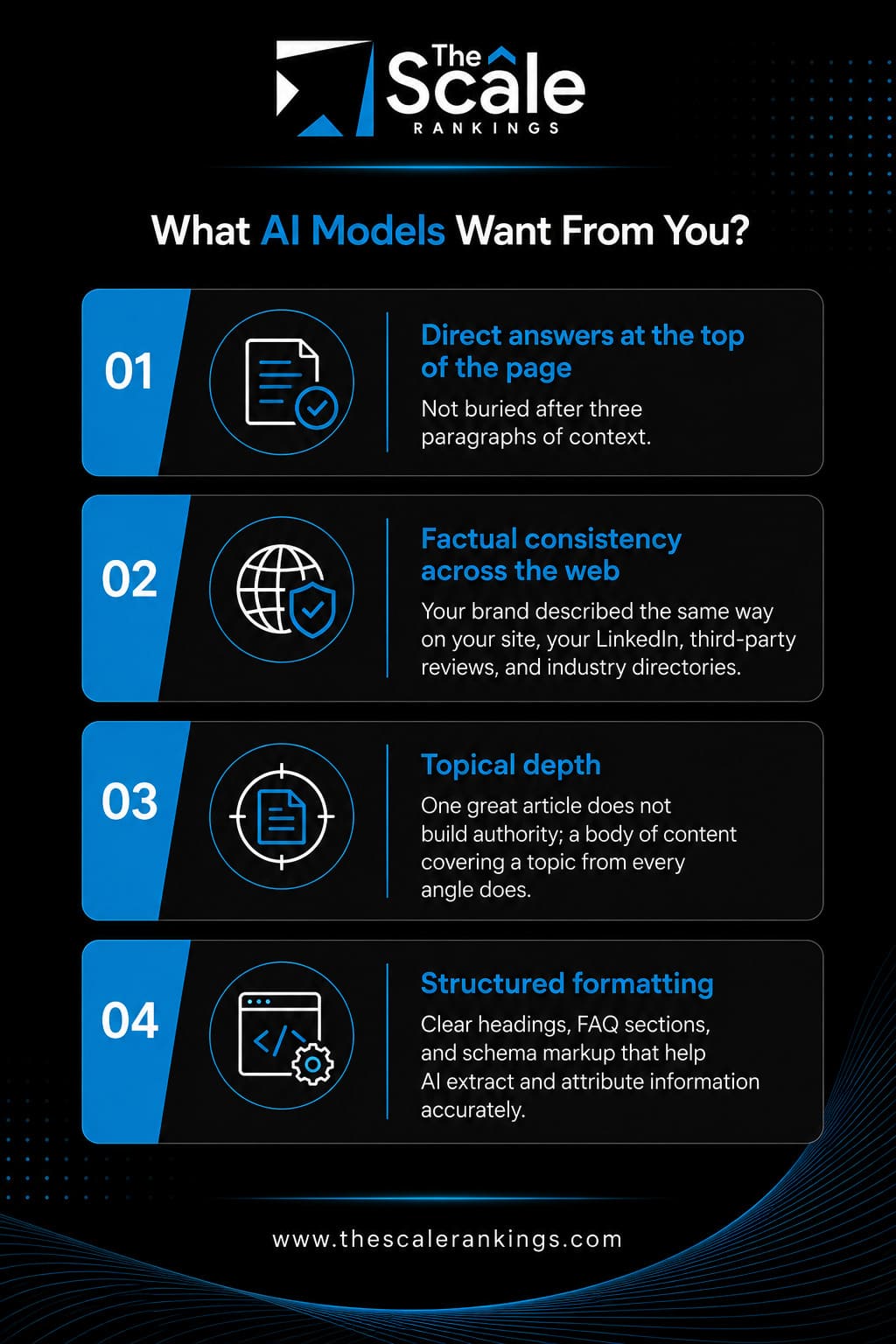
Brands serious about learning how to get featured in AI answers need to prioritize authority, factual consistency, and structured content formatting.
Our experts recommend you treat these four signals as your baseline audit checklist before investing in anything else. If your content fails on all four, no amount of backlinks will get you cited in AI search engine optimization outcomes.
Learning how to get featured in AI answers starts with creating content that directly solves user queries instead of focusing only on keyword rankings. It is then followed by other strategies that help you improve visibility and build authority. This increases your chances of showing up in AI-generated results.
One of the biggest mistakes brands make when trying to understand how to get featured in AI answers is writing content that delays the actual answer.
AI content optimization starts with a brutally simple principle: lead with the answer. AI models extract information to generate responses. They are not reading your intro paragraph about why this topic matters. They are scanning for the clearest, most direct answer to the question being asked. If your competitor's page answers it in the first sentence and yours answers it in paragraph four, your competitor gets cited. Every time.
There is a core shift in AI search engine optimization techniques. Writing for extraction, not for engagement in the traditional sense. The content still needs to be good. It just needs to be structured so an AI can find the valuable part instantly.
Answer Engine Optimization (AEO) is the discipline of structuring content to appear as direct responses in AI and voice search. A strong AEO strategy is currently one of the fastest ways to start showing up in AI-generated answers with consistency. Traditional Search Engine Optimization (SEO) still matters. But AI-driven discovery requires brands to optimize for citations, entity trust, and answer visibility.
Last year, Semrush analyzed 10 million+ keywords and found AI Overviews expanded from 6.49% of queries to 24.61% before stabilizing. This shows that AI-generated answers are rapidly becoming a standard part of search results, making the AEO strategy critical for brands. The mechanics are not complicated. If you want to know how to get featured in AI answers, your content must be easy for AI systems to extract, verify, and cite confidently. You just need to:
What makes AEO strategy different from traditional SEO is the end goal. Traditional SEO gets someone to click your link. A well-executed AEO approach gets your content cited in a response that may never send anyone to your site at all. But it builds brand familiarity every single time your name appears in an AI answer.
Your website is one data point. What the rest of the internet says about you is another, and in AI SEO, the second one often carries more weight.
Citations in AI search are shaped heavily by third-party mentions. These can be industry publications, niche directories, credible blogs, research citations, and review platforms. When multiple trusted sources reference your brand consistently and accurately, AI models register that as a signal of legitimacy. It is essentially brand authority SEO adapted for how AI models validate sources rather than how search engines count links.
Our experts recommend identifying the ten most authoritative sources in your niche and building a deliberate strategy to earn genuine mentions there. Original research, expert quotes, contributed articles, and proprietary data all open those doors. Paid placements do not carry the same weight. Earned citations do.
This one catches most brands off guard. If your company description on your website says one thing, your Crunchbase says something slightly different, and third-party reviews describe you in entirely different terms, AI models register that inconsistency. And inconsistency reduces confidence. Lower confidence means fewer citations.
AI optimization strategies include what is increasingly being called entity hygiene: auditing every place your brand appears online and making sure the name, description, category, and core information are factually identical. It sounds tedious. It absolutely is. It also directly affects your brand visibility in AI answers in ways that most brands completely underestimate.
Run a search for your brand across five different platforms right now. If the descriptions do not match, you have found your first fix.
LLM SEO strategy operates on a different logic than traditional keyword targeting. Large language models are trained to understand topics holistically, not to match keyword strings. A brand that has published twenty well-structured articles on employee onboarding will be cited far more often than a brand with one viral post on the same topic.
This is the depth-over-breadth principle in AI search engine optimization. Building content clusters that cover every angle of your core topics. The basics, the nuances, the comparisons, the edge cases, the mistakes. Creates the kind of topical authority that AI models recognize and reward. It also means your content shows up across a wider range of related queries, not just the exact one you targeted.
Our experts recommend mapping your content against your three to five core topics and identifying the gaps. The gaps are almost always where your AI citation opportunities are being lost.
Most brands implementing AI search engine optimization services for the first time completely ignore this. You have no idea whether any of this is working unless you are actively tracking where you show up in AI responses. Understanding how to get featured in AI answers also requires ongoing monitoring because AI search visibility changes constantly across platforms.
Monitoring brand mentions in AI-generated answers is still a largely manual process for most teams, but it is non-negotiable. Run your target queries monthly across ChatGPT, Perplexity, Gemini, and Google AI Overviews. Document which sources get cited. Track whether your brand appears, and if it does not, note who does. That list of competitors showing up in your place is your content gap roadmap.
Some generative AI search engine optimization agency teams are building proprietary workflows for this kind of tracking at scale. If you are doing it manually, even a simple spreadsheet tracking queries, AI responses, and cited sources will surface patterns fast. AI citations optimization is impossible without this baseline.
Most brands already create content and invest in SEO. Brands that fail to adapt to Google AI answers are highly vulnerable. But showing up in AI-generated answers requires a different level of consistency and strategy. Brands need to structure content properly, improve topical authority, monitor AI mentions, and maintain factual consistency across the web.
That takes ongoing work. It also takes technical oversight. Many internal teams simply do not have the time to track how ChatGPT, Gemini, Perplexity, and Google AI Overviews are citing sources every month. This is where working with a trusted generative AI search engine optimization agency becomes useful. The goal is not to replace your marketing team. It is to help align your SEO efforts with how AI systems actually select and cite information.
At The Scale Rankings, we help brands improve visibility in AI-driven search environments. Our approach focuses on content clarity, citation opportunities, topical authority, and long-term Answer Engine Optimization (AEO). Brands can better position themselves as trusted sources in AI-generated answers using AI search engine optimization services. Because in the AI search era, visibility is about being referenced.
The Scale Rankings is your go-to partner for all things SEO. We focus on crafting personalized SEO strategies that deliver real results, from boosting your rankings to increasing organic traffic. With our expertise in on-page SEO, off-page SEO, and technical SEO, we ensure your brand stands out in the digital crowd.
The Scale Rankings ensures to make sure your audience finds exactly what they’re looking for. As one of the best search engine optimization (SEO) companies, we dig into the core of your business, crafting strategies that hit home across industries. Our services include:
 Let’s Chat
Need help with your next SEO project? Our experts are here to help. Reach out to us for a free consultation or more information.
 +1 877 33 SCALE
 [email protected]
 1870 The Exchange SE Ste 220 PMB 47489, Atlanta, GA 30339-2171




 Local SEO
 E-Commerce SEO
 International SEO
 SEO Consulting
 Conversion Rate Optimization
 Content Marketing
 Content Strategy
 Website Content
 Answer Engine Optimization
 Amazon SEO
 Generative Engine Optimization
 AI Citation Building
 Entity SEO