



May 11, 2026 By The Scale Rankings

| How To Rank In ChatGPT depends on how clearly AI systems understand, trust, and reference your brand across the web. Better entity SEO, authoritative content, technical SEO, AI citations, and consistent brand signals all help improve your visibility across multiple AI-powered search platforms. |
Businesses are busy optimizing for Google while an entirely new search behavior has quietly taken root. Millions of people now ask AI tools questions and accept the answer without scrolling, clicking, or questioning it much. AI search is less "let me browse options" and more “just tell me who to trust.”
So…how to rank in ChatGPT search results? That's exactly what this guide is here to answer.
OpenAI leadership stated that users send approximately 2.5 billion prompts per day to ChatGPT. AI search is no longer a niche behavior. It fundamentally changes how brands need to think about discoverability online.
Whether you're an SEO professional who's been hearing about AI visibility and wants to actually understand it, a marketer whose CMO is now asking awkward questions about "LLM SEO," or a business owner who asked ChatGPT about their own industry and quietly panicked, welcome. You're in the right place.
Firstly, how does ChatGPT decide what to mention?
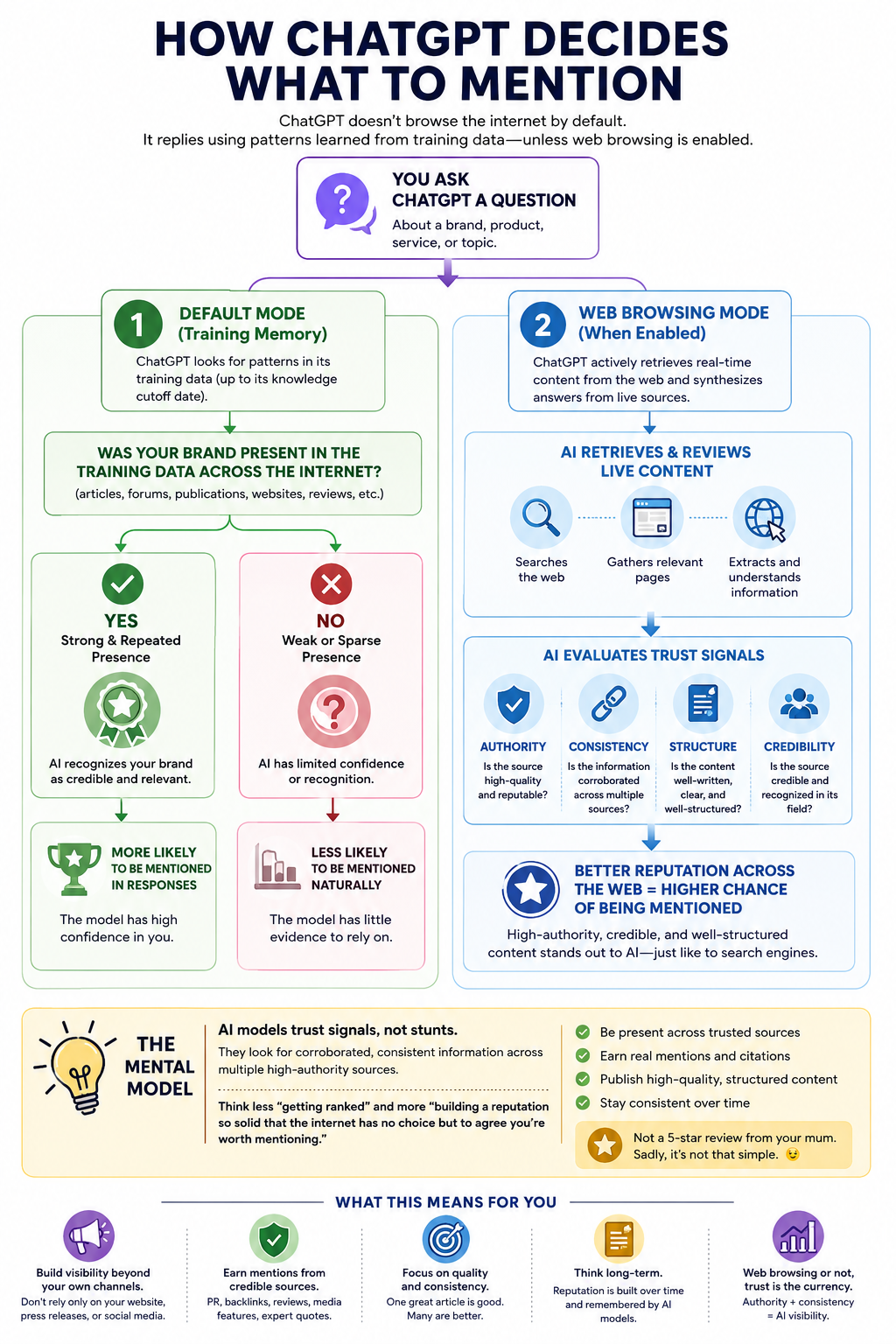
When you think about why ChatGPT is not mentioning your brand, think this way. ChatGPT recommended everyone in your industry except you. Before you take it personally, the AI isn't biased against you; it's just uninformed about you. Here are the most common reasons brands fall through the AI-visibility cracks:
As the best SEO agency in USA, The Scale Rankings experts recommend you start by auditing your current AI presence before anything else. Open ChatGPT, ask what your customers would ask, and see who shows up. That ten-minute exercise will tell you more than any dashboard.
Brands hear "optimize for AI" and immediately start publishing content that sounds like it was written by AI, to appear in AI search results. Which is ironic. And counterproductive. And, frankly, a little embarrassing. Understanding how to rank in ChatGPT starts with ChatGPT SEO optimization truth: the content that performs best is the kind that's genuinely useful to actual humans, complete answers, real expertise, clear structure, and zero filler. Turns out AI is pretty good at sniffing out the filler. Go figure.
People ask ChatGPT the way they'd ask a knowledgeable friend: "What's the best project management tool for a 10-person remote team with a limited budget?" Not just "project management software." Your content needs to meet that conversational specificity. Think about the actual questions your audience types while you are trying to rank products in ChatGPT, not the broad keywords they used to Google five years ago, and build content around direct, satisfying answers.
A 2,000-word article that genuinely answers a question from multiple angles, uses real examples, and lands on a clear conclusion will outperform a 6,000-word piece that circles the same idea seventeen times. AI models recognize informational density, not word count. Don't repeat yourself. Don't add a paragraph just to hit a length target. Be thorough, then stop.
Use headings, subheadings, and short paragraphs. Not just because it looks nice (though it does), but because clear structure helps AI models correctly extract meaning from your content. If a model is trying to answer "what does Company X specialize in," a well-organized service page gives it exactly what it needs. A wall of text with buried key points gives it a metaphorical headache, and it moves on.
Pick the subjects your brand legitimately owns and go deep on all of them. A site with 30 well-researched, interconnected articles on a focused topic signals topical authority in a way AI models recognize and reward. Publishing one article on CRM software, one on cryptocurrency, and one on sourdough recipes does not, even if all three are well-written.
Experience, Expertise, Authoritativeness, Trustworthiness (EEAT), Google developed this framework, but it describes how AI models evaluate content quality. Author bios with real credentials, cited external sources, original data or research, and consistent editorial standards all contribute. If your content reads like it was produced by a credible human who actually knows what they're talking about, it earns more trust from both search engines and AI systems. Turns out authenticity scales.
Entity based SEO is about making sure AI and search engines clearly understand who you are, what you do, and why you matter. Keep your brand name, description, category, location, and key details consistent across your website, Google Business Profile, LinkedIn, directories, and press mentions. The clearer and more repeated your brand story is across trusted sources, the easier it becomes for AI tools to recognize, trust, and rank higher in ChatGPT.
Nobody puts "fixed robots.txt" in their LinkedIn wins, but they probably should. When ChatGPT browses the web or Perplexity actively crawls sources, they index pages just like search engines do. Slow load times, poor mobile performance, broken links, thin content all of it gets a model moving on. A proper SEO audit is table stakes for LLM SEO, not optional extra credit.
One specific thing that quietly trips up a lot of teams: some AI platforms use their own crawler bots with distinct user agent strings. If you've accidentally blocked them in your robots.txt, even with a well-meaning broad rule, your content never enters their consideration set. All that work, invisible. Don't let three lines of the config file quietly undo months of effort.
Most using AI and ChatGPT for SEO advice online is either recycled traditional SEO advice with new labels or wildly overcomplicated theories nobody can verify. In reality, to rank a brand better in ChatGPT requires doing a handful of practical things consistently well. The focus is less about gaming algorithms and more about becoming a trustworthy, repeatedly referenced source across the web. Using ChatGPT for SEO can greatly help you.
Here’s a breakdown of the AI SEO practices that are consistently producing real-world results for serious teams:
| AI SEO Best Practice | What It Actually Means | Why It Works for AI Search |
| Pair Content Depth with Citation Authority | Create genuinely comprehensive content, then earn mentions and backlinks from trusted external sources. | AI models trust information that appears both on your site and across reputable third-party platforms. External validation strengthens credibility. |
| Publish Original Data & Research | Release surveys, proprietary studies, benchmark reports, or unique industry statistics. | AI systems frequently cite original research directly in generated answers, especially when answering informational or comparison queries. |
| Maintain Consistent Publishing | Publish regularly with a clear topical focus instead of posting randomly or inconsistently. | Consistency signals topical authority and reliability over time, making your brand easier for AI systems to recognize and trust. |
| Stay Topically Focused | Build clusters of related content around subjects your brand genuinely owns. | AI models favor entities that demonstrate expertise depth rather than shallow coverage across unrelated topics. |
| Encourage Real Human Advocacy | Generate reviews, discussions, testimonials, community mentions, and organic recommendations. | AI increasingly factors in public sentiment and real-world reputation signals when generating recommendations. |
| Keep Messaging Consistent Across Platforms | Ensure your website, LinkedIn, directories, press mentions, and social profiles align clearly. | Consistent entity information helps AI models confidently identify and understand your brand. |
| Optimize for Citation-Worthy Content | Use clear structure, statistics, concise explanations, and quotable insights. | Well-structured content is easier for AI systems to extract, summarize, and cite accurately. |
| Refresh High-Value Content Regularly | Update important pages with new insights, statistics, and examples over time. | Freshness improves trustworthiness and keeps AI systems from favoring more recently updated competitors. |
| Build Brand Recognition Beyond SEO | Invest in PR, podcasts, partnerships, webinars, and industry visibility. | AI visibility often correlates with broader web presence, not just rankings in traditional search engines. |
| Prioritize Expertise Over Volume | Publish fewer high-quality resources instead of mass-producing thin AI content. | AI models reward depth, clarity, and usefulness more than sheer publishing frequency alone. |
At the core of an AI SEO strategy, the winning formula is surprisingly simple: become a source worth citing. Brands that consistently publish credible information, earn trust across the web, and create content people genuinely reference are the ones most likely to appear in AI-generated answers. The tactics may evolve, but authority, clarity, and authentic reputation remain the signals that matter most.
In traditional SEO, backlinks are currency. But in the AI and ChatGPT SEO strategy, AI search citations play a similar role. It's your brand being mentioned in a source the model trusts or actively retrieves from. This includes long-form editorial content, expert roundups, credible review platforms, active Reddit threads, and industry reports. When these sources keep naming your brand in relevant contexts, the model builds an association and starts surfacing you when it matters.
Here's how to approach AI citation building without burning through your budget or your patience:
Our data-driven SEO agency recommends focusing on 5-10 truly authoritative publications in your niche rather than scattering your name across 200 low-quality directories. A few strong mentions beat a hundred forgettable ones, every time. And one honest warning: AI citation building is slow. Anyone promising AI visibility optimization in two weeks is confused, selling something, or both.
The Scale Rankings is your go-to partner for all things SEO. We focus on crafting personalized SEO strategies that deliver real results, from boosting your rankings to increasing organic traffic. With our expertise in on-page SEO, off-page SEO, and technical SEO, we ensure your brand stands out in the digital crowd.
The Scale Rankings ensures to make sure your audience finds exactly what they’re looking for. As one of the best search engine optimization (SEO) companies, we dig into the core of your business, crafting strategies that hit home across industries. Our services include:
 Let’s Chat
Need help with your next SEO project? Our experts are here to help. Reach out to us for a free consultation or more information.
 +1 877 33 SCALE
 [email protected]
 1870 The Exchange SE Ste 220 PMB 47489, Atlanta, GA 30339-2171




 Local SEO
 E-Commerce SEO
 International SEO
 SEO Consulting
 Conversion Rate Optimization
 Content Marketing
 Content Strategy
 Website Content
 Answer Engine Optimization
 Amazon SEO
 Generative Engine Optimization
 AI Citation Building
 Entity SEO