



August 13, 2026 By The Scale Rankings

On-page SEO is still the base of search visibility in 2026. Backlinks and technical setup lay the groundwork. But your on-page helps search engines and AI tools read, understand, and rank your content.
Google's Helpful Content system, AI Overviews, and AI models changed the game. Now they judge three things. What your page is about, how it is built, and whether it actually helps people.
Even expert content fails if search bots and AI cannot read its structure. This is the ultimate SEO checklist for 2026. Whether you call it an on page SEO checklist or a full SEO strategy checklist, the goal is the same. Rank on Google and in AI answers, one factor at a time.
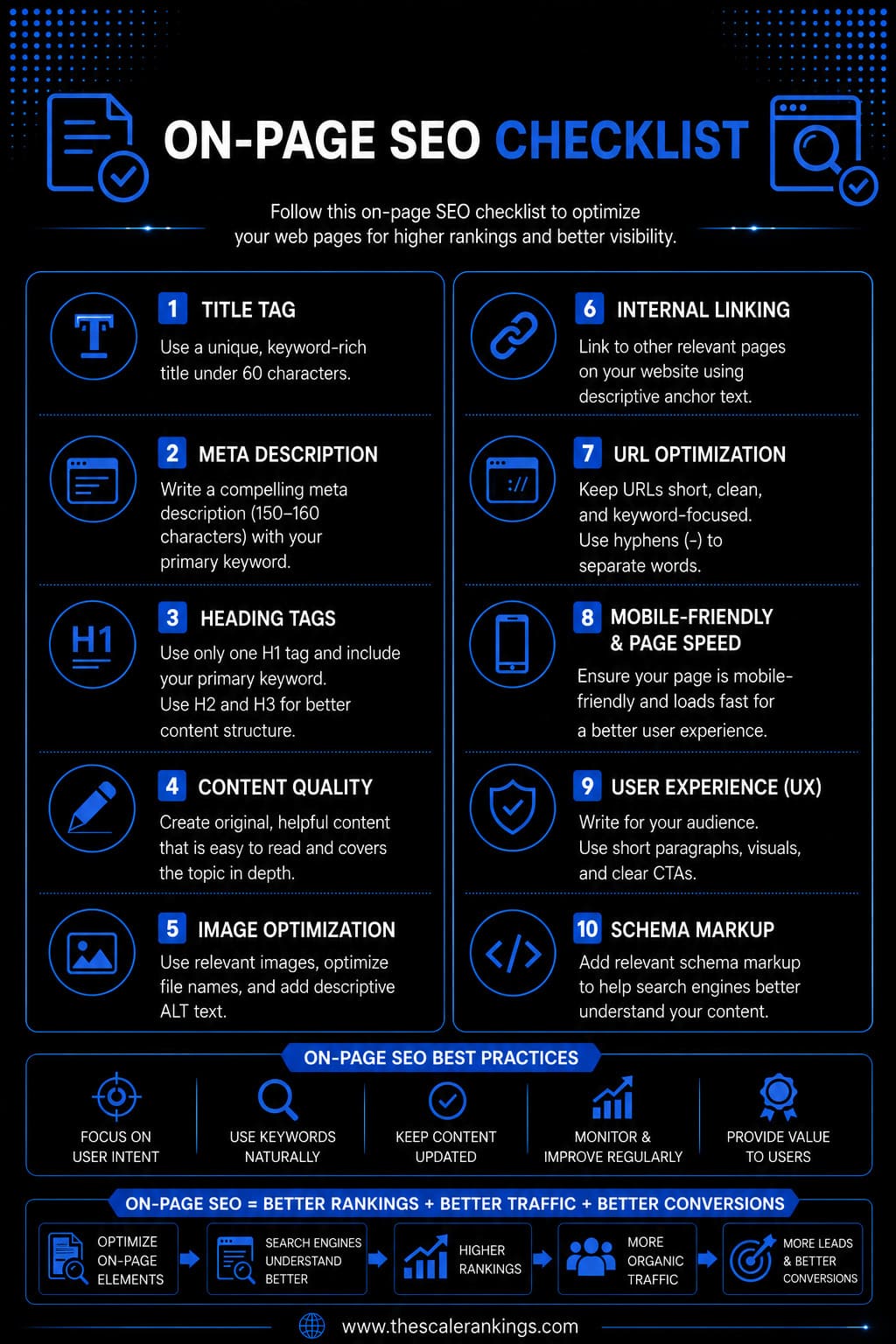
On-page SEO means improving the entire page visible to your viewer. It helps you rank higher and serves users better. This covers your content, your HTML tags, your images, your internal links, and your layout. In short, it is everything you control on the page itself.
SEO runs on three pillars that work as a team. Technical SEO gets you in the door. Off-page SEO builds your reputation. On-page is where most pages win or lose their rankings. On-page SEO answers the user's actual question. You need all three, but they each handle a different job.
| Type | Focus | Main Job |
| On-Page SEO | Content, tags, headers, links, UX | Match intent and cover the topic well |
| Off-Page SEO | Backlinks, mentions, PR | Build authority and trust |
| Technical SEO | Speed, crawling, indexing | Help bots reach and read your pages |
All these three form your full search strategy. On-page SEO is what sits on the page, like your content and tags. Off-page SEO is what happens behind the page, like backlinks and brand mentions. Technical SEO is how the page gets delivered, like speed and indexing.
Site-wide settings cannot fix page-level problems. Each page has its own topic and its own type of visitor. Optimizing one page at a time lets you match exact search terms. It also lets you guide each visitor toward the right action.
AI Overviews pull factual lines straight from well-built pages. Search engines now read your words as real-world topics. And Google's Helpful Content system rewards real depth over recycled summaries.
Two more things decide your rankings. Your content must match the user's goal, whether they want to learn, compare, or buy. And your page must feel good to use, with low exits and clean design. Treat every page as its own asset, and you cover far more ground in search.
This on page optimization checklist sorts the 25 most important factors into six simple groups. Each group tackles one part of your page. Work through this on page SEO checklist in order, and you will not miss a key ranking signal. Let us start with keywords.
The title tag remains one of the strongest HTML ranking signals used by search engines to index context. Placing your primary keyword early in the title tag signals immediate relevance to search crawlers and improves click-through rates on SERPs.
A well-crafted title tag sets clear expectations for both users and search bots. Once your title tag is optimized, align your main header to reinforce page relevance.
Your H1 tag acts as the visible headline of your web page and must clearly introduce the core subject. Including your primary keyword in the H1 confirms page context for visitors and reinforces topic focus for search crawlers.
Ensure every page features exactly one H1 tag that matches the intent of your title tag while remaining visually distinct and readable for users.
Search engines and AI answer engines weigh the opening text of a document when determining initial relevance. Introducing your target keyword in the first 100 words establishes immediate context before readers or crawlers scroll further.
Integrating your main topic early reduces bounce rates by reassuring visitors they have landed on the right resource.
Modern search algorithms use Latent Semantic Indexing (LSI) and entity mapping to evaluate how thoroughly a topic is covered. Integrating secondary terms, synonyms, and related subtopics helps search engines understand the complete scope of your content.
Spreading secondary keywords naturally across subheadings and body paragraphs builds comprehensive topic authority without sounding repetitive.
Artificially forcing keywords into your text harms readability and triggers search engine spam filters. Semantic search engines evaluate contextual relationships and overall helpfulness rather than exact phrase frequency.
Write naturally for human readers first, using contextual variations that flow logically within your content structure.
High-performing content must balance depth, originality, and structural clarity to satisfy modern search evaluation systems. AI search features prioritize pages that deliver well-organized answers, authoritative research, and clean visual layouts. Apply these content optimization factors to ensure your writing satisfies both human intent and machine extraction.
Search intent defines the underlying goal of a user's query. Whether they want to learn, buy, compare, or navigate. Aligning your page format, tone, and depth with user expectations is essential for achieving high rankings.
Matching search intent ensures visitors find exactly what they expect, reducing quick exits and improving engagement metrics.
Search engines favor content that offers unique perspectives, proprietary data, or hands-on experience over synthesized search summaries. Adding original insights ensures your page stands out in Google's Helpful Content evaluations.
Injecting unique value into every piece of content builds long-term domain trust and earns natural editorial backlinks.
Topical authority is established when a page addresses a subject's core questions, subtopics, and edge cases thoroughly. Comprehensive content answers follow-up queries before the reader has to search elsewhere.
Building complete topical depth positions your content as a definitive source for both traditional search rankings and AI summaries.
Digital readers skim content rather than reading every word sequentially. Keeping sentences short, vocabulary accessible, and paragraphs brief ensures your message is easily digestible across all devices.
High readability keeps visitors on your page longer and improves comprehension for AI content scrapers.
A logical heading hierarchy creates a clear document outline for screen readers, users, and search crawlers. Nesting headings sequentially prevents structural confusion and improves accessibility.
Organizing your ideas into a nested heading structure allows search engines to digest and index individual sections accurately.
Incorporate structured FAQ sections addressing direct user queries. FAQs are prime real estate for featured snippets and conversational AI queries.
Targeting common questions with concise answers increases your opportunities to appear in conversational AI answer boxes and People Also Ask modules.
Images enhance visual appeal but can slow down page loading speeds if unoptimized. Proper file naming, modern formats, and descriptive alt text improve both site performance and image search visibility.
Optimizing visual assets balances fast page performance with accessible, image-indexed content.
Adding visual media such as charts, infographics, and embedded videos breaks up text and keeps users engaged. Varied media formats increase overall dwell time and appeal to different learning preferences.
Combining visual assets with text creates an engaging user experience. This encourages longer page visits.
Behind every high-ranking page lies clean, structured HTML code that communicates directly with search engine crawlers. Metadata provides essential context about your content before a user even clicks through from the search results page. Optimizing these technical tags ensures your pages display accurately and attract high-intent traffic.
Your title tag is the primary headline displayed in search engine results and social media shares. Crafting a descriptive title within strict character limits prevents awkward truncation in search snippets.
A well-optimized title tag drives higher click-through rates and establishes clear expectations for searchers.
Meta descriptions act as organic ad copy that entices searchers to click on your snippet over competing results. Including a clear value proposition and target keywords improves snippet relevance and user interest.
Writing persuasive meta descriptions boosts organic click-through rates even when rankings remain stable.
Short, clean, and keyword-focused URLs are easier to read, share, and parse for both humans and search engines. Avoiding random parameters or dynamic strings creates a clear site architecture.
A clean URL structure provides immediate context about your page position within your site's overall hierarchy.
Duplicate content can confuse search engines about which version of a page to index and rank. Self-referencing canonical tags explicitly tell crawlers which master URL should receive indexing priority and link equity.
Implementing canonical tags safeguards your site against unintentional duplicate content issues across variations of your URLs.
Internal linking forms the structural architecture that connects your individual pages into a cohesive website. Strategic links guide search crawlers through your content hierarchy while helping users discover related resources. Optimizing your internal network distributes authority and establishes domain-wide topic clusters.
Linking related content together creates topical hubs that signal depth and authority to search engines. Using descriptive anchor text helps crawlers understand the context of the destination page.
Building intentional internal link pathways distributes page authority and keeps readers exploring your content ecosystem.
Citing reputable external research, official documentation, and industry studies reinforces your content's accuracy. Outbound links demonstrate to search engines that your claims are supported by trusted references.
Linking to credible sources enhances user trust and demonstrates commitment to publishing well-researched information.
Broken links create dead ends for users and disrupt search crawlers navigating your site. Regularly auditing and fixing broken URLs maintains a seamless user experience and protects crawl efficiency.
Maintaining clean internal link paths protects user satisfaction and preserves search engine crawl efficiency.
Search engines measure real-world user engagement to validate whether a page satisfies visitor needs. Fast page performance, mobile adaptability, and scannable visual design directly influence ranking stability. Optimizing these UX factors ensures visitors enjoy a smooth, friction-free browsing experience.
Page loading speed directly impacts user retention and mobile search performance. Optimizing Google's Core Web Vitals metrics ensures your page loads quickly and responds instantly to user interactions.
Passing Core Web Vitals benchmarks reduces user drop-off and fulfills essential technical ranking requirements.
With search engines prioritizing mobile-first indexing, your pages must render flawlessly on smartphone screens. Responsive layouts, accessible tap targets, and legible typography ensure mobile visitors enjoy a full-featured experience.
Providing a fluid mobile experience ensures your pages satisfy the majority of web traffic accessing your site from smartphones.
Online readers quickly scan pages to locate specific facts, statistics, or solutions before reading in depth. Using visual breaks, bold key phrases, and bulleted lists makes critical information instantly accessible.
Designing for scannability helps both skimmers and AI content engines extract essential takeaways effortlessly.
AI-driven search engines and answer overviews extract structured facts directly from web pages to generate instant responses. Adapting your content structure for machine readability ensures your insights are selected as authoritative sources for LLMs. These modern factors position your assets for top visibility in AI-first search environments.
AI Overviews extract short, definitive summaries from pages that answer questions directly. Formatting core takeaways as clear definitions, bulleted steps, or structured comparison tables maximizes extraction potential.
Structuring key information cleanly increases the likelihood of your content appearing in prominent AI-generated search modules.
Structured data (JSON-LD) translates your page content into a standardized code language that search engines parse instantly. Implementing relevant Schema types clarifies author info, article details, and page features.
Common Schemas: Article, FAQPage, BreadcrumbList, and Organization.
Adding rich Schema markup gives search engines explicit technical clarity regarding the purpose and structure of your page.
Nail these and AI engines can quote you directly. That means visibility in the answers people now read first. It is the fastest-growing source of search traffic. Next, let us figure out where to start.
You cannot fix everything at once, and you should not try. Some factors move rankings far more than others. This table ranks the checklist by impact, so you spend your time well. Start at the top and work down.
| Priority | Factor | Target / What to Check |
| High | Search intent | Content directly matches the user's query and intent |
| High | Title tag | Include the primary keyword naturally; aim for 50–60 characters |
| High | H1 heading | Use one clear H1 focused on the main topic |
| High | Content quality | Provide accurate, useful, and comprehensive topic coverage |
| High | Core Web Vitals | Optimize LCP, INP, and CLS for a fast, stable experience |
| Medium | Internal linking | Link to relevant pages with descriptive anchor text |
| Medium | URL | Keep it short, lowercase, descriptive, and hyphenated |
| Medium | Meta description | Clearly communicate the benefit; aim for 140–160 characters |
| Medium | Schema markup | Add valid JSON-LD such as Article or FAQ schema when relevant |
| Low | Images | Compress images, use WebP where suitable, and add useful alt text |
| Low | Outbound links | Link to credible sources when they support your claims |
This SEO Strategy Checklist needs consistency. beats guesswork every time. A repeatable process keeps quality high on every page you publish. It also stops your team from skipping steps. Use this five-stage pipeline from research to refresh.
1. Research → Study top-ranking pages and confirm search intent
2. Optimize → Apply titles, headings, images, and meta descriptions
3. Publish → Add schema and finish internal linking
4. Audit → Check indexing, speed, and markup
5. Refresh → Re-optimize every 3–6 months
Follow the same five steps every time, and quality stays steady. New posts and old refreshes both get the same care. That reliability is what compounds over months. Keep the quick checklist below within reach.
Run this check before every publish. It catches the small misses that quietly hurt rankings. Prefer a done-for-you review? Grab a Free on page SEO audit and let a specialist run it.
Sometimes the clearest way to learn is to see it. Below is the same page before and after optimization. Notice how nothing about the actual topic changes. Only the structure and tags do.
BEFORE Title: Home Page └── H1: Welcome to Our Marketing Blog - Wall of text, no subheadings, no bold - Missing alt text (image1.png) - Messy URL (/post?id=84920) - Result: poor visibility, low engagement | AFTER Title: On-Page SEO Checklist: 25 Factors to Optimize Every Page └── H1: On-Page SEO Checklist - H2s with short paragraphs and tables - Bullet points and bold takeaways - Alt text (on-page-SEO-checklist.png) - Clean URL (/on-page-SEO-checklist/) - Result: higher rankings, rich snippets, more conversions |
The content stayed the same, but the results flipped. Clean structure turned a hidden page into a findable one. That is the power of on-page work. Apply these same principles to every page template you run.
Not every page has the same goal. A homepage, a blog post, and a product page all serve different visitors. So the checklist bends to fit each one. Here is how to adapt it across your main page types.
Page Type → Primary Goal → Key Optimization
Your homepage is your brand's front door. So lead with a clear value line above the fold. So add simple navigation and one obvious call to action, like a Free on page SEO audit. Service pages target buyers, so optimize them for transactional terms like search engine optimization services. A strong service page ranks for search engine optimization services and turns clicks into leads. Add social proof, and lay out your services in clean tables.
Master service pages group related offers into one hub that links out to each sub-service. Blog posts and guides inform and build authority. Use clear headings, target learning-focused keywords, and link toward your service pages. Product pages need extra care to avoid duplicate content. Add product schema, write unique descriptions, compress images, and set clean canonical tags.
Match the checklist to each page's real job, and every page pulls its weight. A homepage builds trust. A blog post earns traffic. A product page drives the sale.
Search is driven by AI and smarter meaning-matching. Three shifts stated below matter most this year. Build them into your routine, and you stay visible everywhere.
Fold these habits into your AI SEO strategy from day one. A modern ai SEO strategy pairs fresh SEO techniques with the checklist above. Your best SEO techniques keep working even as algorithms change.
Even great content can fail on small, preventable errors. They drag down rankings and frustrate readers. The good news is that they are all easy to fix. Watch for these six in particular.
And multiple H1 tags blur your page structure, which confuses your main signal. Fix these six, and you protect both your rankings and your visitors. Now let us gear up with the right tools.
Google Search Console is your starting point, tracking impressions, indexed pages, and search queries. Google PageSpeed Insights measures your Core Web Vitals on both mobile and desktop. Screaming Frog crawls your whole site to find broken links and missing meta tags. For deeper work, Ahrefs or Semrush surface content gaps and track your rankings. Yoast or Rank Math manage titles, meta tags, and schema right inside WordPress.
Together, these tools turn a slow manual audit into a quick, repeatable check. They flag problems before those problems cost you traffic. Pick two or three and learn them well. Next, let us set a schedule for using them.
On-page SEO is an ongoing task. Content ages, competitors improve, and algorithms shift under your feet. A regular audit keeps your pages sharp and competitive. Follow this simple schedule to stay ahead.
| Frequency | Pages | Goal |
| Before publishing | All new pages | Check basic tech and meta setup |
| Monthly | Core landing and service pages | Track rankings, clicks, and conversions |
| Every 3-6 months | High-traffic blog posts | Update content, stats, and links |
| Twice a year | Evergreen pillar pages | Full content and structure refresh |
| After updates | Whole site | Re-check key pages after Google updates |
Stick to this cadence, and your content stays fresh year-round. You catch decay early, before it drags your rankings down. You also stay ready for the next algorithm update. Here is what a structured plan can achieve.
A structured on-page plan delivers real, measurable growth. This quick example comes from a custom automotive brand. It shows how the right fixes compounds over a year. The lesson applies to almost any site.
Gearstar builds custom performance transmissions, and their traffic has flatlined. The cause was internal competition. Their blog posts fought their product pages for the same keywords, and their category metadata repeated itself. Search engines could not tell which page to rank.
The team fixed it in three moves. They re-mapped blog and product pages so each targeted a distinct intent, ending the keyword overlap. They deepened key pages with builder specs, dyno-testing data, and richer descriptions. Then they rebuilt the heading order and metadata across their product hubs.
The results followed within twelve months. Organic traffic climbed by 53.07%, new users grew and lead conversions rose by 57.43%. They also took top-three rankings for competitive automotive terms. Small, systematic fixes compounded into major organic gains.
On-page SEO checklists can attract the right audience, build trust, and turn organic traffic into meaningful business growth.
At The Scale Rankings, our SEO specialists can help you put this checklist into action. From SEO audits and on-page optimization to technical SEO, content strategy, AEO, and GEO, we create a search strategy tailored to your business and goals.
Whether you want to strengthen your existing pages, expand your organic visibility, or build a stronger presence across Google and AI search, our team can help you take the next step. Get your Free SEO Audit and discover how to make your website work harder for your business.
The Scale Rankings is your go-to partner for all things SEO. We focus on crafting personalized SEO strategies that deliver real results, from boosting your rankings to increasing organic traffic. With our expertise in on-page SEO, off-page SEO, and technical SEO, we ensure your brand stands out in the digital crowd.
The Scale Rankings ensures to make sure your audience finds exactly what they’re looking for. As one of the best search engine optimization (SEO) companies, we dig into the core of your business, crafting strategies that hit home across industries. Our services include:
 Let’s Chat
Need help with your next SEO project? Our experts are here to help. Reach out to us for a free consultation or more information.
 +1 877 33 SCALE
 [email protected]
 1870 The Exchange SE Ste 220 PMB 47489, Atlanta, GA 30339-2171




 Local SEO
 E-Commerce SEO
 International SEO
 SEO Consulting
 Conversion Rate Optimization
 Content Marketing
 Content Strategy
 Website Content
 Answer Engine Optimization
 Amazon SEO
 Generative Engine Optimization
 AI Citation Building
 Entity SEO