



June 12, 2026 By The Scale Rankings

| A step-by-step SEO strategy helps SaaS companies build sustainable organic traffic, attract qualified leads, and reduce dependence on paid advertising. By targeting buyers across every stage of the funnel, optimizing for both traditional search and AI-driven discovery, and building topical authority. |
First…What Makes SEO for SaaS Different?
SaaS purchases are rarely impulsive. B2B SaaS sales cycles average 30-90 days for most segments. Multiple stakeholders are involved. The technical evaluators, budget owners, and end users often search independently, at different stages, using entirely different queries.
This is one reason SEO for B2B SaaS companies requires deeper content strategies and longer-term nurturing than many other digital channels. The discovery path goes this way:
Organic search → AI Overview → Review site → Competitor comparison → Demo request
Each touchpoint is an opportunity for a well-optimised SaaS company to show up. Here’s what SaaS SEO vs. E-Commerce vs. Local SEO looks like:
| Factor | SaaS SEO | E-Commerce SEO | Local SEO |
| Keyword intent | Problem → solution → vendor | Transactional | Geographic + transactional |
| Funnel depth | Deep - TOFU to BOFU | Shallow - often single-session | Shallow - near-me intent |
| Conversion path | Long - demo, trial, subscribe | Short - add to cart, buy | Short - call, visit, book |
| Content type | Education-heavy | Product-focused | Location-focused |
| KPIs | MQLs, pipeline, CAC | Revenue, ROAS, AOV | Calls, directions, visits |
SaaS SEO marketing requires content at every stage of the buyer journey. It goes like:
Each stage requires different content formats, different keyword strategies, and different calls to action. Skipping the top two stages means ceding the entire research phase to competitors.
TL;DR: SEO for SaaS Companies
|
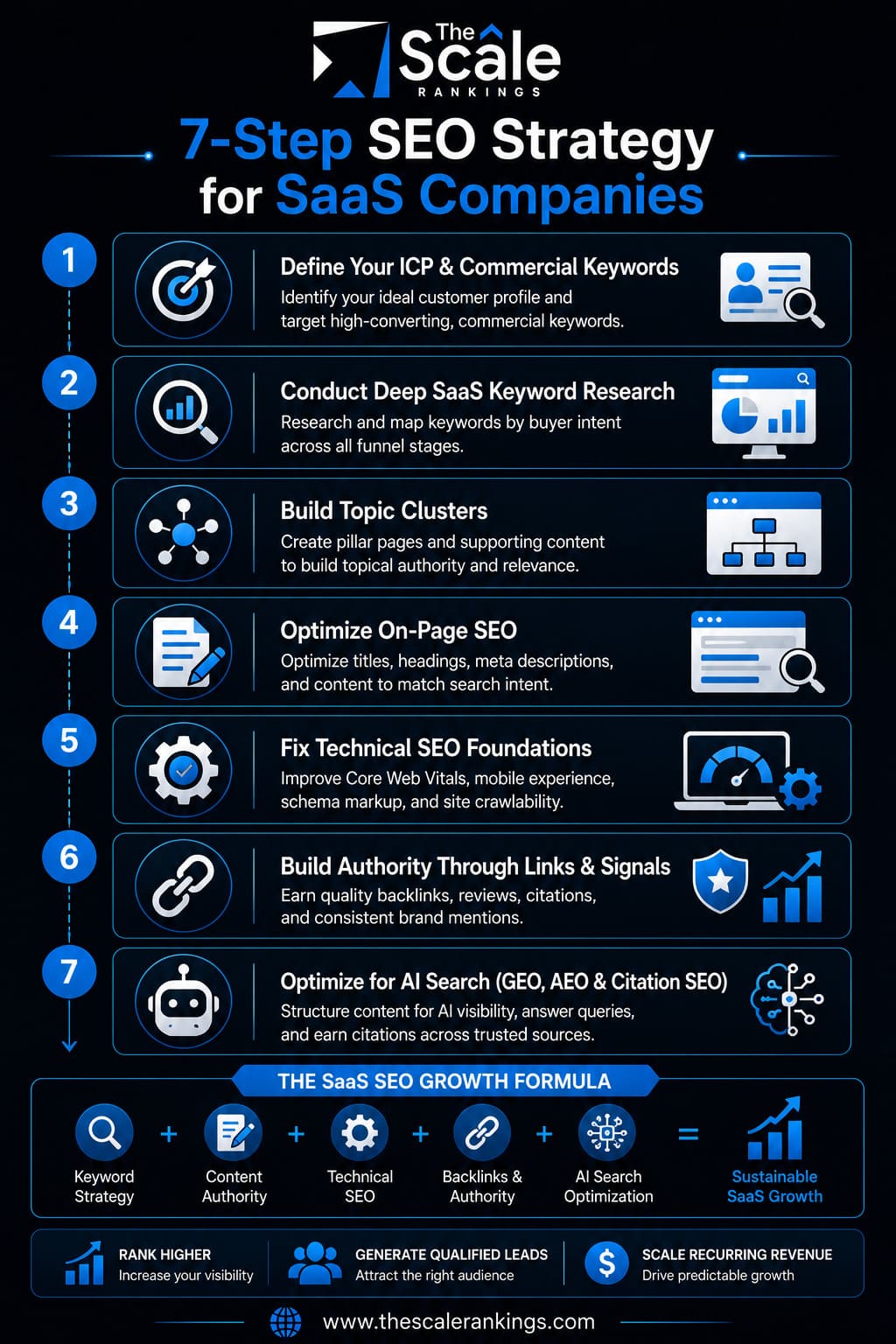
SEO for SaaS companies works when in process. Organic rankings do not pause when the budget runs out. Content built today keeps attracting qualified traffic next month, next quarter, and two years from now. The compounding economics of search engine optimization (SEO) are why the fastest-growing SaaS companies treat organic as a pipeline asset.
SEO strategy for SaaS starts with clarity on who you are trying to attract.
Self-serve SaaS, SMB-focused SaaS, and enterprise SaaS have meaningfully different buyer behaviors, keyword patterns, and content expectations. A product targeting enterprise IT teams requires a different language, depth, and funnel architecture than one targeting solo founders.
Define your ICP first. Then map your primary keyword categories: software category keywords ("CRM for small sales teams"), problem-aware keywords ("how to track sales pipeline"), and competitor keywords ("best alternative to [competitor]").
Use Ahrefs, Semrush, and Google Search Console to build a comprehensive keyword map. Organise keywords into four types that reflect the SaaS buyer's progression:
Map every keyword to a funnel stage before assigning it to a content type. Building a list of SEO keywords for SaaS based on buyer intent helps ensure content aligns with the right audience at the right stage.
The most effective SaaS SEO architecture is the topic cluster model.
One pillar page covers a broad subject comprehensively. "The Complete Guide to Sales Pipeline Management." Cluster pages go deep on specific subtopics. "How to Calculate Pipeline Velocity," "Sales Pipeline Stages Explained," "CRM Pipeline vs Spreadsheet." Every cluster page links back to the pillar. The pillar links to each cluster.
This structure builds topical authority with Google. It signals that your site does not just mention a topic. It comprehensively owns it. And it creates a natural path for buyers at different awareness stages to enter and move through your content.
On-page optimisation is the layer most SaaS companies get partially right and partially wrong.
Every key page needs the primary keyword in the title tag, H1 heading, and within the first 100 words of body copy. Meta descriptions should address a specific buyer pain point. Header hierarchy (H2 → H3) should mirror how a decision-maker would research the topic.
User intent alignment matters as much as keyword placement. If the top-ranking pages for your target keyword are all comparison articles, publishing a product features page will not rank. This is regardless of how well it is optimised technically.
Technical SEO issues suppress rankings silently. They rarely produce visible errors. They just prevent pages from performing at their potential. A strong technical SEO for SaaS framework ensures search engines can crawl, understand, and rank product pages, documentation hubs, and supporting content efficiently. The checklist goes like:
For SaaS companies with gated content, long demo request forms, and multi-step conversion paths, technical performance directly impacts conversion rates.
Domain authority in SaaS SEO is built through quality external signals.
Guest posts and editorial contributions in respected industry publications carry more weight than dozens of directory listings. Review platform citations like G2, Capterra, and Trustpilot serve as both authority signals and discovery channels. Original research and proprietary data studies earn links naturally because they create citable content that other publications reference.
Entity signals include consistent brand information across the web. They matter increasingly as Google and AI systems use cross-referenced data to verify a brand's authority and relevance. NAP consistency, accurate business profiles, and a coherent brand description everywhere your company appears all contribute.
AI-generated search surfaces have fundamentally changed how SaaS buyers discover products. Google's AI Overviews, ChatGPT Browse, and Perplexity now synthesise recommendations at the top of many search experiences. When a founder asks ChatGPT, "What is the best CRM for a 10-person sales team?" the brands cited in that response earn visibility before any organic result is seen.
An effective AI SEO strategy combines traditional rankings, AI visibility, entity authority, and citation acquisition into a unified organic growth model.
Generative Engine Optimization (GEO)
It’s the discipline of structuring SaaS content so AI systems cite it. This requires inverted-pyramid content formatting, direct-answer paragraphs, structured data, and original data that positions your brand as a primary source rather than a secondary reference.
Answer Engine Optimization (AEO)
It targets the conversational queries that surface in AI Overviews. Question-based searches like "what does [software category] software do" and "how does [product type] improve [outcome]." FAQ schema and structured direct-answer sections are the primary tools.
Citation-based SEO
For earning editorial brand mentions on authoritative SaaS publications, building entity consistency, and publishing original research. This increases the likelihood of AI platforms recommending your brand by name. A SaaS company that AI systems associate with a specific category earns discovery at the earliest stage of the buying journey.
AI Overviews caused significant CTR reductions on impacted queries in 2025 and 2026. For SaaS companies, this makes optimising for AI surfaces as important as optimising for traditional organic rankings.
GEO for SaaS
It means getting your brand recommended by name in ChatGPT, Perplexity, Gemini, and Google's AI Overviews. The foundation is factual, structured, citable content. All written clearly enough that an AI can extract a specific recommendation from it and attribute it to your brand.
AEO for SaaS
This targets the question-based queries that trigger AI-generated answers. Structured FAQ content, direct-answer paragraphs under question-based headings, and FAQPage schema markup all improve eligibility for AI citation.
Citation-based SEO
It builds the off-site authority layer that AI systems use to validate a brand's credibility. Publishing original research increases AI citation probability by 22 to 40% according to Princeton-cited research in the GEO literature. Earning editorial mentions on G2, TechCrunch, and respected SaaS industry publications builds the external signal profile that AI models cross-reference when deciding which brands to recommend.
Entity consistency the same brand name, description, and positioning across every web property. This removes ambiguity for AI systems. Ambiguity reduces citation confidence. Consistency builds it.
In-House SEO vs Agency vs Consultant? The right answer depends on stage and scale. Whether you work with an SEO consultant for SaaS, build an internal team, or hire an SEO agency for SaaS companies, success depends on matching expertise to your growth stage.
Early-stage SaaS
For many founders, SEO for startups begins with targeting niche opportunities where larger competitors are not yet investing heavily. A founder or small marketing team can execute foundational SEO with the right tools and guidance. Focus on long-tail, low-competition, high-intent keywords and build topical authority in a narrow niche before expanding.
Growth-stage SaaS
The volume and complexity of SEO work exceed what a non-specialist team can handle effectively alongside other responsibilities. An SEO agency for SaaS companies provides immediate multi-specialist capability without the cost of building a full in-house SEO team.
Enterprise SaaS
Large-scale platforms with thousands of pages, multiple product lines, and international markets need enterprise SEO for SaaS supported by a combination of in-house technical ownership and specialist agency expertise.
Not every SEO agency understands SaaS. These are the criteria that matter. The best B2B SEO partners understand long sales cycles, multiple decision-makers, and revenue-focused organic growth.
Proven B2B SaaS experience with verifiable case studies. A full-funnel approach that covers technical SEO, content, GEO, AEO, and AI citation building. Transparent reporting tied to pipeline metrics rather than vanity statistics. Affordable SEO services with clear ROI benchmarks that connect investment to business outcomes. The best rated SEO agency for SaaS will also demonstrate measurable pipeline impact rather than focusing solely on rankings.
The Scale Rankings is built for SaaS businesses that need organic search to contribute directly to the pipeline. As a team focused on SaaS growth, we apply the same principles used by leading SEO marketing for SaaS companies to help clients generate a qualified pipeline through organic search.
The service covers the full stack: technical SEO, content development, GEO, AEO, entity SEO, and AI citation building. Client results include maximum growth in organic traffic and significant increases in leads generated from search. Engagements are scoped to the SaaS company's growth stage rather than applied generically.
For SaaS companies evaluating SEO as a growth channel, The Scale Rankings offers a free strategy consultation to assess where you are and what the opportunity looks like.
The Scale Rankings is your go-to partner for all things SEO. We focus on crafting personalized SEO strategies that deliver real results, from boosting your rankings to increasing organic traffic. With our expertise in on-page SEO, off-page SEO, and technical SEO, we ensure your brand stands out in the digital crowd.
The Scale Rankings ensures to make sure your audience finds exactly what they’re looking for. As one of the best search engine optimization (SEO) companies, we dig into the core of your business, crafting strategies that hit home across industries. Our services include:
 Let’s Chat
Need help with your next SEO project? Our experts are here to help. Reach out to us for a free consultation or more information.
 +1 877 33 SCALE
 [email protected]
 1870 The Exchange SE Ste 220 PMB 47489, Atlanta, GA 30339-2171




 Local SEO
 E-Commerce SEO
 International SEO
 SEO Consulting
 Conversion Rate Optimization
 Content Marketing
 Content Strategy
 Website Content
 Answer Engine Optimization
 Amazon SEO
 Generative Engine Optimization
 AI Citation Building
 Entity SEO