



May 15, 2026 By The Scale Rankings

| How to get cited by AI tools depends on short, extractable answers, schema, entity signals, and original data. Keep pages crawlable, fast, and well-sourced to increase chances to get cited by ChatGPT, Perplexity, and Google AI Overviews. |
Users now ask chat-style engines and expect concise, sourced answers. Many queries end in a chat window, not a SERP. That shift changes where attention and clicks flow.
ChatGPT, Perplexity, Claude, Gemini, and Google AI Overviews now generate answers. These systems first retrieve candidate documents or facts from indexes. Then a language model synthesizes a conversational answer using those sources. Some tools add explicit citations or source lists beneath the generated answer. Other tools provide inline credits or short URLs. Update cadence and source rules vary across providers and products.
Follow these 15 proven steps to get your website cited by AI search tools or LLMs:
|
Google revealed that AI Overviews now reach 1.5+ billion monthly users globally. That means AI-generated answers are now one of the biggest visibility layers on the internet. If AI citations for a website's sources in these summaries, your brand gets exposed to an audience measured in billions.
Being cited on AI tools like ChatGPT, Perplexity, and Google AI Overviews puts your content as the answers people read. That single mention can turn a casual reader into a visitor. It’s like getting name-checked on the internet’s most talkative stage. Small citation, big attention.
AI citations are a compact credibility boost with measurable payoff. Treat them like mini endorsements inside answers people actually read. Optimize for extractable answers and reliable signals. Then watch citations turn into clicks and recognition.
Expert guide: How to appear in AI search results
To get cited on AI is now a tactical skill for content owners. You want your content inside AI answers, not lost in a long search results list. This guide explains how to get cited by AI tools with clear, practical tactics and witty asides. Below is a proven AI SEO strategy that can help you:
Build clustered content around core topics with a clear pillar page. Pillars should give concise answers and link to deeper subpages. Retrieval systems prefer sites with coherent topical structures. Write long-form guides that remain scannable and modular. Break guides into focused subheadings and short answer blocks. That layout helps AI systems extract relevant passages cleanly.
Use headings that mirror real questions users ask in chat. Phrase questions conversationally and answer them directly at the heading. This matches how users prompt AI tools and improves relevance. Include short, plain-language answers right after questions. Add alternative phrasings and synonyms. These variations help retrieval layers map different prompts to your content.
Optimizing for LLM citations is easy. Design pages with extractable 1-3 sentence answer blocks. Put a concise TL;DR at the top of each section. Then expand with steps, tables, and brief examples for context. Use clear H2s, H3s, lists, and tables to help parsers. Tables and labeled data are machine-friendly and often picked as factual sources. Keep paragraphs short and focused for easy extraction.
Define author, brand, and product entities on-site with persistent identifiers. Author pages, consistent bios, and structured profiles help build entity signals. Retrieval systems use those signals to weigh authority. Ensure NAP data is consistent for local entities. Use canonical author names across publications and external profiles. Strong entity hygiene helps AI tools attribute facts correctly.
Implement relevant Schema.org types for answers and products. FAQPage, HowTo, Article, Product, and Organization schemas are particularly useful. Schema helps AI overviews find structured answers fast. Mark up the author and date metadata too. Clear schema reduces ambiguity and improves mapping to overview slots. Keep markup accurate and avoid misleading annotations.
Run surveys, do experiments, and publish datasets that your niche values. Original data creates primary-source signals that other sites cite. AI tools prioritize primary evidence when available. Package research as short summaries, charts, and downloadable CSVs. Data that’s easy to parse and link increases the chance of being used directly in AI answers.
Learn the strategy: How to build AI citations
Show real expertise and direct experience on content pages. Use author bios with credentials, date stamps, and sourcing. Let readers and crawlers see who wrote what and why they qualify. Add trust signals like citations to primary sources and transparent methodology. AI retrieval layers reward content that shows accountable provenance and verifiable facts.
Earn mentions in reputable publications and industry blogs. External references and backlinks strengthen contextual authority signals. AI systems often favor sources frequently cited elsewhere. Use targeted PR, guest posts, and expert comments to spread mentions. The wider and more reputable the coverage, the higher your content’s selection odds become.
Format answers the way overview boxes prefer. Start with a concise answer line followed by short evidence. Use numbered steps and clear bullets where applicable. Add short summaries and quick stats near the top of pages. Those elements map directly to the snippet-style outputs that get cited in the AI overview display.
Craft isolated facts, definitions, and short statistics in standalone paragraphs. Label those blocks clearly so parsers can extract them without extra context. Keep them factual and well-sourced. Place these blocks near the top of relevant sections. AI tools often favor nearby context when selecting sources for a specific claim.
Ensure pages are crawlable with server-rendered HTML where possible. Avoid hiding crucial text behind heavy JavaScript. Indexable HTML improves retrieval accuracy. Fix slow page speeds and broken links. Use XML sitemaps and proper canonical tags. Mechanical hygiene prevents content from being omitted by crawlers and retrieval layers.
Create rich author pages with bios, credentials, and work history. Link author profiles to external professional networks or publications. Clear author identity helps attribution. Publish consistent bylines and cross-link related pieces. That builds a track record that readers and AI systems can reference when weighing authority.
Map topic relationships rather than chasing exact keywords. Create content that covers synonyms, related concepts, and user intents. Semantic breadth helps retrieval systems match diverse prompts. Annotate entities and relationships within content. Use natural language that shows how topics connect. An AI answer engine SEO approach increases relevance across many query phrasings.
Target outreach to outlets that AI tools frequently use as sources. When those outlets cite you, the retrieval layer learns to favor your content too. Aim for reputable industry coverage. Focus on quality and relevance in outreach. One well-placed mention in an authoritative site beats many low-quality links.
Refresh cornerstone pages quarterly to keep facts current. Add new citations, fix outdated figures, and tighten explanations. Freshness reduces content decay and keeps retrieval signals strong. Monitor queries and adjust wording for new user prompts. Small edits can shift how often a page appears in AI source lists.
So that’s a quick strategy for you. Take one moment to ensure your page has a concise answer. Add short extractable blocks, schema, and author info. Confirm crawlability, speed, and up-to-date data.
Not every AI citation tool fits every team or budget. Profound suits enterprises that need deep visibility tracking, while Peec AI is ideal for beginners. Semrush works as a powerful all-in-one SEO and AI visibility solution, and Rankability is tailored for agencies. On a tighter budget, Otterly AI keeps monitoring affordable. Scrunch AI focuses on rich citation analytics, and Ahrefs combines backlink intelligence with AI monitoring. Pick the option that best matches your current needs and where you want your AI visibility to grow next.
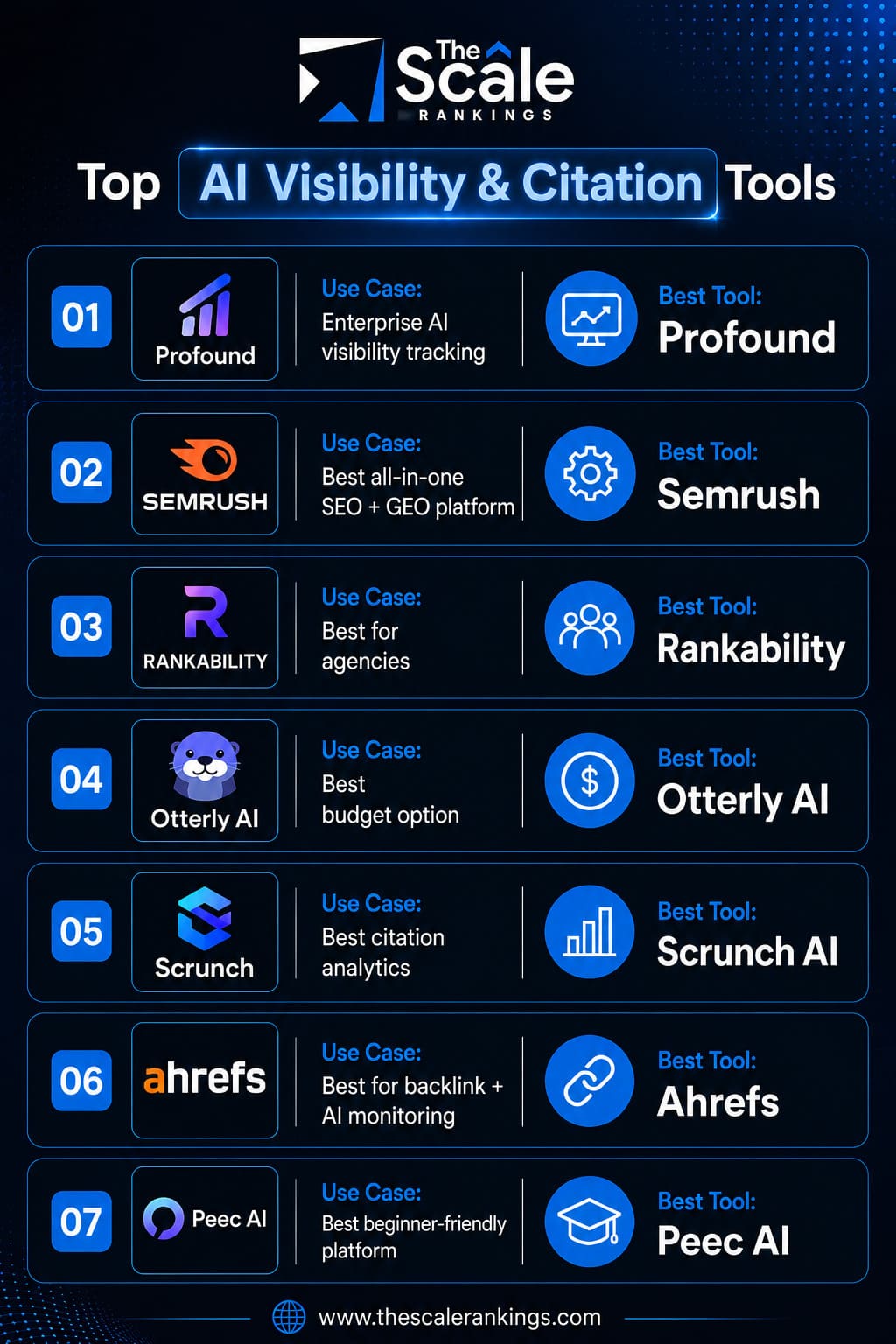
AI overviews and chat answers now shape discovery and decisions. Being cited by AI search engines is a distinct, measurable visibility outcome. Focus on extractable answers, entity clarity, and maintained content.
Leading AI citation optimization services, like that of The Scale Rankings, include GEO, LLM citation tactics, and AI visibility monitoring. They combine entity work, structured content, and technical hygiene to improve citation chances. This evolution reflects changing search behaviors and new attention surfaces.
Need help building an AI citation strategy? Work with our AI citation SEO agency specializing in GEO and LLM visibility. We can help you scale with ease.
The Scale Rankings is your go-to partner for all things SEO. We focus on crafting personalized SEO strategies that deliver real results, from boosting your rankings to increasing organic traffic. With our expertise in on-page SEO, off-page SEO, and technical SEO, we ensure your brand stands out in the digital crowd.
The Scale Rankings ensures to make sure your audience finds exactly what they’re looking for. As one of the best search engine optimization (SEO) companies, we dig into the core of your business, crafting strategies that hit home across industries. Our services include:
 Let’s Chat
Need help with your next SEO project? Our experts are here to help. Reach out to us for a free consultation or more information.
 +1 877 33 SCALE
 [email protected]
 1870 The Exchange SE Ste 220 PMB 47489, Atlanta, GA 30339-2171




 Local SEO
 E-Commerce SEO
 International SEO
 SEO Consulting
 Conversion Rate Optimization
 Content Marketing
 Content Strategy
 Website Content
 Answer Engine Optimization
 Amazon SEO
 Generative Engine Optimization
 AI Citation Building
 Entity SEO