



May 29, 2026 By The Scale Rankings

| Increase in organic traffic starts with targeting the right keywords, fixing technical SEO issues, and creating content built around topical authority and E-E-A-T. This guide covers 10 proven SEO strategies, including AI Overview optimization, internal linking, backlink building, and GEO tactics that help websites rank higher and drive long-term organic growth. |
Knowing how to increase organic traffic is one of the highest-value skills in digital marketing today. Organic traffic is the measure of how many real people find you through search.
Before diving into tactics, let us clear up a common confusion: organic traffic vs paid traffic. Organic traffic comes from unpaid search results, while paid traffic is generated through ads that businesses pay for to appear on search engines and other platforms.
Get this right, and your website becomes an asset that compounds over time. Get it wrong, and you are stuck spending money on ads just to stay visible. This guide covers 2026-ready strategies to drive organic traffic to your website.
If you're wondering why your website isn't ranking at all, start with our diagnostics guide first.
10 actionable ways to increase your website’s organic traffic: 1. Do SEO keyword research to target what your audience actually searches for 2. Optimize on-page elements: title tags, headers, keyword mapping, and URL structure on every page 3. Build a pillar-and-cluster content architecture to establish topical authority 4. Fix technical SEO issues blocking Google from crawling and indexing your site 5. Publish E-E-A-T-driven content consistently and refresh underperforming posts 6. Earn high-quality backlinks through digital PR and thought leadership 7. Optimize for AI Overviews, featured snippets, and zero-click searches using GEO 8. Build a deliberate internal linking structure to distribute page authority 9. Strengthen E-E-A-T and brand signals to build trust with Google and AI systems 10. Track organic search rankings monthly and iterate based on real data |
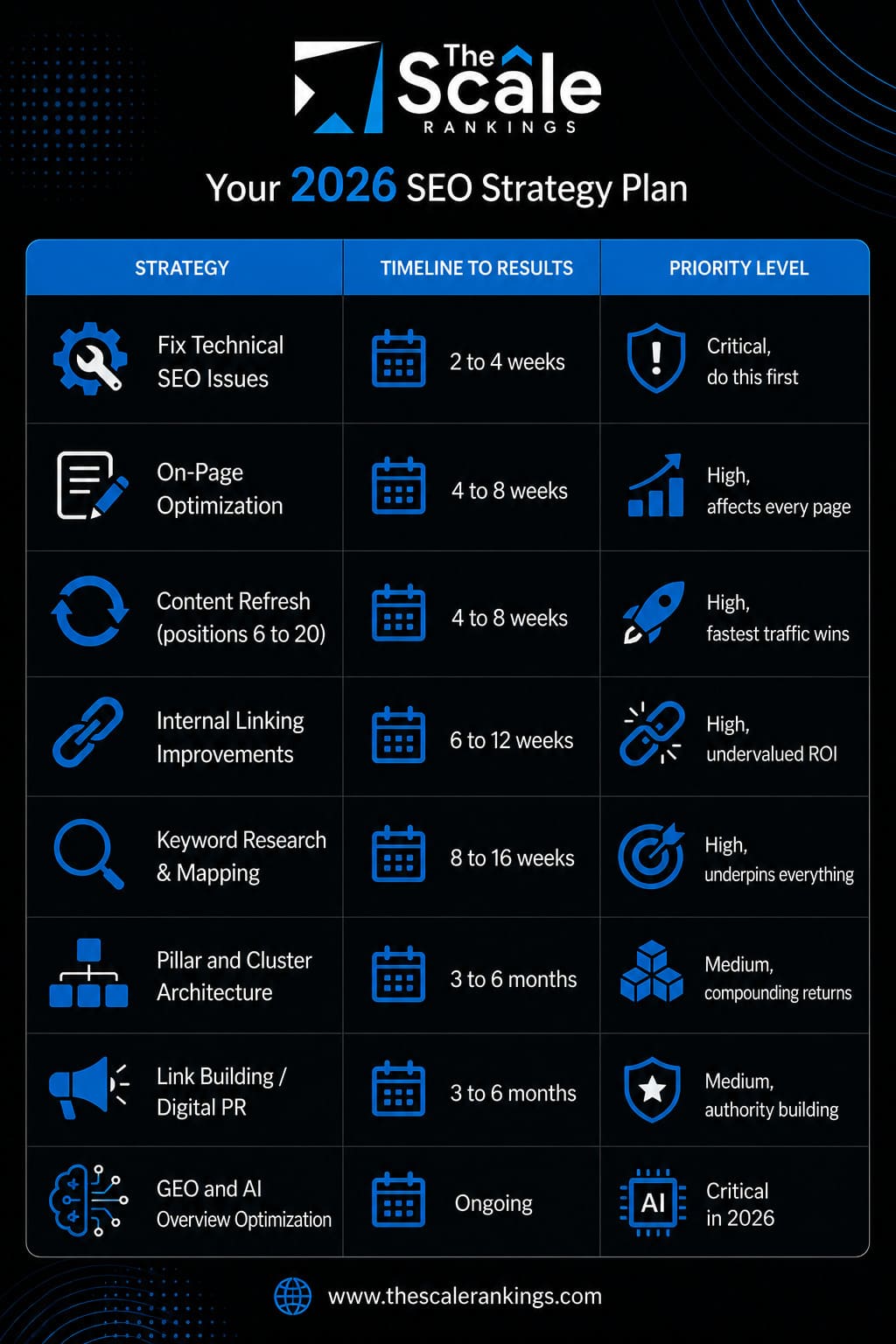
Knowing how to increase organic traffic is not the hard part. The hard part is doing the work consistently over months and years. These 10 strategies cover the full spectrum. From fixing technical SEO issues at the foundation, to mastering SEO keyword research, to optimizing for the AI-powered search that defines the latest SEO trends in 2026.
Most sites do not fail because of bad writing. They fail because they target keywords nobody searches for, or keywords too competitive to crack. Effective SEO keyword research fixes that.
Every query falls into one of four intents: informational, navigational, commercial, or transactional. Rank for the wrong intent, and even great content will underperform. Use Ahrefs, Semrush, or Google Search Console to verify intent before targeting any keyword.
Long-tail keywords account for roughly 70% of all searches. They are more specific, less competitive, and convert better. Ranking number one for a precise long-tail query beats sitting on page three for a broad one every time.
Assign one target keyword per page and build your internal linking strategy around that map. Targeting multiple keywords on a single page causes keyword cannibalization, where your own pages compete against each other, and neither ranks well.
On-page optimization is table stakes for organic traffic SEO. Every element of a page, from the title tag to the header structure, should clearly communicate relevance to both search engines and readers.
Keep title tags under 60 characters with the primary keyword near the front. Your meta description (under 155 characters) should state the value clearly enough to earn the click. A top ranking with a dull title is wasted real estate.
One H1 per page with your primary keyword. H2s and H3s break content logically and include secondary keywords naturally. Short paragraphs, clear headers, and scannable structure consistently outperform dense walls of text, both with readers and with Google.
One of the top SEO tips in 2026 is to build topical authority instead of publishing random content. Random blog posts do not build authority. A coherent content structure does. Topical authority is one of the latest SEO trends shaping how Google evaluates sites, and pillar-and-cluster architecture is the most effective way to build it.
One pillar page covers a broad topic comprehensively. Multiple cluster posts go deep on specific subtopics. They all link back to the pillar. This structure signals to Google that you own a topic, and website organic traffic follows authority.
Strong pillar pages are comprehensive (typically 3,000+ words), answer every major reader question, and funnel visitors into cluster content and service CTAs. Think of them as the hub your entire content strategy revolves around.
Technical SEO issues are invisible to the casual observer but very visible to Google. They are also among the most fixable problems in any SEO strategy, and fixing them often produces the fastest ranking gains.
LCP (load speed), INP (interactivity), and CLS (layout stability) directly affect organic search rankings. A page that scores poorly on Core Web Vitals loses rankings even if its content is excellent. Run PageSpeed Insights and fix what Google flags.
Check robots.txt for unintentional blocks. Submit an accurate XML sitemap in Search Console. Verify canonical tags are correctly implemented. And treat mobile optimization as the baseline, not an upgrade. Google uses the mobile version of your site to rank you.
Content is the engine of organic traffic. In 2026, Google's algorithm distinguishes clearly between content that genuinely helps people and content that exists purely to rank. E-E-A-T is the framework that determines which side your content falls on.
Write from first-hand experience. Cite credible sources. Use author bios that establish real credentials. Include original data or insights that cannot be found elsewhere. Google's Helpful Content system rewards genuine expertise and penalizes thin, generic content.
Refreshing old content regularly can help increase organic traffic on website pages faster than publishing new posts. Pages sitting in positions 6 to 20 in Search Console are your highest-leverage targets. A focused refresh, updating stats, improving depth, and tightening on-page optimization, can double or triple traffic faster than writing anything new. Run a quarterly refresh cycle.
Backlinks remain a top-three Google ranking signal. A link from a credible, relevant site tells Google your content is trustworthy. Quality matters far more than quantity: ten authoritative links outperform a thousand low-quality ones.
Guest posting on industry publications, broken link building, resource page outreach, and expert roundup participation all remain effective white-hat approaches. The common thread: create content worth linking to, then find the right people to show it to.
Surveys, proprietary data, and original case studies attract natural backlinks from journalists and industry analysts. These links come from high-authority domains without cold outreach. Pair original research with digital PR, and you have a repeatable authority-building system.
This is the section most SEO guides still miss. The search results page has fundamentally changed. AI Overviews, featured snippets, and zero-click searches now dominate the top of many results pages. Optimizing for them is no longer optional.
Ahrefs reported that AI Overviews reduce clicks by 58%. But brands cited within AI Overviews earn 35% more clicks than those absent from the results entirely. The opportunity is real, and the brands winning it are the ones that improve organic traffic with AI-specific optimization.
Generative Engine Optimization (GEO) is the practice of optimizing content to be cited by AI systems like Google's AI Overviews and Perplexity. Is SEO dead or evolving? It is evolving, and GEO is the proof. Clear structure, factual precision, and genuine authority are what AI crawlers favor.
Ask a question in a header, and answer it directly in the first sentence below. Use numbered steps for how-tos, tables for comparisons, and FAQ schema for Q&A content. Answer Engine Optimization (AEO) and featured snippet optimization share the same core principle: give the clearest, most direct answer possible.
Internal linking is one of the most underused SEO techniques in practice. Done well, it distributes authority from your strongest pages to your weaker ones and signals topical relevance to search engines at scale.
Start with your top ten pages in Search Console. Those pages hold the most authority. Link from them to the pages you want to boost, using descriptive anchor text that includes the target keyword of the destination page. Aim for three to five internal links per 1,000 words. Orphan pages with no internal links pointing to them are essentially invisible to Google.
In 2026, trust is a ranking factor. Both Google and AI systems weigh brand credibility when deciding which sources to surface. Weak brand presence is one of the core reasons sites are hit by Helpful Content Updates.
Every piece of content needs a real author with a bio demonstrating relevant expertise. Add schema markup for authors and articles. Gather and display genuine reviews. Get mentioned in credible industry publications. These signals, taken together, build the brand footprint that both Google and AI systems interpret as trustworthiness.
Every strategy in this guide produces data. That data tells you what is working, what is not, and where your next move is. Optimizing without measurement is how growth plateaus.
Track four numbers in Google Search Console and GA4: impressions, CTR, average position, and conversions. A drop in impressions signals a crawling or algorithm issue. A drop in CTR with stable impressions signals a title tag problem. Both are fixable once you know which one it is.
Filter your performance report by pages in positions 6 to 20. These are already indexed and relevant. Improve the title tag, add internal links from stronger pages, and refresh the content. Over 30 to 60 days, many of these pages will move into the top five, where CTR increases dramatically.
These 10 strategies are not theory. They are the same ways to increase your website traffic that the best SEO services company uses every day with real clients. But executing all ten consistently while running a business is genuinely hard. It takes the right SEO analysis tools, deep expertise across technical, content, and link-building disciplines, and constant iteration. We move step by step:
Organic Traffic Growth Flowchart Expert SEO Keyword Research ↓ On-Page Optimization + Technical SEO Fixes ↓ Pillar + Cluster Content Published ↓ Internal Linking + Backlink Outreach ↓ Track, Measure, Refresh ↺ Organic Search Rankings Compound Over Time |
Strong SEO systems create steady website traffic for business growth over time. At The Scale Rankings, we handle the entire organic traffic SEO lifecycle for you. From audit to architecture to content to authority building, we build the systems that drive compounding organic growth.
Organic traffic compounds. Every piece of content we optimize, every backlink we earn, and every technical issue we fix makes your next effort more effective. Our experts start by building your content architecture around topical authority, combined with other expert tactics. The results show you the next move.
The Scale Rankings is your go-to partner for all things SEO. We focus on crafting personalized SEO strategies that deliver real results, from boosting your rankings to increasing organic traffic. With our expertise in on-page SEO, off-page SEO, and technical SEO, we ensure your brand stands out in the digital crowd.
The Scale Rankings ensures to make sure your audience finds exactly what they’re looking for. As one of the best search engine optimization (SEO) companies, we dig into the core of your business, crafting strategies that hit home across industries. Our services include:
 Let’s Chat
Need help with your next SEO project? Our experts are here to help. Reach out to us for a free consultation or more information.
 +1 877 33 SCALE
 [email protected]
 1870 The Exchange SE Ste 220 PMB 47489, Atlanta, GA 30339-2171



 Local SEO
 E-Commerce SEO
 International SEO
 SEO Consulting
 Conversion Rate Optimization
 Content Marketing
 Content Strategy
 Website Content
 Answer Engine Optimization
 Amazon SEO
 Generative Engine Optimization
 AI Citation Building
 Entity SEO