



May 27, 2026 By The Scale Rankings

| Google ranks based on your crawlability, content matching search intent, and trusted external sources linking to you. A beautiful website structure with no backlinks, slow load times, or thin content will not rank. |
Are you the one asking why my website is not ranking? Google evaluates every page across these 3 factors only:
A page has to clear a minimum threshold in all three. Most sites fail on just 1-2 specific signals. This is exactly what the 10 reasons map to.
But…there is now a fourth dimension. Even if you rank on Google's traditional results, you may be completely absent from Google AI Overviews, ChatGPT, and Perplexity. It matters because a growing share of searchers are getting their answers without ever clicking a link.
This guide covers the 10 main reasons why your website is not ranking on Google.
The 13 reasons and quick answers for why your website is not ranking:
|
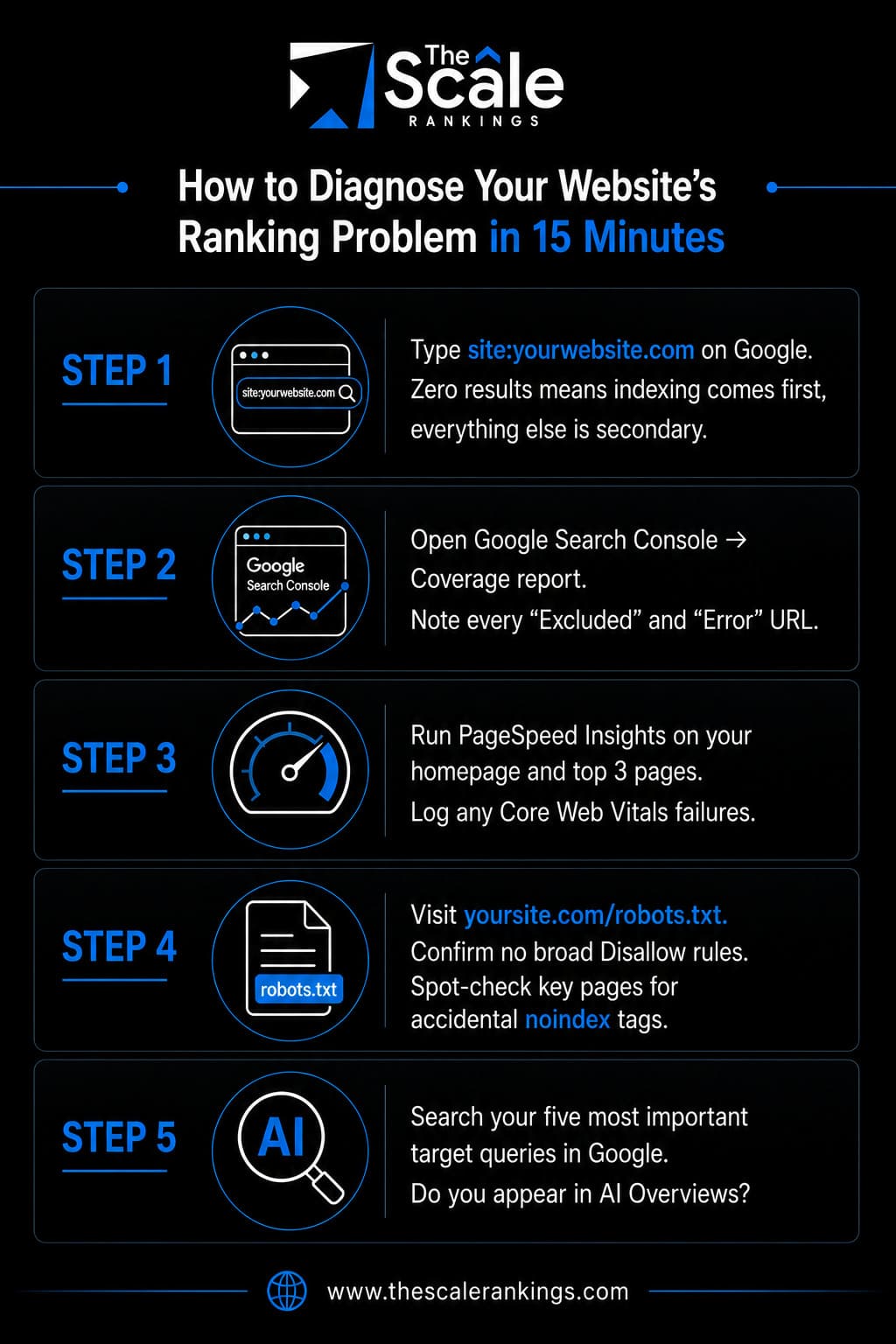
If your website is not ranking and it's frustrating you, the problem may not be your content at all. In many cases, Google either has not indexed your pages yet or your site is accidentally telling Google not to index them.
A missing page cannot appear in search results, no matter how good your on-page SEO is. This often happens because pages were never submitted properly, or a hidden noindex tag was left behind during development or by an SEO plugin.
Diagnose it: Search site:yourwebsite.com in Google. Very few or zero results usually point to an indexing issue. Then check Google Search Console → Coverage for warnings like “Excluded” or “Excluded by noindex tag.”
Fix it: Submit your XML sitemap in Google Search Console, request indexing for important pages, and remove any accidental noindex tags or X-Robots-Tag headers. Once Google can crawl and index your pages correctly, your Search engine optimization (SEO) efforts can actually start gaining visibility.
A single overly broad rule in your robots.txt file can block Google from crawling your entire site. In 2026, this problem extends further. Cloudflare's default Bot Fight Mode quietly blocks GPTBot, PerplexityBot, and ClaudeBot on millions of sites, making you invisible in AI search before you even know AI search is a category worth caring about.
Diagnose it: Visit yoursite.com/robots.txt. Look for Disallow: / or rules targeting major crawlers. In Cloudflare, check Security → Bots.
Fix it: Remove blocking rules. Whitelist legitimate search and AI crawlers explicitly. This is a five-minute fix with serious consequences if ignored.
Targeting "SEO agency" or "accountant" as a brand-new domain is competing against sites that have been building authority for a decade. Your site at DR 12 does not rank against DR 80+ domains, no matter how good your content is. This is not a content problem. It is a keyword targeting problem.
Diagnose it: Check your target keywords in Ahrefs or SEMrush. If every top-ranking page has a domain rating above 60 and your site is under 20, you need a different entry point.
Fix it: Build initial traction through long-tail keywords. 3-5 word phrases with lower competition where you can actually win. Local SEO is another faster-traction path for businesses with a geographic focus. Win the smaller terms first, then use that authority to climb toward broader ones.
Industry experts recommend treating long-tail keyword wins as stepping stones, not consolation prizes. They build the authority that makes competitive terms achievable later.
Google's Helpful Content System is now baked directly into its core algorithm. It evaluates every page for genuine informational value. Thin pages with under 600 words and no original insight fail this evaluation. So do articles with 2019 statistics published under a 2026 date. So does content that technically covers a topic, but in the wrong format for what searchers actually want. This is where on-page SEO and content quality intersect.
Diagnose it: Pages with high impressions but below 1% click-through rate in Google Search Console are being semi-surfaced but not trusted enough to push higher.
Fix it: Expand coverage. Add original examples, current data, and practical depth. Restructure to match the format of pages already ranking for your target keyword. If they're all listicles and yours is a long essay, that mismatch matters.
The first result on Google has an average of 3.8x more backlinks than positions two through ten. A site with zero external links has no third-party validation. Google has no evidence that anyone else on the internet considers your content worth referencing.
Diagnose it: Run your domain through Ahrefs or Moz. If you have fewer than ten unique referring domains and your site is more than six months old, backlinks are your primary gap.
Fix it: Guest posts on relevant niche publications, original research that earns organic citations, digital PR, and niche directory listings. These are the legitimate, ethical SEO practices that build lasting authority without putting your site at risk. Our experts recommend starting with linkable content like original data, tools, and comprehensive guides before expecting links to come in naturally.
Multiple pages targeting the same primary keyword compete against each other. Google can only show a limited number of results per domain per query. When your own pages fight for the same term, authority signals get split, and neither ranks as well as one consolidated page would.
Diagnose it: Search site:yourwebsite.com "your keyword" in Google. Three or more of your own pages appearing? That is cannibalization.
Fix it: Consolidate overlapping pages with 301 redirects or merge into the main source page for one definitive version. Use internal links to signal which page is authoritative for each topic. This is a classic on-page SEO issue that compounds quietly over time.
Google uses Core Web Vitals (LCP, INP, CLS) as direct ranking signals, measured from real Chrome user data. Pages at position one are measurably more likely to pass Core Web Vitals than those at position nine. When load time increases from one second to three seconds, bounce rate rises by 32%. That bounce data feeds back into rankings.
Diagnose it: Run your key pages through Google PageSpeed Insights. Open Google Search Console → Core Web Vitals report.
Fix it: Compress and convert images to WebP. Implement lazy loading. Move render-blocking JavaScript to a defer or async tag. Upgrade hosting if needed. A CDN helps significantly for global audiences. These are SEO techniques that most site owners defer for too long.
If your site suddenly started not ranking on Google, a Google update or penalty may be the reason. Google rolls out constant Core Updates, Helpful Content updates, and spam-related changes that can quietly reduce visibility for sites with trust, quality, or link issues.
Sometimes the impact is algorithmic. Other times, it is a direct manual action from Google for violations like manipulative backlinks, cloaking, or scraped content. Either way, your website ranking in Google search can drop dramatically overnight.
Diagnose it: Compare traffic drops in Google Analytics with known algorithm update dates from sources like Moz or Search Engine Land. Then check Google Search Console → Security and Manual Actions for any listed penalties.
Fix it: If it is a manual penalty, correct the violation and submit a reconsideration request. If it is algorithmic, improve the underlying quality issues and wait for Google to reassess your site in a future update. Following best SEO practices and adapting to the latest SEO trends is now essential for long-term recovery and stable rankings.
This is where almost every other "why is my website not ranking" guide stops short. In 2026, Google AI Overviews appeared on over 65% of search queries. Even if you rank number five in organic results, the AI Overview above the fold is citing your competitors and absorbing the clicks. Ranking on Google and being visible in Google AI search are now two separate problems requiring two separate strategies.
Diagnose it: Search your ten most important target queries in Google. Who appears in the AI Overview? Is your site among them? If competitors are getting cited and you are not, you have an AI visibility gap that traditional Search Engine Optimization (SEO) alone will not close.
Fix it: Generative Engine Optimization (GEO) restructuring content for AI extractability, building entity authority, and implementing schema markup that makes you eligible for AI citation. An effective SEO strategy in 2026 accounts for both channels.
Before you move to the next reason why my website is not ranking, you must know why ChatGPT is not mentioning your website.
Google AI Mode, Perplexity, ChatGPT, and other Generative AI tools do not cite sources based on ranking position alone. They favor content that leads with direct answers, uses clear heading hierarchies, and is formatted in a way that makes information easy to extract. Content that buries answers three paragraphs deep, uses vague marketing language, or lacks structured FAQ sections gets passed over, regardless of how well it ranks organically.
Diagnose it: Read your own pages as if you are an AI trying to pull a direct answer. Does each section open with a clear, quotable statement? Is there a FAQ section with schema markup? If not, you have an Answer Engine Optimization (AEO) gap.
Fix it: Restructure pages with answer-first writing, descriptive H-tag hierarchies, and FAQ schema. This is the semantic SEO dimension that directly affects AI citation eligibility. AI-generated content from your competitors that is better structured will get cited instead of yours.
Sometimes why your website is not ranking is a single misconfigured tag. Sometimes it is a strategy problem. Maybe wrong keyword targeting, thin content, and no authority signals. And increasingly in 2026, it is an AI visibility gap that an effective SEO strategy alone will not solve.
A technical SEO agency like The Scale Rankings works across all 3 layers:
If you find issues at any step that you cannot resolve alone, our growth-focused SEO services can help you. Get an expert eye on what the 15-minute check misses.
The Scale Rankings is your go-to partner for all things SEO. We focus on crafting personalized SEO strategies that deliver real results, from boosting your rankings to increasing organic traffic. With our expertise in on-page SEO, off-page SEO, and technical SEO, we ensure your brand stands out in the digital crowd.
The Scale Rankings ensures to make sure your audience finds exactly what they’re looking for. As one of the best search engine optimization (SEO) companies, we dig into the core of your business, crafting strategies that hit home across industries. Our services include:
 Let’s Chat
Need help with your next SEO project? Our experts are here to help. Reach out to us for a free consultation or more information.
 +1 877 33 SCALE
 [email protected]
 1870 The Exchange SE Ste 220 PMB 47489, Atlanta, GA 30339-2171



 Local SEO
 E-Commerce SEO
 International SEO
 SEO Consulting
 Conversion Rate Optimization
 Content Marketing
 Content Strategy
 Website Content
 Answer Engine Optimization
 Amazon SEO
 Generative Engine Optimization
 AI Citation Building
 Entity SEO