



May 28, 2026 By The Scale Rankings

| SEO trends in 2026 are shifting from clicks to visibility inside AI-generated answers. Zero-click searches, GEO, AEO, E-E-A-T, original research, and topical authority are now deciding how brands appear across Google, ChatGPT, and AI search platforms. |
Most of the Google searches today end without a single click. It’s because Google and AI tools like ChatGPT answered the question right there. These shifts are among the biggest AI search trends shaping how users discover brands online. And yet, most businesses are left wondering why organic traffic looks flat despite technically "doing everything right."
The SEO trends 2026 are surfacing and aren't predictions anymore. They're documented shifts already affecting traffic, leads, and brand visibility. This blog covers what the macro SEO trends 2026 have brought to the surface and highlights some of the latest SEO trends impacting search visibility today.
Here's your 10-second summary before we go deeper: 1. Zero-click search has crossed 58%, clicks are declining, and AI impressions are rising 2. GEO (Generative Engine Optimization) is now standard practice. 3. AEO (Answer Engine Optimization) bridges Google rankings and AI answer visibility 4. E-E-A-T is how AI systems decide who to cite, not just how Google ranks pages 5. Original research is the highest-citation content format in both traditional and AI search 6. Topical authority beats scattered keyword targeting, depth wins over breadth 7. Digital PR is now the unified currency of traditional SEO and AI citation building 8. Few marketers track AI visibility, which means there's a huge first-mover advantage right now |
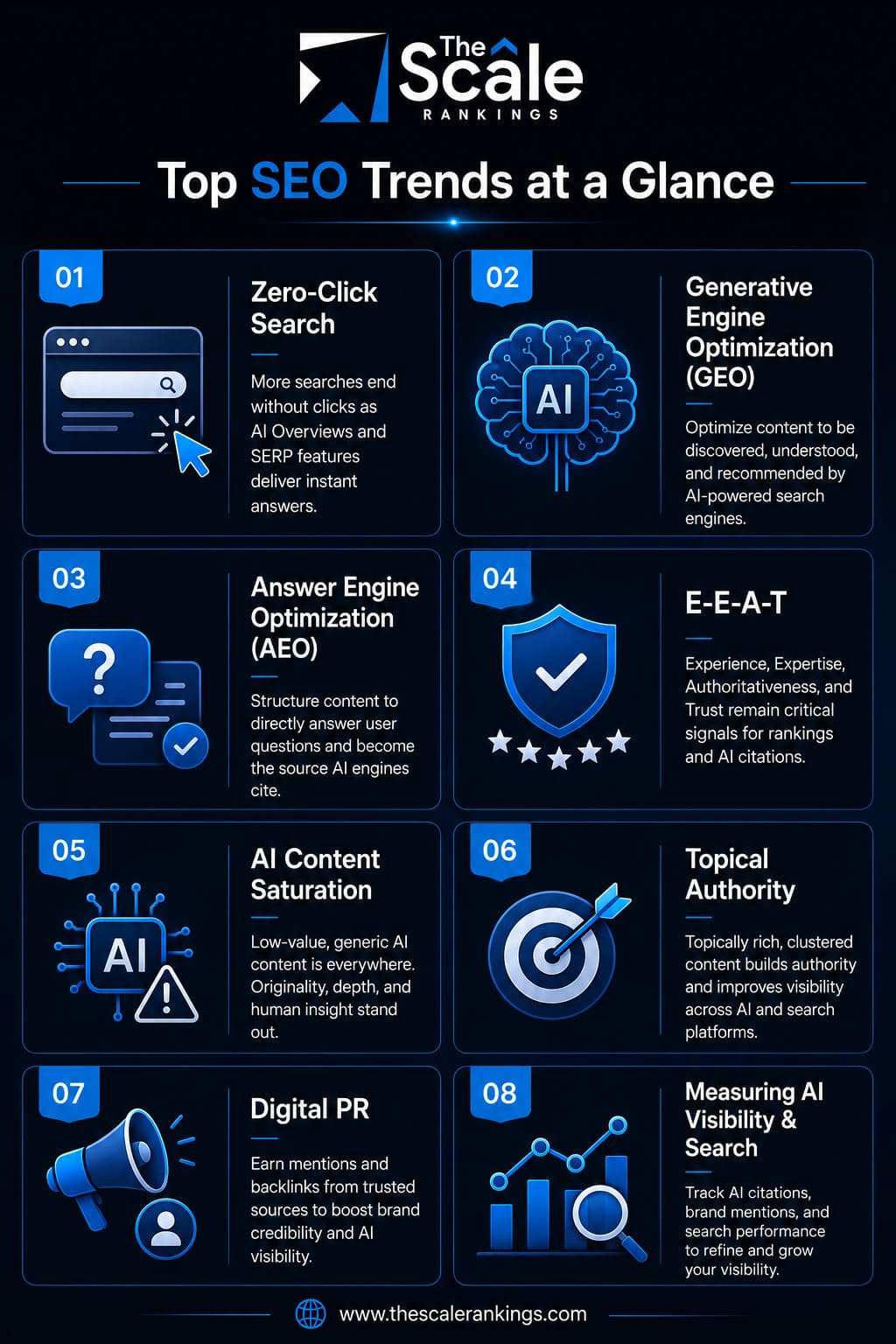
Still thinking if SEO is dying? No…the definition of "winning at search" is expanding. Ranking #1 still matters. But it's now one channel inside a multi-surface visibility system. Brands that get this are pulling ahead as search engine optimization trends continue evolving rapidly.
More than half of Google searches now end without anyone clicking through to a website. Ahrefs tracked 300,000 keywords and found a 34.5% CTR drop for #1 rankings when AI Overviews appear. When an AI Overview is present, most searches result in zero clicks. That's not a marginal shift. That's a structural change in how people consume search results, and one of the biggest Google SEO trends marketers are watching closely.
But…Why does it matter?
Brands that only optimized for click traffic are feeling real revenue impact. But here's the flip side! Brands appearing inside the AI answer are building brand authority, trust, and brand recall during high-intent queries. The zero-click era doesn't punish all brands equally. It specifically punishes brands that have only optimized for clicks.
What to do about it:
GEO means optimizing to appear in AI-generated answers across ChatGPT, Perplexity, Google AI Overviews, and Gemini. It has moved from "experimental tactic" to standard marketing practice and is central to SEO trends 2026. Every query that ChatGPT or Perplexity answers without citing your brand is a missed touchpoint. Unlike AI search vs traditional SEO, where you're trying to rank, GEO requires entirely different signals.
Entity footprint across the web, external AI citations from trusted sources, content structured for machine readability, and a schema that makes your pages easy to extract. A page optimized purely for keyword density is invisible to AI retrieval systems. Generative AI search engine optimization requires a different approach and deeper generative AI optimization efforts.
The core activities for AI search optimization in GEO include:
AEO means structuring content to appear in featured snippets, People Also Ask boxes, voice search results, and AI answer panels. It has become the primary SEO strategy for the zero-click era. It matters so much because when an AI Overview appears on a SERP, it triggers a maximum zero-click rate. But the brand cited inside that box? They're still getting read. AEO is how you get inside the box.
A Google featured snippet and preferential treatment from AI retrieval systems like RAG (Retrieval-Augmented Generation). One content investment, two visibility outcomes. That's the kind of efficiency SEOs love.
The AI answer engine optimization playbook is simpler than you'd think:
Google's E-E-A-T framework includes Experience, Expertise, Authoritativeness, and Trustworthiness. It was originally a quality guideline for human reviewers. In 2026, it's functioning as the trust signal that AI systems use to determine which sources get cited in generated answers. Named authors with verifiable credentials, external citations, original data, and consistent brand signals feed into E-E-A-T scores. And AI models have learned to preferentially retrieve from E-E-A-T-rich sources.
Why does it matter for Google SEO trends?
Content written by "Admin" with no bio, no credentials, and no external references is ranking lower on Google. It's getting skipped entirely by AI retrieval systems pulling answers for ChatGPT and Perplexity. E-E-A-T is table stakes for both traditional SEO and AI search optimization in 2026 and a core part of SEO optimization trends.
You can escape this using some tactics. Add verified author bios with credentials to every published piece. Cite external sources. Keep your brand's NAP (Name, Address, Phone) the same everywhere. Pursue thought leadership in authoritative publications. Strong LLM citations from trusted domains also improve AI retrieval confidence.
The flood of AI-generated content has created a predictable counter-reaction. Google's Helpful Content System has become more aggressive at identifying thin, templated, derivative pages. At the same time, AI retrieval systems prefer original data because these are non-duplicable signals of genuine expertise. You can't generate original research with a prompt. That's exactly why it's so valuable now and why AI SEO trends increasingly reward authentic expertise.
Original research is the single most citation-earning content format in both traditional and AI search. The AI content SEO risk is real: if your content strategy is mostly "summarize what others have said," you're competing in a race to the bottom where AI can always produce faster and cheaper. Content quality vs quantity SEO 2026 has a clear answer- one original data study outperforms fifty derivative articles. These SEO best practices in 2026 are becoming essential for sustainable growth.
If you've worked with 50 clients and seen a consistent pattern, write about it. If you ran a survey, publish the findings with your own analysis. That "We analyzed X and found Y" framing is exactly what Google and AI systems are looking for, and it's something only you can provide. This approach also supports stronger generative AI optimization performance over time.
Any site with 30 deeply interconnected articles on a focused topic demonstrably outranks sites with hundreds of shallow posts targeting more keywords. Google's understanding of topical depth has matured significantly. AI models show an even stronger preference for topical authority. They cite sources that demonstrate genuine depth within a defined domain, not generalists who touch everything lightly. Content clusters are no longer an advanced tactic. They're baseline and among the most effective SEO strategies for long-term authority.
If your content strategy is "write about whatever has search volume this week," you're building a collection of orphan pages that signal nothing to Google or AI systems. Pillar page strategy 2026 is about building a tight web of content that collectively says: we are the authoritative resource on this topic. That signal compounds over time in ways that isolated keyword targeting never does.
Audit your existing content. Group it into clusters with clear pillar pages at the center. Fill gaps, consolidate thin content, and link clusters explicitly. The structure you build now becomes an asset that keeps compounding. Those are the SEO best practices in 2026 that actually help and align with evolving search engine optimization trends.
One well-placed article in a high-authority publication does three things simultaneously in 2026.
One investment. Three authority outcomes. That's why digital PR has emerged as the highest-ROI off-page strategy of the year and one of the defining SEO trends updates.
Traditional link building for outreach, guest posts on niche blogs, and link exchanges. It still has value. But a single placement in Forbes, a major industry journal, or a respected research aggregator is worth more than dozens of mid-tier links, precisely because AI models consistently draw from those sources when generating answers. Digital PR is the convergence point between traditional search authority and AI citation building strategy. Many brands now partner with a generative AI search engine optimization agency to improve digital PR visibility across AI systems.
Target publications that AI models already draw from when answering queries in your niche. Track both backlink acquisition and whether that placement leads to subsequent AI citations. That's your real ROI measurement now. Tracking LLM citations is becoming just as important as monitoring backlinks.
The brands building AI visibility measurement frameworks right now are establishing baselines their competitors won't have for another year. Key AI visibility tracking tools metrics include: AI Overview appearance rate in Google Search Console, brand citation frequency in ChatGPT and Perplexity, and AI impression share vs. organic click share ratio. These metrics are increasingly tied to SEO trends 2026 and future reporting standards.
You can't optimize what you can't see. And right now, most brands are operating blind on AI search visibility. Search visibility metrics for 2026 are evolving fast. Early adopters who build measurement habits now will have comparative data that latecomers simply can't catch up on. Monitoring AI SEO trends and AI search trends consistently will become critical for competitive benchmarking.
How to measure AI search visibility today (without expensive tools):
The trends we've covered aren't a temporary disruption. They're the new structural reality of how information is discovered and consumed. Three developments worth watching as we head into late 2026 and 2027, as part of ongoing SEO trends 2026 updates:
AI assistants that don't just answer questions but complete full transactions (research → comparison → purchase) within a single AI interface. Brands with AI-readable product and service data will have a significant first-mover edge here. AI answer engine optimization will play a major role in these systems.
Text, image, video, and voice queries are increasingly being handled by unified AI search systems. Visual content optimization will move from optional to an essential SEO marketing trend. These developments are also influencing broader AI search trends and Google SEO trends.
AI surfaces will become a primary ad channel. Organic authority built now creates lower-cost visibility before paid competition intensifies. The brands showing up organically in AI answers today are preempting the bidding wars coming in 2027. The future of SEO with AI will heavily depend on visibility across both paid and organic AI ecosystems.
The programmatic SEO and local SEO automation trends are also accelerating. AI-assisted content scaling and automated local search optimization are becoming standard tools, not differentiators. More brands are using programmatic SEO frameworks to scale content efficiently while maintaining topical authority.
Need help adapting your strategy to the latest SEO trends for 2026? A trusted generative AI search engine optimization agency can help you build visibility across Google, ChatGPT, Perplexity, and other AI-driven search platforms. The Scale Rankings, one of America’s top SEO agencies, helps brands with AI search optimization, GEO, AEO, technical SEO, digital PR, content strategy, and AI visibility growth, designed for the future of search.
The Scale Rankings is your go-to partner for all things SEO. We focus on crafting personalized SEO strategies that deliver real results, from boosting your rankings to increasing organic traffic. With our expertise in on-page SEO, off-page SEO, and technical SEO, we ensure your brand stands out in the digital crowd.
The Scale Rankings ensures to make sure your audience finds exactly what they’re looking for. As one of the best search engine optimization (SEO) companies, we dig into the core of your business, crafting strategies that hit home across industries. Our services include:
 Let’s Chat
Need help with your next SEO project? Our experts are here to help. Reach out to us for a free consultation or more information.
 +1 877 33 SCALE
 [email protected]
 1870 The Exchange SE Ste 220 PMB 47489, Atlanta, GA 30339-2171




 Local SEO
 E-Commerce SEO
 International SEO
 SEO Consulting
 Conversion Rate Optimization
 Content Marketing
 Content Strategy
 Website Content
 Answer Engine Optimization
 Amazon SEO
 Generative Engine Optimization
 AI Citation Building
 Entity SEO