



May 8, 2026 By The Scale Rankings

You've invested in SEO. Your website ranks. Your content is solid. But when someone opens ChatGPT and asks for the best [your service] in [your industry], your brand is nowhere in the answer.
A competitor you've never heard of gets cited. An agency half your size gets recommended. And your brand? Invisible.
This isn't a fluke. It's a systematic problem, and it has nothing to do with how good your product or service actually is. ChatGPT, Perplexity, Gemini, and every other AI tool that's eating into Google's search traffic operate on a completely different set of signals than traditional search engines. If you haven't optimized for those signals, you won't show up. It's that simple.
Here's exactly why your brand isn't appearing in ChatGPT, and what you need to do about it.
Most business owners assume the problem is technical - a crawling issue, a sitemap problem, or something buried in their code. It rarely is.
The actual reason is this: large language models like ChatGPT don't crawl the web the way Google does. They were trained on a snapshot of the internet, and they generate responses based on patterns in that training data combined with real-time retrieval from sources they've been taught to trust.
For your brand to appear in a ChatGPT response, one of two things needs to be true:
If neither of those is true, ChatGPT simply doesn't know you exist - or doesn't know you well enough to recommend you confidently.
This is the single biggest reason most brands don't appear in ChatGPT answers. An "entity" in AI terms isn't just a name - it's a cluster of consistent, corroborating information about who you are, what you do, where you operate, and why you're credible.
Google's Knowledge Graph, Wikipedia, Crunchbase, LinkedIn, industry directories, press mentions, and review platforms are the places where AI models form their understanding of a brand. If your brand only lives on your own website, the model has nothing to work with.
The fix starts with entity building, making sure your brand is mentioned, described consistently, and linked to across multiple trusted third-party sources. This is what we call AI citation building, and it's not optional anymore.
ChatGPT and other AI tools favor content that's easy to extract and summarize. That means:
If your content is written as a flowing narrative without structure - or worse, if it buries the key points in long paragraphs, AI retrieval systems will skip it in favor of content that's easier to parse.
AI models learn to trust certain domains over time. When they generate a response about the best SEO agencies, they pull from sources they've been trained to consider authoritative: Forbes, Search Engine Journal, G2, Clutch, industry review sites, and established blogs with track records.
If none of those sources have ever mentioned your brand, if every mention of you lives only on your own domain, then you have no standing in the AI's reference system.
Getting mentioned on trusted external sources isn't just an SEO tactic anymore. It's the primary mechanism through which AI models build confidence in recommending a brand. One cited mention on Search Engine Journal is worth more for AI visibility than a hundred pages on your own site.
This is one that most people don't expect. Research into how LLMs determine brand credibility shows a strong correlation between branded search volume and AI citation frequency. In simple terms, if people aren't searching for your brand by name, AI models interpret that as a signal that you're not particularly well-known or trusted.
This creates a compounding problem. Low brand awareness leads to low branded search volume. Low branded search volume leads to low AI search citation frequency. And low AI citation frequency keeps you invisible to the exact buyers who are turning to AI tools for recommendations.
The solution isn't to fake searches. It's to build genuine brand recognition through PR, thought leadership, and community presence - the kind of activity that produces real branded searches over time.
Schema markup tells machines - including AI retrieval systems - exactly what your content is about. An Organization schema tells AI tools your brand name, what you do, where you're located, and how to contact you. An Article schema helps them understand the author, the topic, and the date. An FAQ schema makes your Q&A content directly retrievable.
Most websites don't have schema markup implemented properly, or at all. That's a missed opportunity that's growing more expensive every month as AI-driven search becomes the dominant discovery channel.
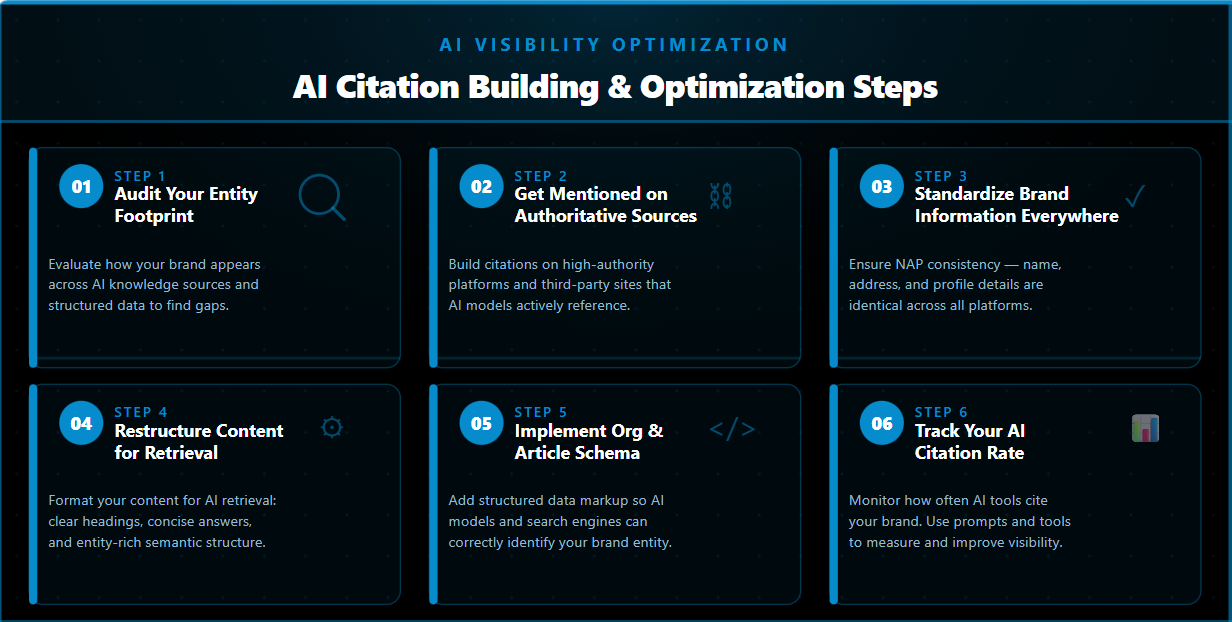
Let's be concrete. Here's what it takes to move from invisible to cited in AI-generated answers:
Open ChatGPT and type "Tell me about [your brand name]." If the model says it doesn't know your brand, or if the information it gives is vague, outdated, or wrong, you have an entity problem. That's your starting point.
Target publications and directories that AI models consistently cite in your space. For an SEO agency, that means Clutch, G2, Search Engine Journal, Forbes, Entrepreneur, and niche marketing blogs with real domain authority. One well-placed guest post or case study on the right site does more for AI visibility than six months of publishing on your own blog.
Your brand name, description, services, and contact information should be identical across your website, Google Business Profile, LinkedIn, Crunchbase, industry directories, and every other platform where you exist. Inconsistency confuses entity resolution, the process by which AI models decide whether two mentions are the same brand.
Go back through your key service pages and blog posts. Add a direct answer to the main question in the first paragraph. Break body copy into clearly labeled sections. Add FAQ blocks at the end of each post. This alone can significantly increase how often your content gets pulled into AI responses.
If you're running a Next.js or WordPress site, adding basic schema markup is a one-time implementation that pays off indefinitely. Start with the Organization schema on your homepage and the Article schema on every blog post.
You can't improve what you don't measure. Tools like Perplexity's Pro search, manual ChatGPT prompting, and emerging AI monitoring platforms let you track how often your brand appears for target prompts. Run a baseline audit now, and check it monthly after implementing the steps above.
Not appearing in ChatGPT results?
Read our complete guide on how to rank in ChatGPT and improve your AI visibility.
There's no honest answer that fits every brand, but here's what we've seen in practice: brands that implement entity building and content restructuring simultaneously typically start seeing citation improvement within 6 - 10 weeks. Brands that only publish more content without building external entity signals see little to no change, even after several months.
The timeline compresses significantly when you combine on-site content optimization with active outreach for external mentions. A guest post that goes live on a DA 60+ site in week one can influence AI retrieval within days - not months. The model's real-time retrieval system picks up new content from trusted sources quickly.
Don't wait for your traditional SEO efforts to pay off before addressing AI visibility. The two strategies need to run in parallel. The brands that figure this out first will be the ones recommended by AI tools for the next five years.
Traditional SEO is competitive but predictable. You know what you're optimizing for, you can measure it, and the feedback loop is well-understood.
AI-generated answers are different. When ChatGPT recommends a brand, that recommendation carries implicit trust - the user has delegated the decision to an AI they believe has done the research. That's a fundamentally different kind of endorsement than appearing in a list of ten blue links.
Studies on AI-driven traffic show that visitors arriving from AI referrals convert at three to five times the rate of visitors from organic search. They arrive further down the decision journey, already predisposed to trust the recommended brand.
That's why being invisible in ChatGPT today isn't just an SEO problem. It's a revenue problem that will compound as AI tools continue to absorb queries that once drove organic traffic.
The brands building AI citation authority right now will be the ones writing the rules. The brands waiting to see how it plays out will be playing catch-up.
The Scale Rankings specializes in AI citation optimization, generative engine optimization, and entity SEO for businesses that want to be found in AI-generated search results - not just Google. If your brand isn't showing up in ChatGPT, we can tell you exactly why and build a strategy to fix it.
The Scale Rankings is your go-to partner for all things SEO. We focus on crafting personalized SEO strategies that deliver real results, from boosting your rankings to increasing organic traffic. With our expertise in on-page SEO, off-page SEO, and technical SEO, we ensure your brand stands out in the digital crowd.
The Scale Rankings ensures to make sure your audience finds exactly what they’re looking for. As one of the best search engine optimization (SEO) companies, we dig into the core of your business, crafting strategies that hit home across industries. Our services include:
 Let’s Chat
Need help with your next SEO project? Our experts are here to help. Reach out to us for a free consultation or more information.
 +1 877 33 SCALE
 [email protected]
 1870 The Exchange SE Ste 220 PMB 47489, Atlanta, GA 30339-2171




 Local SEO
 E-Commerce SEO
 International SEO
 SEO Consulting
 Conversion Rate Optimization
 Content Marketing
 Content Strategy
 Website Content
 Answer Engine Optimization
 Amazon SEO
 Generative Engine Optimization
 AI Citation Building
 Entity SEO