



June 1, 2026 By The Scale Rankings

| Study the top 5 results for your target keyword. Notice the content type, the format, and the angle. That pattern tells you exactly what Google believes matches user intent for that query. If the top results are all listicles, write a listicle. If they are all in-depth guides, write a guide. Match the format before you worry about anything else. |
Most websites never make it to Google's first page. Why? Because the people running them publish articles, check rankings, and wait, wondering why nothing moves. Ranking on Google's first page is about knowing the right strategies. It’s about understanding what Google rewards and then building your strategies around that.
Before anything, you must understand Google's goal.
Google wants to send its users to the best possible result for every search. Every business wants to rank top on Google, but only websites that consistently deliver value earn those positions. That is it. Every algorithm update, ranking factor, quality guideline, or anything Google does serves that one goal. When your page genuinely answers what a user is searching for, Google has a reason to rank it.
Find out what helps websites earn stronger visibility in competitive search results:
|
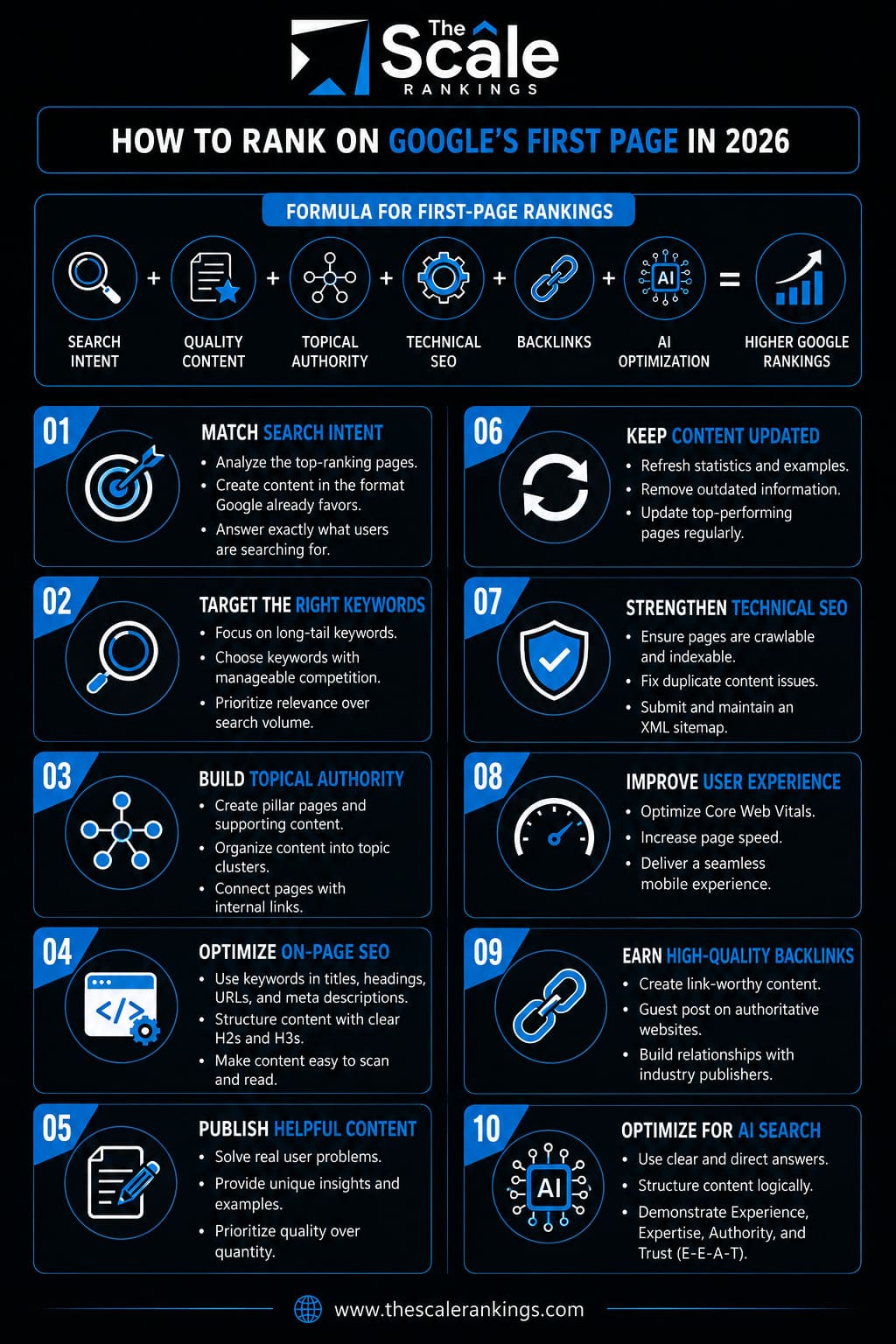
Learning how to rank on Google first page is about understanding what Google is actually trying to do. Google's job is to surface the most useful, trustworthy, and relevant results for every search. Your job is to be that result. To rank your website on Google first page, every SEO element must work together. So here are the most useful techniques you can use now:
Most people pick keywords based on search volume alone. That is a mistake! High-volume keywords are dominated by sites with years of authority. A new or mid-size website competing for a 50,000 monthly search keyword is like opening a local cafe across the street from Starbucks on day one.
Start with keywords that are really helpful. Look for keywords with:
Long-tail keywords (phrases with three or more words) are your entry point. They have lower competition. They attract more specific, motivated traffic. And they are far easier to rank for when your site is still building authority. Ranking for ten long-tail keywords can bring more qualified traffic and help get your website in top 10 results faster than fighting for one broad term.
One strong article is not enough. Google rewards websites that demonstrate deep knowledge of a subject. Group your keywords into topic clusters. One central "pillar" page covers the broad topic. Several "cluster" pages go deep on specific aspects. Internal links connect them all.
This structure tells Google your site is a genuine resource on the topic. Topical authority is one of the most consistent ways to improve Google ranking over time. For many businesses, this is the best SEO strategy to rank website pages consistently across an entire topic.
Getting on-page SEO right is non-negotiable. This is where most websites leave points on the table because they do it sloppily.
Your title tag has two jobs. First, it needs to tell Google what the page is about. Second, it needs to convince the user to click. Include your primary keyword naturally. But…keep it under 50-60 characters (580 pixels). Give users a reason to choose your result over the nine others on the page.
The second version signals relevance, freshness, and a clear benefit.
Meta descriptions do not directly affect rankings. But they affect click-through rates, which matter a lot. A higher click-through rate signals to Google that users prefer your result, which can improve ranking on Google over time. That can improve your position over time. Write a meta description that completes the promise your title makes. Keep it under 150-160 characters (920 pixels). Use active language. Mention the benefit clearly.
Most visitors do not read every word. They scan first. If your page looks like a wall of text, they leave. Use clear H2 and H3 headings to break up sections. Write short paragraphs (3-4 sentences maximum). Use bold text sparingly to highlight critical information. Your content structure should allow someone to understand the key points just by skimming the headings and the first sentence of each paragraph.
Include your primary keyword in:
Use secondary keywords and related phrases naturally throughout the body to rank higher on Google search for related queries. Do not force them. Write naturally first. Then read back and see where related terms fit without disrupting the flow.
Creating content that satisfies search intent remains one of the best ways to increase organic traffic over the long term. But…publishing content regularly is not the same as publishing content strategically. Many websites churn out articles on every topic imaginable and wonder why their organic traffic is going down. The problem is often content that competes with itself, or content that covers topics without enough depth to rank.
Google's Helpful Content system specifically targets content written to rank rather than to help. Ask yourself: Does this page actually help someone? Does it add anything that a user cannot get from the already ranking sites? If your answer is no, do not publish it. Rewrite it until it does something different, takes a unique angle, goes deeper, uses real examples, or solves a problem the existing results miss.
Fresh content means publishing new articles and keeping existing pages updated. Google favors pages that stay up to date. Set a schedule to revisit your top-performing pages every six to twelve months. Update statistics, add new examples, remove outdated advice, and check that all links still work. This kind of content maintenance improves rankings faster than publishing brand-new articles.
Every time you publish a new page, link to it from existing relevant pages. And link from it to other relevant pages. Internal links do two things. They help Google discover and understand your content. They also pass authority from established pages to newer ones. Think of your website like a city. Internal links are the roads. A city with well-connected roads is easier to navigate than one with dead ends everywhere.
Technical SEO is the foundation. Everything else (content, links, keywords) sits on top of it. If the foundation is unstable, rankings are unpredictable.
A page that Google cannot crawl will never rank. Check your robots.txt file and ensure it is not accidentally blocking important pages. Use Google Search Console to request indexing for new pages. Check the Coverage report regularly for errors.
Duplicate content confuses Google. It does not know which version to rank. This dilutes authority and can suppress both versions. Use canonical tags to tell Google which version of a page is the primary one. Consolidate similar content into single, comprehensive pages rather than spreading thin information across multiple URLs.
A sitemap helps Google discover all your pages efficiently. Keep it clean, only include pages you want indexed. Submit it through Google Search Console. Update it whenever you publish or remove significant content.
Google uses hundreds of signals to determine search engine ranking. Some matters more than others. These are the ones that consistently make or break rankings.
Google officially uses Core Web Vitals as a website ranking factor. These measures how fast and stable your page feels to users.
The three metrics that matter most:
A slow, unstable page frustrates users. Frustrated users leave quickly. A high bounce rate tells Google your page is not serving users well.
Use Google's PageSpeed Insights tool to find exactly where your site is losing points and what to fix.
A backlink is a link from another website to yours. Google treats it as a vote of confidence.
Not all votes are equal. A backlink from a well-established, relevant website in your industry carries far more weight than ten links from random low-authority directories.
Focus on earning links through:
Avoid buying links or participating in link schemes. Google is very good at identifying unnatural link patterns. The penalty is not worth it.
Google uses the mobile version of your site to determine rankings. Not the desktop version. If your mobile experience is slow, hard to navigate, or missing content, your rankings will suffer (even for users searching on desktop). Test your site on multiple devices. Make sure buttons are easy to tap, fonts are readable without zooming, and nothing breaks on smaller screens.
Search engine optimization (SEO) in 2026 is not dramatically different from 2023 in its fundamentals. But several trends are shaping how the game is played.
Generative Engine Optimization (GEO) is the practice of optimizing content for AI-driven search results. AI systems favor content that is:
The good news is that what is good for humans is increasingly what is good for AI. Write clear, accurate, specific content. That works for both.
E-E-A-T: The Foundation of AI and Traditional Rankings
Experience, Expertise, Authoritativeness, and Trustworthiness (known as E-E-A-T) underpins how Google evaluates content quality. Demonstrate experience by sharing real observations. Show expertise by going beyond surface-level information. Build authoritativeness through consistent, high-quality content and reputable backlinks. Drive trust through your About page, author bios, and contact information.
Many businesses working to recover traffic choose to partner with specialists. An organic SEO services company like The Scale Rankings often provides structured audits that identify the exact issues holding a site back.
The Scale Rankings is your go-to partner for all things SEO. We focus on crafting personalized SEO strategies that deliver real results, from boosting your rankings to increasing organic traffic. With our expertise in on-page SEO, off-page SEO, and technical SEO, we ensure your brand stands out in the digital crowd.
The Scale Rankings ensures to make sure your audience finds exactly what they’re looking for. As one of the best search engine optimization (SEO) companies, we dig into the core of your business, crafting strategies that hit home across industries. Our services include:
 Let’s Chat
Need help with your next SEO project? Our experts are here to help. Reach out to us for a free consultation or more information.
 +1 877 33 SCALE
 [email protected]
 1870 The Exchange SE Ste 220 PMB 47489, Atlanta, GA 30339-2171



 Local SEO
 E-Commerce SEO
 International SEO
 SEO Consulting
 Conversion Rate Optimization
 Content Marketing
 Content Strategy
 Website Content
 Answer Engine Optimization
 Amazon SEO
 Generative Engine Optimization
 AI Citation Building
 Entity SEO