



June 15, 2026 By The Scale Rankings

| Tracking AI citations starts with monitoring how often AI platforms mention your brand, content, or website. It helps identify visibility gaps, improve AI search presence, and uncover opportunities for content optimization and digital PR. |
The biggest challenge faced today is that AI doesn't automatically tell you when it mentions your business. You have to actively check. The good news is that tracking AI citations doesn't require expensive tools or technical expertise. You can start with simple methods today and scale up as you learn what works.
This guide walks you through exactly how to monitor when AI recommends your brand, measure your performance against competitors, spot problems in how you're described, and what to fix next.
TL;DR: Best Ways of Tracking AI Citations
|
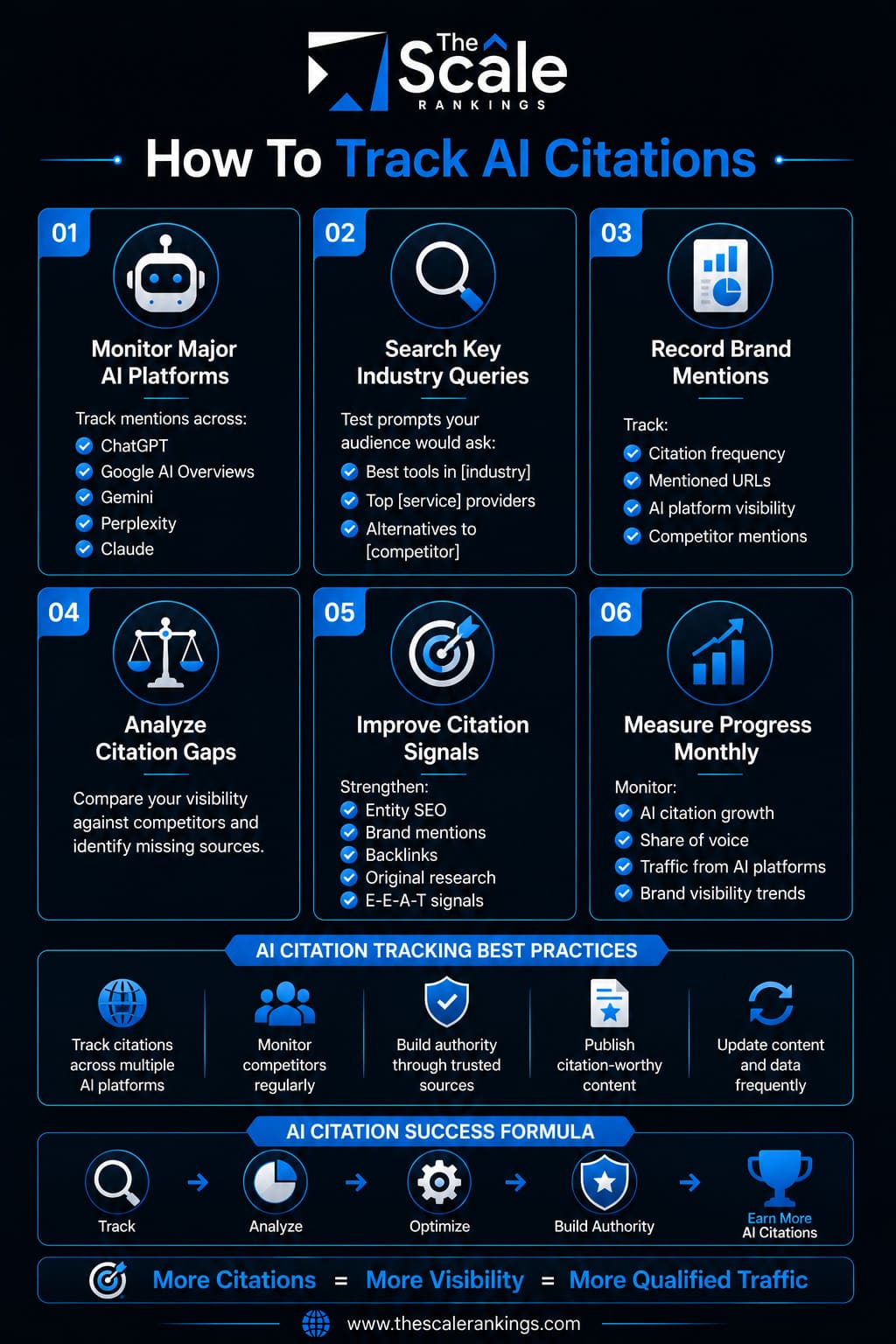
Before choosing tools or running prompts, establish a shared measurement vocabulary. These four metrics form the backbone of any AI citation tracking tool system. Every tool you use, every report you produce, and every strategy decision you make should connect back to at least one of them.
Formula: (Responses where your brand is cited ÷ Total responses tested) × 100
Citation rate is your primary performance indicator. It tells you what percentage of the time AI platforms recommend your brand when asked relevant queries.
Run the same prompt set monthly. Keep prompts frozen between cycles. This changes them between periods, destroying period-over-period comparability. Even a 0% baseline is a valid starting point. It gives you a measurable floor from which every improvement becomes quantifiable.
Formula: (Your brand mentions ÷ Total brand mentions across all competitors) × 100
Citation rate tells you how often you appear. SOV tells you how much of the conversation you own relative to the full competitive set.
A brand with a citation rate in a category where one competitor has major SOV is still losing ground. SOV is the metric that reveals whether your AI search visibility is growing or shrinking in a competitive context. It is more important than raw citation numbers, and the one most brands fail to track.
Not all citations are equal. An AI citing your brand inaccurately, in a negative context, or in a lower-priority position than competitors has different implications than a first-mention positive recommendation.
Categorise every citation as positive, neutral, or negative. Flag responses where your brand is described incorrectly. The wrong pricing, outdated features, and inaccurate positioning. Incorrect LLM citations compound across millions of responses if left unchecked. Identifying them early allows you to address the entity signals and source material the AI is drawing from.
When AI tools generate answers in your category, which external domains are they citing? These domains are your highest-priority link-building and PR targets. If an AI consistently cites G2, a specific industry publication, and two competitor blogs when answering category queries. And your brand is absent from all of them, you have a direct action list.
Getting mentioned on the exact sources AI systems pull from for your category directly improves your AI citation signals. Source domain coverage is the bridge between citation tracking and citation building.
Before spending on any paid tool, run this free method first. It takes 20 to 30 minutes and gives you an immediate picture of where your brand stands today.
Structure your prompts across four query types that mirror how real buyers search.
Build 25 to 50 prompts across these four types. Tie them to your highest-revenue pages. The queries that, if you ranked for them, would produce the most qualified traffic.
Open ChatGPT (GPT-4o with Browse enabled), Perplexity, and Google AI Overviews. Run each prompt and document the full response. Screenshot or copy the output.
For each response, record: whether your brand is mentioned, the exact context of the mention, whether your URL is cited as a source, which competitors appear instead of or alongside you, and the overall sentiment of the citation.
Keep this documentation. AI responses change over time. Having historical evidence of how your brand was described is valuable for diagnosing why citation frequency changed between reporting periods.
Create a spreadsheet with these columns for every prompt run:
Prompt | Platform | Brand Cited? (Y/N) | Citation URL | Competitors Cited | Sentiment | Date
This becomes your baseline measurement document. Every subsequent monthly run uses the same structure. Period-over-period comparison is only possible if the columns are consistent.
Use Google Search Console's regex filter ^(how|who|what|where|when|why|which|can|could|do|does|did|is|are|was|were)\b to surface question-format queries your site already ranks for. Prioritise those queries in your prompt set first. They are the searches most likely to trigger AI-generated responses.
Apply the citation rate formula from the metrics section: (Responses where your brand is cited ÷ Total responses tested) × 100.
Calculate it separately for each platform. Your ChatGPT citation rate, your Perplexity citation rate, and your Google AI Overview citation rate will differ. Each platform weights sources differently and requires different optimisation approaches.
This baseline is your starting point for everything that follows.
The manual method establishes a baseline. The tracking system scales and systematises it.
Start with 25 to 50 high-intent prompts tied to your revenue pages category queries, alternatives queries, and integration or use-case queries.
Create a separate "citation validation set" prompts where you expect your domain to appear if the AI response mentions your category. This validation set confirms whether your pages are being crawled and indexed as source material by each platform.
Freeze this prompt set. Do not add, remove, or rephrase prompts mid-program. Consistency is what makes the data usable.
Match your tool selection to your budget and operational context.
Create a custom channel group in GA4 to segment referral traffic from AI platforms separately from standard organic or referral traffic.
Add these referral domains to your AI channel group: chat.openai.com, perplexity.ai, gemini.google.com, bing.com/chat.
Since March 2026, Google Search Console has shown AI Mode traffic through a dedicated filter. Enable it. Monitor it weekly. This data shows you which pages are receiving traffic from Google's AI, which surfaces a direct signal about which pages are being cited in AI Overviews.
Run all prompts manually as described in the previous section. Configure your chosen tool simultaneously. Record citation rate, share of voice, and sentiment for each platform separately.
Screenshot key AI responses at baseline. When responses change in subsequent months, you will need historical documentation to diagnose whether the change was driven by your own content improvements, competitor actions, or platform-level algorithm shifts.
Tracking reveals gaps. Building the citations to close those gaps is a different discipline entirely.
Most marketing teams can set up a tracking spreadsheet and configure a tool. Very few have the in-house expertise to systematically improve citation rate across six or more AI platforms simultaneously through digital PR campaigns, entity SEO optimization, structured content at scale, and platform-specific citation strategies.
Tracking is the diagnostic. Building is the treatment. Most businesses need specialist help with the treatment.
The right agency for AI citation optimization covers the full cycle, not just one part of it. Look for a full-funnel approach:
Citation audit → Entity optimization → Content structuring → Digital PR → Ongoing tracking
Each stage feeds the next. Agencies that only offer one-layer content without entity SEO, or outreach without structured data, produce partial results.
Platform-specific expertise matters. Google AI Overviews, ChatGPT, Perplexity, and Gemini each weigh citations differently and respond to different optimisation signals. A generic SEO approach applied uniformly across all platforms produces inconsistent results.
Full-service capability under one roof matters for efficiency: GEO, AEO, and entity-based SEO and AI citation building should be coordinated disciplines, not siloed services from different providers.
The Scale Rankings deliver measurable AI citation results. Our clients have seen over 85% increases in AI search visibility and over 70% growth in lead conversions from AI search. For businesses serious about owning their category in AI-generated search, The Scale Rankings provides the complete infrastructure, from the initial citation audit through to sustained citation building and monthly performance tracking.
The Scale Rankings is your go-to partner for all things SEO. We focus on crafting personalized SEO strategies that deliver real results, from boosting your rankings to increasing organic traffic. With our expertise in on-page SEO, off-page SEO, and technical SEO, we ensure your brand stands out in the digital crowd.
The Scale Rankings ensures to make sure your audience finds exactly what they’re looking for. As one of the best search engine optimization (SEO) companies, we dig into the core of your business, crafting strategies that hit home across industries. Our services include:
 Let’s Chat
Need help with your next SEO project? Our experts are here to help. Reach out to us for a free consultation or more information.
 +1 877 33 SCALE
 [email protected]
 1870 The Exchange SE Ste 220 PMB 47489, Atlanta, GA 30339-2171



 Local SEO
 E-Commerce SEO
 International SEO
 SEO Consulting
 Conversion Rate Optimization
 Content Marketing
 Content Strategy
 Website Content
 Answer Engine Optimization
 Amazon SEO
 Generative Engine Optimization
 AI Citation Building
 Entity SEO