



June 8, 2026 By The Scale Rankings

| AI citation tracking helps brands monitor how often they appear in ChatGPT, Perplexity, Gemini, and Google AI Overviews, where buying decisions are increasingly influenced. The right tools not only measure visibility but also reveal citation gaps and opportunities to improve AI search presence. |
A competitor just got recommended by ChatGPT to someone in your target market. They didn't run an ad. They didn't outrank you on Google. They just showed up in the right AI answer at the right moment, and you didn't.
The frustrating part? You had no idea it happened.
That's the problem with AI search visibility in 2026. It's entirely invisible unless you're actively measuring it. No rank tracker automatically tells you whether ChatGPT is mentioning your brand, no Google Search Console for Perplexity, and no built-in dashboard that shows you whether your AI citations are growing or declining.
You have to build that visibility yourself, and the right tools make all the difference.
This guide covers the best tools for tracking AI citations right now, what each one actually measures, who it's built for, and how to choose the right one for your situation.
TL;DR: Quick Recap
|
Before getting into the tools, it's worth being clear about why this matters in a way that wasn't true 18 months ago.
AI Overviews now appear in nearly half of all Google searches. ChatGPT processes hundreds of millions of queries every month. Perplexity has built an audience of research-driven, high-intent users who are making decisions based on what the platform recommends to them.
The buyers who used to read ten blue links before making a decision are now reading one AI-generated answer, and trusting it implicitly. When that answer recommends your competitor's brand, you've lost the sale before you even knew it was available.
Traditional SEO rank tracking doesn't capture this. A page can sit at position one on Google and be completely absent from every AI answer for the same keyword. These are different systems with different criteria, and measuring only one of them gives you an incomplete and increasingly inaccurate picture of your actual search visibility.
AI citation tracking bridges that gap. It tells you whether your brand is being cited, how often, in what context, against which competitors, and what to do about it when you're not.
Not all tools in this space measure the same things. Before choosing one, understand these four metrics. They're what separate a useful tool from a dashboard full of numbers that don't connect to outcomes.
How often your brand or URL is cited in AI-generated answers for your target queries. This is the core metric.
How your citation frequency compare to competitors for the same queries. Relative visibility matters more than raw numbers.
Whether AI tools mention your brand positively, neutrally, or negatively. An LLM that cites you inaccurately or in a negative context can actively damage your brand.
Which external sources AI tools are pulling from when they generate answers about your category. These are your citation building targets.
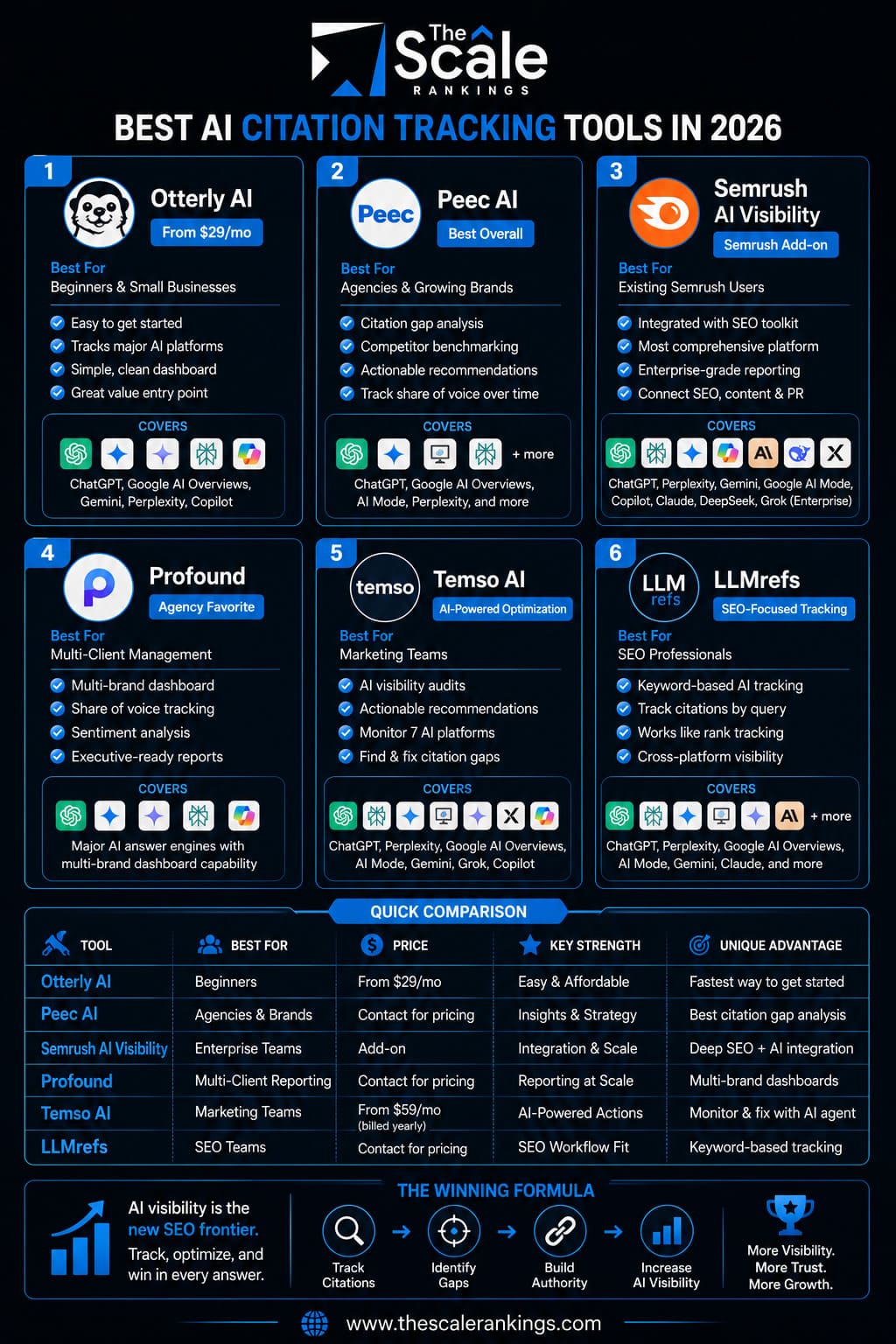
Pricing: From $29/month
Covers: ChatGPT, Google AI Overviews, Gemini, Perplexity, Copilot
Best for: Small businesses, solopreneurs, and brands testing AI citation tracking for the first time.
Otterly.AI is the most accessible entry point into AI citation tracking. It monitors your brand mentions and website citations across all five major AI platforms on a schedule, tracks changes over time, and surfaces the information in a clean dashboard that doesn't require a data analyst to interpret.
For businesses new to generative engine optimization who want to establish a baseline quickly and without a significant budget commitment, Otterly.AI is the right starting point. At $29/month, it covers the core platforms and gives you the visibility to understand where you stand before investing in a more sophisticated setup.
Where it has limitations: the analytics are relatively surface-level compared to enterprise tools, and there's limited competitive benchmarking at the entry tier. If you have a small brand and a limited budget, start here. If you're an agency managing multiple clients or a brand competing in a crowded category, you'll likely outgrow it within a few months.
Pricing: Contact for pricing
Covers: ChatGPT, Google AI Overviews, AI Mode, Perplexity, and more
Best for: SEO agencies, marketing managers, and brands that want not just monitoring but an actionable improvement strategy.
Peec AI is the tool that most consistently comes up when SEO professionals discuss AI citation optimization in 2026, and for good reason. It goes beyond counting mentions. It runs citation gap analysis that shows you which sources AI engines trust in your category, then surfaces actionable recommendations based on that data.
That distinction matters. Most AI citation tools tell you that you're not being cited. Peec AI tells you why, and specifically which third-party sources your competitors are being cited from. This gives you a direct playbook for your AI citation building strategy.
The competitive benchmarking is the strongest in its class at this price point. You can see the share of voice across every tracked platform, monitor how it shifts weekly, and map those shifts to content or link building activity you've done. This is the feedback loop that turns AI citation building into a repeatable process.
Pricing: Add-on to existing Semrush plans
Covers: ChatGPT, Perplexity, Gemini, Google AI Mode, Copilot, Claude, DeepSeek, Grok (Enterprise tier)
Best for: Established marketing teams running integrated SEO and content operations on Semrush.
If your team already uses Semrush for keyword research, rank tracking, and backlink analysis, their AI Visibility Toolkit is the most natural extension of your existing workflow. It integrates AI citation data with the SEO, content, and PR tools you're already using. That’s how you can close gaps without switching between platforms.
The enterprise tier covers the most comprehensive list of AI platforms available in any single tool, including Claude, DeepSeek, and Grok, alongside the standard four. For brands competing at scale who need cross-platform visibility without stitching together multiple subscriptions, this is the most complete single-tool solution on the market.
The limitation is the same one that comes with every all-in-one platform. If you're not already in the Semrush ecosystem, the cost and setup overhead may not justify adding it just for AI citation tracking. For existing Semrush users, it's a very straightforward decision.
Pricing: Contact for pricing
Covers: Major AI answer engines with multi-brand dashboard capability
Best for: Digital agencies and enterprise brands managing AI citation visibility across multiple clients or brand entities.
Profound was built specifically for teams managing visibility across multiple brands or clients. This makes it one of the most relevant tools for digital agencies running AI citation optimization programs at scale.
Where most AI citation tools are built around a single brand view, Profound's core feature is the multi-brand dashboard. You can track citation frequency, share of voice, and sentiment across an entire client portfolio in one view, generate exec-ready reports without manual compilation, and identify patterns across brands that inform your overall generative search citation strategy.
For agencies offering AI citation services or brands with multiple sub-brands that need tracking independently. Profound eliminates the operational overhead of managing separate tool instances per client.
Pricing: From $59/month (billed yearly)
Covers: ChatGPT, Perplexity, Google AI Overviews, Google AI Mode, Gemini, Grok, Microsoft Copilot
Best for: Marketing teams without dedicated AI SEO specialists who need monitoring and guided implementation in one tool.
Temso AI goes one step further than monitoring. It's an AI agent that runs audits of your brand's AI visibility and executes improvement work alongside the tracking. It monitors across seven AI platforms simultaneously and surfaces specific actions: which content to create, which sources to target for LLM citations, and where your citation gaps are widest relative to competitors.
The distinction is significant. Most tools in this space measure the problem. Temso attempts to solve it. For brands that don't have a dedicated SEO team or generative engine optimization specialist in-house, having an agentic tool that not only identifies the gaps but also recommends the specific fixes reduces the expertise barrier significantly.
At $59/month for the entry tier, it sits at the affordable end of tools with genuine workflow capability, making it one of the higher-value options for mid-market brands.
Pricing: Contact for pricing
Covers: ChatGPT, Perplexity, Google AI Overviews, AI Mode, Gemini, Claude, and more
Best for: SEO professionals and agencies running large-scale keyword operations who want AI citation data integrated with existing tracking workflows.
LLMrefs is built for SEO teams who think in keywords. It maps your existing keyword lists to AI visibility. It shows which brands and URLs get cited for each query across all major AI platforms. Also, it structures the data in a format that should feel familiar to anyone who's used a traditional rank tracker.
If you're managing a large keyword portfolio and want AI citation data to sit alongside your organic ranking data in a consistent format, LLMrefs fills that gap more naturally than tools built specifically for brand monitoring. You're not learning a new measurement framework. You're extending the one you already use.
Before investing in any of the tools above, there's a free method every brand should run first to establish a baseline understanding of their current AI citation status.
Open ChatGPT, Perplexity, and Google AI Overviews. Run these four types of queries:
1. Category queries: "What are the best [your service] companies?"
2. Problem queries: "How do I [solve the problem you solve]?"
3. Comparison queries: "[Your brand] vs [Competitor]"
4. Direct brand query: "Tell me about [your brand name]"
Document who appears in each answer, whether you appear at all, and what sources the AI is citing when it generates its response. This takes 20–30 minutes and gives you the baseline data to understand where your AI citations stand today before you start spending money to track them more systematically.
The manual approach doesn't scale, which is why the tools above exist. Remember, it costs nothing and delivers an immediate signal.
The right tool depends on three variables: your budget, your team's technical depth, and whether you need monitoring only or monitoring plus implementation guidance.
Tracking AI citations is only useful if the data connects to action. Here's the sequence that turns monitoring into improvement:
The Scale Rankings specializes in AI citation building, generative engine optimization, and entity SEO for brands that want to be found in AI-generated search results. If you're not showing up in ChatGPT or Perplexity for your target queries, we can show you exactly why and build the citation authority to fix it. Let’s connect.
The Scale Rankings is your go-to partner for all things SEO. We focus on crafting personalized SEO strategies that deliver real results, from boosting your rankings to increasing organic traffic. With our expertise in on-page SEO, off-page SEO, and technical SEO, we ensure your brand stands out in the digital crowd.
The Scale Rankings ensures to make sure your audience finds exactly what they’re looking for. As one of the best search engine optimization (SEO) companies, we dig into the core of your business, crafting strategies that hit home across industries. Our services include:
 Let’s Chat
Need help with your next SEO project? Our experts are here to help. Reach out to us for a free consultation or more information.
 +1 877 33 SCALE
 [email protected]
 1870 The Exchange SE Ste 220 PMB 47489, Atlanta, GA 30339-2171



 Local SEO
 E-Commerce SEO
 International SEO
 SEO Consulting
 Conversion Rate Optimization
 Content Marketing
 Content Strategy
 Website Content
 Answer Engine Optimization
 Amazon SEO
 Generative Engine Optimization
 AI Citation Building
 Entity SEO