



May 19, 2026 By The Scale Rankings

| An AI citation strategy for startups is about making it easier for AI systems to understand, trust, and cite your business. This requires making your brand easier to understand and verify. Start with clean brand facts, helpful pages, relevant mentions, and regular tracking. |
Businesses increasingly rely on AI models like ChatGPT, Gemini, and Perplexity. This brings the need for an effective AI citation strategy for startups. The right ones can help startups improve their chances of being recognized in AI search results and get more traffic to their platforms.
According to the Pew Research Center, 34% of U.S. adults had already used ChatGPT by 2025, nearly double the adoption seen in 2023. This shift shows how quickly AI tools are becoming part of how people research products, compare businesses, and discover brands. If you want to get cited in AI search results, you need proof, clarity, and a few breadcrumbs.
AI citation strategy for startups that helps ChatGPT, Gemini, Perplexity & other AI models reference your brand:
|
An AI citation strategy for startups hinges on some essential elements. This insight will help you position your startup as a thought leader in the industry. Before we go further, here are a few terms you must know:
Lock your Name, entity type, and key attributes, then repeat them consistently across your site and profiles. Add real-world proofs: team bios, addresses, awards, and press. Create a single “About” or “Entity” page that states your canonical description and links to official profiles. This fuels entity SEO and improves citation-based SEO downstream.
Use JSON-LD: Organization, Product, Person, FAQ, HowTo, and Article. Mark your sameAs links (LinkedIn, Crunchbase, GitHub, official social). Keep one canonical URL per claim. Validate schema, avoid duplicates, and keep it human-readable too. Strong structure powers AI citations for a website and supports AI answer engine optimization.
LLMs quote clear, concise, sourced text. Write pages with tight intros, bullet takeaways, and a short “In one line” summary. Add dates, methods, and sources. Include definitions and mini-glossaries. LLMs love stable phrasing.
Think prompt-first: what question would a user ask? Then write a 2-3 sentence answer block that can be copied verbatim. This helps get cited in AI search results and supports an AEO Strategy.
AI Visibility Blueprint: How To Appear In AI Search Results
Earn editorial mentions on reputable sites. Secure listings on trusted directories in your niche. Aim for brand mention SEO. Your brand is named near your core topic and claim. Consistent off-site data supports citation-based SEO and makes your Local AI citation strategy work in real neighborhoods, not just theory. Our experts recommend you prioritize one strong profile per week.
Set up AI citation analysis dashboards and AI citation tracking tools. Check which prompts produce brand mentions and which don’t. Track LLM citations by model and region. Refine your titles, first paragraphs, and schema fields. Small edits in source-of-truth pages can swing whether models cite you or skip you.
The goal is to make your brand's information so clear, consistent, and valuable that AI models can't help but cite it. This involves a meticulous approach to how your brand's data is presented across the web. The right AI citations optimization strategies will systematize this for you.
Ready for the useful part? Good AI Citations Optimization Strategies are not about spraying your startup name across random websites. That is not a strategy. That is digital confetti, and nobody wants to clean it up. The seo strategy for startups should focus on sources that already have trust in your niche.
An AEO Strategy helps your content match how people ask questions. To get cited in AI search results, write pages that answer specific queries. For example, instead of only publishing “Why workflow automation matters,” create a page answering, “What is workflow automation for remote marketing teams?”
This matters because users increasingly consume answers directly inside AI-generated summaries. Ahrefs found that pages ranking under Google AI Overviews experienced an estimated 34.5% drop in click-through rate, meaning visibility now depends not only on rankings, but also on whether AI systems choose to reference your content.
This is AI answer engine optimization in action. Keep definitions short. Add examples. Use clear headings. Mention who the solution is for, when to use it, and what limitations exist. AI tools prefer content that is easy to extract and summarize.
For a SaaS team, a helpful page might compare “employee onboarding software for startups” against spreadsheets and generic project tools. The page should explain features, use cases, costs, and fit. If it sounds like a helpful consultant wrote it, you are on the right track. If it sounds like a brochure swallowed a thesaurus, try again.
Got a local business? Then your citations need a local accent. A Local AI citation strategy helps AI systems understand where you operate, who you serve, and why nearby customers might choose you. This matters for clinics, agencies, law firms, home services, restaurants, gyms, and local SaaS consultants.
A practical Local AI citation strategy starts with consistency. Your business name, address, phone number, service area, opening hours, and categories should match across your website and local listings. If one profile says “Austin” and another says “Texas-wide,” AI may shrug and move on.
This gives AI more useful context. Local visibility is often won by boring consistency. Yes, boring. But boring is better than invisible. Once your local data is clean, your broader citation work has a much stronger base.
AI citation tracking tools help you see if your brand appears in AI answers, which sources are cited, and how your business is described. Even a simple manual tracking sheet is better than pretending everything is fine.
| Tool Name | Best For | Key Features |
| Profound | Enterprise AI visibility tracking | Tracks citations and brand mentions across ChatGPT, Gemini, Claude, Perplexity, and Google AI Overviews |
| AthenaHQ | AI search optimization and monitoring | Real-time prompt tracking, citation analysis, competitor benchmarking |
| Otterly.AI | AI mentions and citation tracking | Tracks AI-generated mentions, share of voice, and source visibility |
| Peec AI | AI SEO and GEO analytics | Prompt-level visibility tracking, sentiment analysis, competitor insights |
| Scrunch AI | AI agent and citation monitoring | Measures AI bot interactions, citation frequency, and AI referral trends |
| SE Ranking AI Tracker | Combined SEO + AI visibility tracking | Tracks brand mentions and citations across ChatGPT, Gemini, Perplexity, and AI Overviews |
Good AI citation analysis looks at accuracy, frequency, source quality, and competitor presence. Our experts recommend you record prompts, dates, AI platforms checked, answers shown, cited sources, and errors found. Over time, patterns appear. Sometimes flattering but always useful.
Do not panic if you are missing at first. Most startups are. The point of tracking is to spot gaps and fix them with better pages, clearer profiles, and stronger mentions.
Use AI citation tracking tools to check progress every month. Then use AI citation analysis to decide what to improve next. If AI keeps using outdated descriptions, update your profiles. If competitors appear because of comparison pages, consider creating better educational content.
A SaaS startup selling finance software may need a strategy for AI citations built around comparison pages, integration pages, product documentation, founder interviews, and finance blogs. The goal is to help AI connect the company with a clear use case.
A local accounting firm needs a different setup. Its AI citation building strategy should focus on local listings, review platforms, tax advice pages, service-area pages, and local business mentions. Same principle, different sources.
An agency or consultant may need thought leadership, case studies, podcast mentions, and expert commentary. The key is simple: match citations to buyer behavior. If your buyers read industry newsletters, get mentioned there. If they check local reviews, fix those first.
This is also why startup SEO cannot be copied and pasted. The best plan depends on your market, buyer journey, location, and level of existing trust. AI citations work best when they reflect how real people discover and compare businesses.
Your startup may be hard to cite for reasons that look tiny. A different tagline on every profile. An old product description in a directory. A blog full of clever headlines but no direct answers. Tiny cracks, big confusion. Some of the key mistakes include:
Finally, do not forget tracking. Without tracking, you will not know whether your updates helped. You may also miss wrong answers about your company. And yes, AI can get things wrong with great confidence. Very relatable, but still a problem.
Want a realistic starting plan? Good. This AI citation strategy for startups begins with clarity. A simple 30-day plan is better to fit in your hectic schedule. Check it out below:
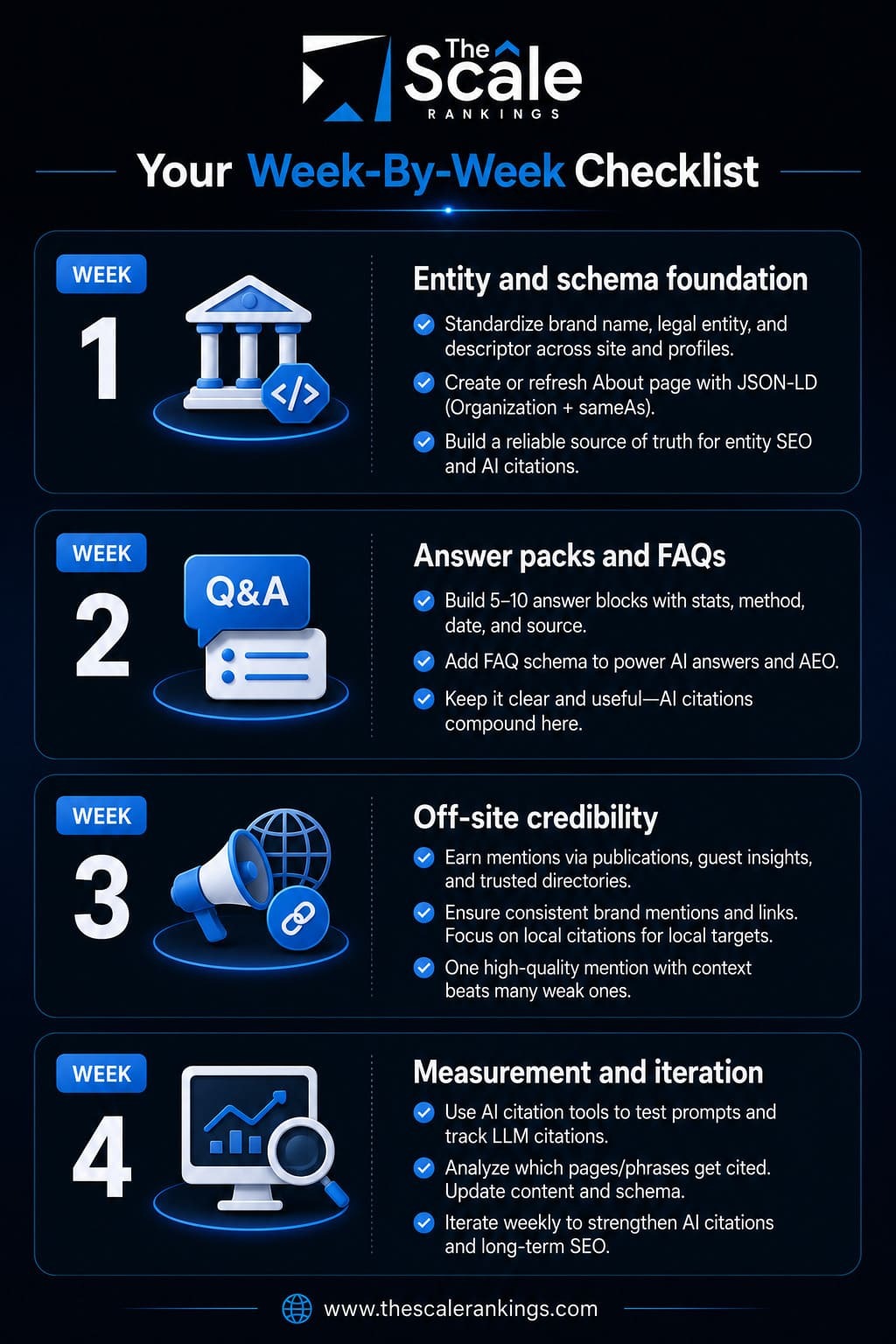
Early startups may handle citation work in-house. Larger teams may need outside help when tracking, content, technical cleanup, and outreach become too much to manage.
You do not always need outside help. But if your startup operates in a competitive category, has confusing brand data, or depends heavily on AI-driven discovery, structured support can save time.
A leading AI citation SEO agency like The Scale Rankings explains citation quality, entity clarity, content gaps, and tracking methods to you in plain language. Our AI SEO services include delivering results, not just content creation.
The Scale Rankings is your go-to partner for all things SEO. We focus on crafting personalized SEO strategies that deliver real results, from boosting your rankings to increasing organic traffic. With our expertise in on-page SEO, off-page SEO, and technical SEO, we ensure your brand stands out in the digital crowd.
The Scale Rankings ensures to make sure your audience finds exactly what they’re looking for. As one of the best search engine optimization (SEO) companies, we dig into the core of your business, crafting strategies that hit home across industries. Our services include:
 Let’s Chat
Need help with your next SEO project? Our experts are here to help. Reach out to us for a free consultation or more information.
 +1 877 33 SCALE
 [email protected]
 1870 The Exchange SE Ste 220 PMB 47489, Atlanta, GA 30339-2171




 Local SEO
 E-Commerce SEO
 International SEO
 SEO Consulting
 Conversion Rate Optimization
 Content Marketing
 Content Strategy
 Website Content
 Answer Engine Optimization
 Amazon SEO
 Generative Engine Optimization
 AI Citation Building
 Entity SEO