



May 22, 2026 By The Scale Rankings

| How LLMs Rank Content depends on how clearly your content answers a question, how consistently your brand appears across credible sources, how well your content is structured for machine comprehension, and how often other trusted sources reference your work. |
Understanding how LLMs rank content is now a real business requirement. LLMs work differently from Google. There is no ranked list. You’ll see a generated response instead. The model reads a question, pulls from what it learned during training and live web data, and writes an answer. Your content either influences that answer or it does not.
LLM models favor credible, clear, and well-structured content during training or retrieval. It is pattern-matching against content it has learned to associate with authority on a given topic. These are the signals that decide LLM visibility optimization, and most websites are not yet building for them.
Here’s the clear logic behind who gets cited and who gets ignored:
|
LLMs don't cite randomly. They look for specific signals. These signals can be as simple as clarity or as technical as topical depth. Here's exactly what those signals are:
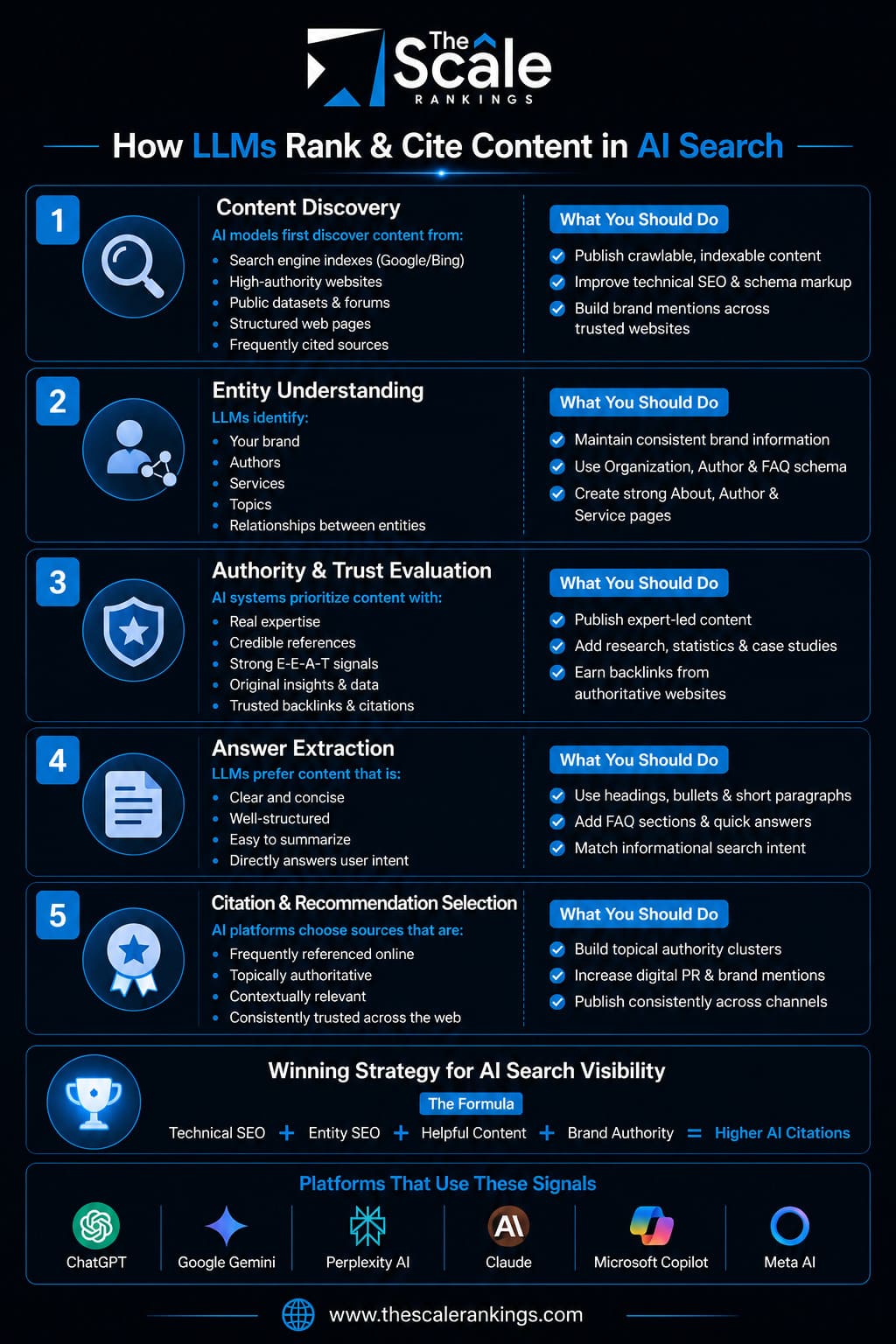
LLMs do not appreciate vague writing. They are trained to find content that answers questions directly. If your page takes four paragraphs to get to the point, an LLM will likely pass over it in favor of one that leads with the answer.
Content structure for LLMs matters more than most people realize. Short paragraphs. Clear headings. Direct answers near the top of a section. A model scanning for an answer to "what is Answer Engine Optimization" will pull from the page that defines it cleanly in the first two sentences, not the one that spends three paragraphs on context first.
LLM content optimization starts with writing for comprehension, not for cleverness. The clearer your content is, the more useful it becomes to a language model trying to synthesize a response.
A page that covers one question well is useful. A website that covers an entire topic comprehensively becomes a reference point.
LLMs are trained on large datasets. During that training, content that consistently covered a topic with depth and accuracy became associated with authority on that subject. A site that has published twenty strong articles on AI SEO optimization will have more LLM visibility than one that has published a single overview.
This is why topical authority building is a core part of LLM SEO. It is not about keyword density. It is about becoming the source a model has seen consistently, repeatedly, and reliably on a given subject.
Not all content ranks the same in an AI's eyes. Some signals carry more weight than others. LLMs are trained on patterns. They learn to trust certain types of content. And they repeat what they trust. Here's what actually moves the needle.
LLMs learn from web-scale data. During training, they absorbed patterns about which sources were referenced often, which were cited by other credible sites, and which appeared across multiple trusted contexts. That learning shapes which sources a model leans on when generating a response.
This is why brand mention optimization is a genuine LLM ranking factor. When your brand is consistently mentioned in industry publications, relevant forums, respected databases, and third-party articles, that signal accumulates. The model learns to associate your name with authority on your topic.
LLM citation optimization is partly an off-page effort. You cannot fix it only by rewriting your own content. You need your brand and content to appear in the places LLMs were trained to trust.
LLMs retrieve information efficiently. They look for content that places the answer close to the question, not buried under preamble.
Content structure for LLMs follows a simple pattern. Ask the question in a heading or subheading. Answer it clearly in the first one or two sentences. Then expand with supporting detail. This mirrors how featured snippets work in traditional search, and for good reason. The formats that work for featured snippets are also the formats LLMs find easiest to parse and cite.
If you want to rank in AI Overviews and appear in AI-generated responses, structuring content this way is foundational. AEO optimization, or Answer Engine Optimization, is built entirely on this principle.
Learn the strategy: How to rank in Google SGE (AI Overviews)
LLMs are trained to favor content that is factually grounded. Pages that include references, cite studies, and link to authoritative sources perform better in LLM retrieval than pages that make claims without any backing.
This applies directly to how LLMs rank content. A page that states "X is true because of Y, according to Z source" is more trustworthy to a language model than one that simply asserts "X is true." Verifiable claims, cited evidence, and linked references all improve LLM citation optimization.
Entities are people, brands, places, and concepts. LLMs build associations between entities and topics during training. If your brand is consistently linked to a specific topic across many sources, the model associates your brand with that topic.
This is the basis of LLM visibility optimization at a brand level. It is not just about individual pages. It is about how your entire web presence reads to a language model over time. Consistent messaging, consistent topic coverage, and consistent brand mentions all compound into a stronger entity association.
LLM citation optimization services focus on three things: content credibility, content structure, and off-page presence. Your content needs to be accurate and well-sourced. It needs to be structured so that language models can extract and use it easily. And your brand needs to be mentioned consistently across the web so models learn to associate your name with authority.
Earning AI search citations also involves being present in the datasets and sources that LLMs are trained on or retrieve from. Wikipedia presence, mentions in reputable publications, citations in academic or industry research, and appearances in widely read newsletters all contribute. These are not traditional SEO tactics. They are visibility strategies built specifically for how LLMs rank content.
Improve your AI visibility: How to build AI citations
SEO got you on Google. But GEO gets you into AI answers. It's a different game with different rules. The old tactics won't cut it here. LLMs don't crawl. They don't click and recall. And what they recall depends on how your content was written, structured, and positioned. Here are the strategies that actually work.
The traditional SEO article format often starts with an introduction, builds context, and reaches the point somewhere in the middle. That format does not serve LLMs well.
Generative engine optimization strategies flip that structure. The answer comes first. The context and depth follow. Every section of a page should function as a self-contained answer to a specific question. A language model should be able to lift any section of your content and use it to answer a related query.
This also improves your ability to rank in AI search results because retrieval-augmented generation systems, which power tools like Perplexity, pull specific chunks of content to build their responses. Pages broken into clearly defined, self-contained sections give these systems more usable material.
Tables, numbered lists, definitions, and step-by-step processes are easier for LLMs to parse than dense prose paragraphs. When information can be presented in a structured format, that is almost always the better choice for LLM content optimization.
A definition of a term in a clean sentence is more citable than the same definition buried in a paragraph. A comparison in a table is more readable for both humans and language models than the same comparison written out in flowing text. Structure is not just a readability choice. It is an LLM ranking factor.
One strong article does not establish topical authority. A cluster of related, well-written articles that interlink and cover a topic from multiple angles does.
LLM SEO rewards breadth and depth together. A site that covers a topic from ten different angles, with each page linking to related ones, signals to both traditional search engines and language models that this domain has comprehensive knowledge. For businesses investing in AI-powered SEO services, topic cluster development is consistently one of the highest-leverage strategies available.
Answer Engine Optimization is the practice of structuring content to appear in direct-answer formats. This includes Google's featured snippets, AI Overviews, and the responses generated by LLM-powered tools.
AEO optimization and LLM content optimization share the same foundation: write clear, direct, well-structured answers to specific questions. The difference is in the depth of application. AEO optimization for featured snippets focuses heavily on the format of individual answers. LLM optimization strategies go further, looking at the entire content ecosystem around a topic.
An Answer Engine Optimization agency will typically audit how well a site's content answers questions, identify gaps where competitors are being cited instead, restructure pages to place answers more prominently, and build out topic coverage to establish authority. This work improves both traditional featured snippet placement and LLM citation rates because the underlying content quality improvement serves both surfaces.
The connection between AI search and traditional SEO runs through content quality. Both reward clarity, accuracy, and depth. Both penalize thin or generic content. Investing in strong SEO content writing that prioritizes real answers over keyword-stuffed paragraphs improves performance across every channel.
Start with your content foundation. Every page on your site should have a clear purpose, a clear audience, and a clear answer it is delivering. If a page cannot answer the question "what does a reader get from this?" in one sentence, it needs rework. LLM optimization strategies reward clarity above almost everything else.
Build your off-page presence deliberately. Identify the publications, platforms, and communities your audience trusts. Contribute to them. Get mentioned in them. Earn links from them. This is brand mention optimization in practice, and it directly influences how LLMs rank content related to your industry.
Work with the right partners. AI-powered SEO services that understand both traditional search signals and LLM-specific ranking factors will move the needle faster than approaches built for one channel alone. The overlap between what helps you rank in AI Overviews and what helps you rank in traditional search is significant. The strategies that serve both are the ones worth investing in.
Understanding how LLMs rank content is genuinely useful. It helps you make better decisions about what to write, how to structure it, and where to build your presence. But knowing the framework and actually implementing it are two different things. Most teams that try to do this in-house find themselves stuck on the parts that require consistent, expert execution. That is where progress stalls.
The brands showing up consistently in AI-generated responses? They are working with people who understand both the technical logic of LLM visibility and the day-to-day work of building it. Working with an experienced SEO team or a professional SEO agency will significantly compress your timeline. The Scale Rankings works with businesses on exactly this. If you are trying to figure out where to start or where you are currently being overlooked in AI search, it is worth a conversation.
The Scale Rankings is your go-to partner for all things SEO. We focus on crafting personalized SEO strategies that deliver real results, from boosting your rankings to increasing organic traffic. With our expertise in on-page SEO, off-page SEO, and technical SEO, we ensure your brand stands out in the digital crowd.
The Scale Rankings ensures to make sure your audience finds exactly what they’re looking for. As one of the best search engine optimization (SEO) companies, we dig into the core of your business, crafting strategies that hit home across industries. Our services include:
 Let’s Chat
Need help with your next SEO project? Our experts are here to help. Reach out to us for a free consultation or more information.
 +1 877 33 SCALE
 [email protected]
 1870 The Exchange SE Ste 220 PMB 47489, Atlanta, GA 30339-2171




 Local SEO
 E-Commerce SEO
 International SEO
 SEO Consulting
 Conversion Rate Optimization
 Content Marketing
 Content Strategy
 Website Content
 Answer Engine Optimization
 Amazon SEO
 Generative Engine Optimization
 AI Citation Building
 Entity SEO