



June 23, 2026 By The Scale Rankings

| Entity SEO helps search engines and AI platforms recognise your brand as a trusted entity. By strengthening your presence across the Knowledge Graph, schema markup, and authoritative third-party sources, you improve both search visibility and AI citation potential. It is a critical factor for earning trust, authority, and recommendations from AI-driven platforms like Google Gemini, ChatGPT, and Perplexity. |
Google defines an entity as "a thing or concept that is singular, unique, well-defined, and distinguishable." Entities can be people, places, organisations, products, events, or abstract concepts.
For example, "Apple" as a keyword could mean the fruit or the company. "Apple Inc." as an entity has a defined identity, attributes, and relationships in the Knowledge Graph. For AI search, this matters enormously. Because Gemini is trained directly on the Knowledge Graph, your entity representation directly determines your AI citation eligibility.
TL;DR: Your Guide to Entity SEO
|
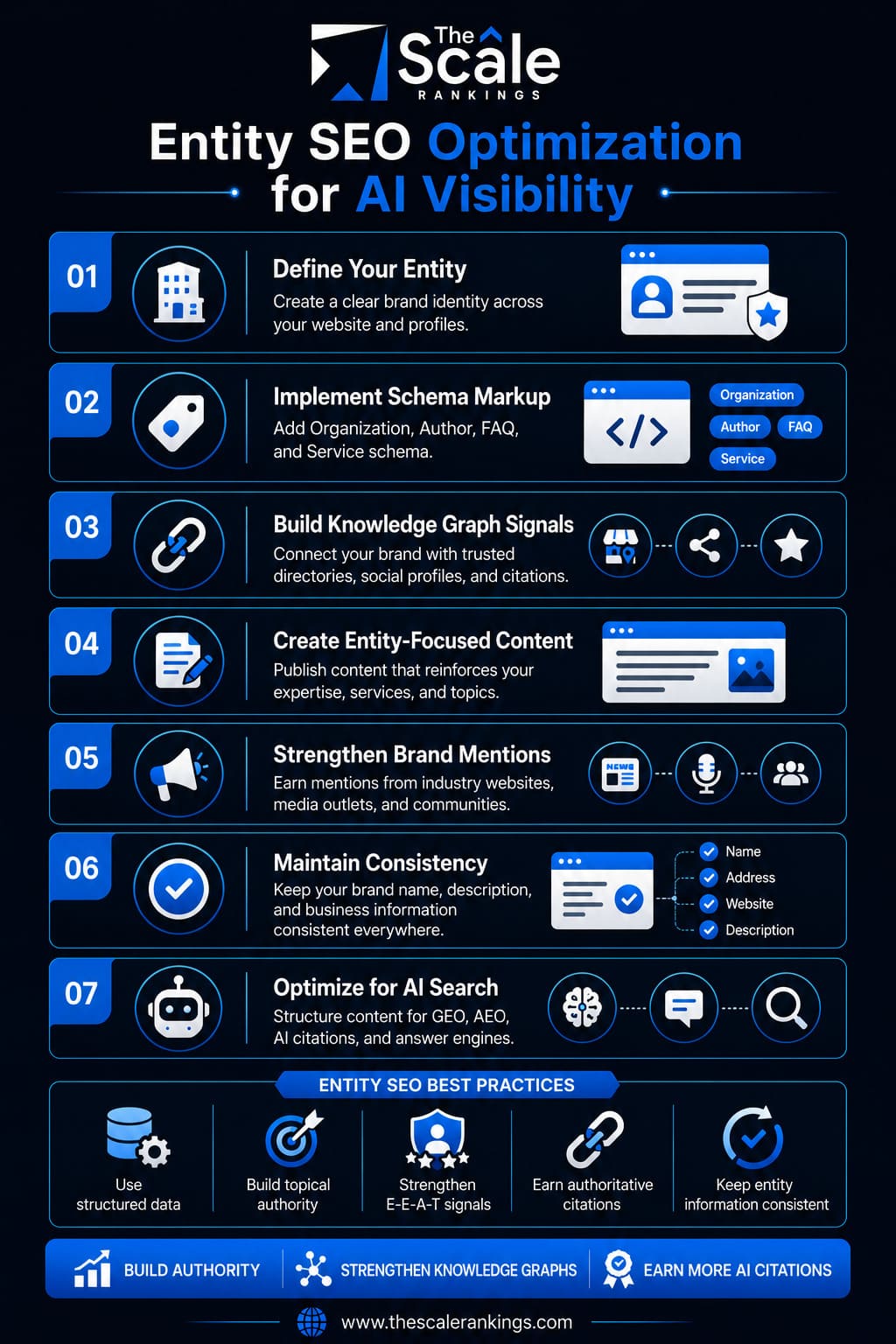
Entity SEO is the practice of optimising your brand, content, and digital presence so search engines unambiguously recognise, classify, and connect your brand as a trusted entity. This is what an entity in SEO truly represents - a recognised "thing," not just a keyword.
Google describes this shift as moving from "strings to things." Keyword SEO optimizes what you say. Entity-based SEO optimizes what Google knows about you. The two are not interchangeable, and you need both as part of any effective SEO strategy.
These overlap but are not the same. Semantic SEO is about optimising for meaning and topic relevance. Entity SEO is a subset focused specifically on establishing your brand, person, or product as a recognised Knowledge Graph entity. Full-spectrum search engine optimization (SEO) requires both.
Google's Knowledge Graph maps entities, their attributes, and their relationships to other entities. It was launched in May 2012 under the banner "things, not strings". Google uses entities to better understand real-world concepts and their connections. This allows search engines and AI systems to deliver more accurate results, Knowledge Panels, and AI-generated answers. This is the foundation of Google entity SEO.
Google maintains an internal entity confidence score. It's a measure of how certain it is that an entity is who or what it claims to be. The signals that feed it include schema markup consistency, Wikidata presence, third-party brand mentions, NAP consistency, and whether a Knowledge Panel exists. Strengthening these signals is the core of Google entity optimization.
Roughly 92% of AI Overview citations come from domains already ranking in Google's top 10. The chain runs like this: entity establishment leads to Knowledge Graph inclusion, which feeds Gemini's training data, which produces AI Overview and AI Mode citations. Entity SEO is not just about organic rankings. It is the primary enabler of AI search visibility. Every brand that wants to appear in Google AI Overviews needs its entity confidence optimised first.
LLMs do not see your brand as text. They recognise it as an entity, the same way they recognise a person or a place. A clean Knowledge Graph footprint has a consistent name, description, and category across Wikipedia, Wikidata, LinkedIn, Crunchbase, and schema. This means models surface you reliably. Inconsistent entity data means the model's guess. And when models guess, your competitors get cited instead. This is why entity-based SEO for LLMs has become a discipline of its own.
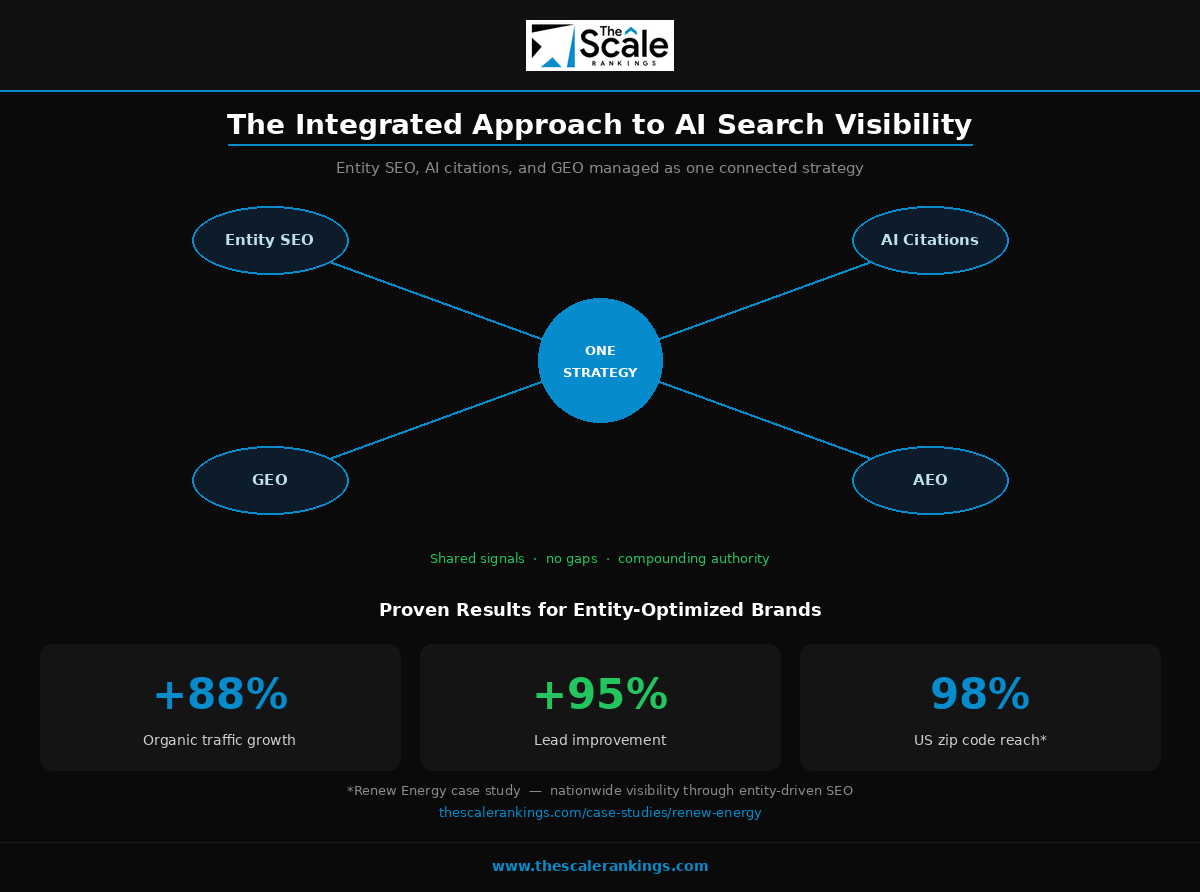
Notably, entity SEO & AI citation building are two sides of one strategy. Entity SEO builds the foundation. Google and LLMs know who you are. AI citation building builds the reach. Your business gets recommended when your category is queried. Build citations without entity clarity, and you risk being misattributed or cited incorrectly.
Platform differences matter. Gemini is trained on the Knowledge Graph, so entity establishment is the most direct path to citation. ChatGPT relies on training data plus browse mode, so entity coherence across web properties determines how accurately it represents you. Perplexity crawls in real time, so entity-rich content with schema ranks higher in its source selection.
Entity SEO is the bridge between traditional keyword-based optimization and the AI-driven search era. Google's Knowledge Graph now holds over 5 billion entities and 500 billion facts, and Gemini AI is trained directly on it. In other words, your entity representation is now your AI citation eligibility. This entity SEO guide breaks the process into 6 steps:
Run your brand through Google's Natural Language API to see what entities Google currently associates with your domain. Search your brand name. Do you have a Knowledge Panel? Is it accurate? Check whether an accurate Wikidata or Wikipedia entry exists. Audit your site's schema markup: is Organization schema correctly implemented with @id and sameAs?
Add JSON-LD Organization schema to your homepage, including name, URL, logo, description, founding date, @id, and sameAs (all official social and directory profiles). Use a canonical entity identifier https://yourdomain.com/#organization. The sameAs property should link to Wikipedia, Wikidata, LinkedIn, Crunchbase, G2, and other authoritative profiles. Add Person schema for key authors and founders. Validate everything with Google's Rich Results Test before publishing. This step is central to effective entity SEO optimization.
A Wikidata entry has no notability requirement and is the single highest-impact, low-cost entity signal. Create a QID for your brand. If your brand meets Wikipedia's notability standards, pursue a page; it is the strongest Knowledge Graph signal available. Add a Crunchbase profile (essential for B2B and SaaS) and consistent listings on G2, Clutch, Capterra, and your LinkedIn Company Page. The coherence rule is absolute: your brand name, description, founding date, and category must be identical across every property.
Your entity home is a dedicated, authoritative About page or homepage section that serves as Google's canonical reference point for your brand. Include a full brand description, founding story, key people (with author schema), services, locations, and official links. This should be the richest, most structured representation of your brand entity anywhere on the web.
Connect your entity to its topic domain through content clusters. Google's entity model maps entities to their topical authority areas. Your pillar pages, supporting cluster articles, and service pages should all reference your Organization schema @id. Add author entity markup to every blog post to connect content to a human expert entity. This reinforces E-E-A-T.
Check Knowledge Panel accuracy monthly. Google can pull incorrect data from third-party sources, so use "Suggest an Edit" to correct it. Watch for entity drift as your business evolves, and update all properties consistently. Track your entity signals: Wikidata views, Knowledge Panel appearance rate, and AI Overview citation rate. Consistent monitoring is what turns knowledge graph optimization into a lasting advantage.
To make it simpler for you, we have a consolidated list below as per your business type. These are the practical benefits of entity SEO across different models.
Entity SEO spans multiple disciplines at once: technical schema implementation, digital PR for entity signals, Wikidata and Wikipedia management, AI citation tracking, and ongoing monitoring. It is a 6–12 month project, not a one-time setup. Most marketing teams have content capability but lack the schema depth, Wikidata expertise, and digital PR network required to build entities at scale. This is where a specialist entity SEO agency makes the difference.
The Scale Rankings helps you with entity SEO services like audit, schema implementation, Wikidata setup, entity home creation, digital PR, and AI citation integration. All are managed as a single AI-era visibility strategy.
What sets the approach apart is proof. Plenty of agencies talk about AI search and entity authority. Few can show what it actually produces. As a specialist entity SEO agency and search engine optimization (SEO) agency, we work to measurable entity outcomes like Knowledge Panel accuracy, AI citation rate, and organic growth. The numbers come from real client engagements. Over 88% organic traffic growth and over 95% lead improvement for entity-optimised brands.
Renew Energy needed to expand visibility well beyond its existing footprint. Through a strategic, entity-driven SEO implementation, it achieved nationwide reach across 98% of U.S. zip codes. The kind of broad, defensible authority that only comes from being recognised as a trusted entity at scale. Here is our approach to AI visibility:
Affordable entity SEO services are available for B2B brands, SaaS companies, and local businesses at different growth stages. If you are not sure how Google currently understands your brand as an entity, The Scale Rankings offers a free Entity SEO audit. This shows your current Knowledge Graph presence, your entity gaps, and a clear action plan to establish your brand as the recognised authority in your space.
The Scale Rankings is your go-to partner for all things SEO. We focus on crafting personalized SEO strategies that deliver real results, from boosting your rankings to increasing organic traffic. With our expertise in on-page SEO, off-page SEO, and technical SEO, we ensure your brand stands out in the digital crowd.
The Scale Rankings ensures to make sure your audience finds exactly what they’re looking for. As one of the best search engine optimization (SEO) companies, we dig into the core of your business, crafting strategies that hit home across industries. Our services include:
 Let’s Chat
Need help with your next SEO project? Our experts are here to help. Reach out to us for a free consultation or more information.
 +1 877 33 SCALE
 [email protected]
 1870 The Exchange SE Ste 220 PMB 47489, Atlanta, GA 30339-2171




 Local SEO
 E-Commerce SEO
 International SEO
 SEO Consulting
 Conversion Rate Optimization
 Content Marketing
 Content Strategy
 Website Content
 Answer Engine Optimization
 Amazon SEO
 Generative Engine Optimization
 AI Citation Building
 Entity SEO