



June 4, 2026 By The Scale Rankings

| If you want to improve your website to rank higher on Google, focus on a combination of content quality, technical SEO, authority building, AI search optimization, and ongoing performance tracking. |
Organic traffic remains the lifeblood of sustainable online growth. Yet 90% of web pages never receive any organic traffic from Google. The gap between page one and page two comes down to the SEO practices you follow.
To help you bridge that gap efficiently, we've curated a list of 10 high-reward SEO tactics. These aren't theoretical concepts; they are proven techniques designed to improve your website ranking.
TL;DR: 10 Hacks To Improve Website RankingHere’s what deserves your attention if higher rankings are the goal:
|
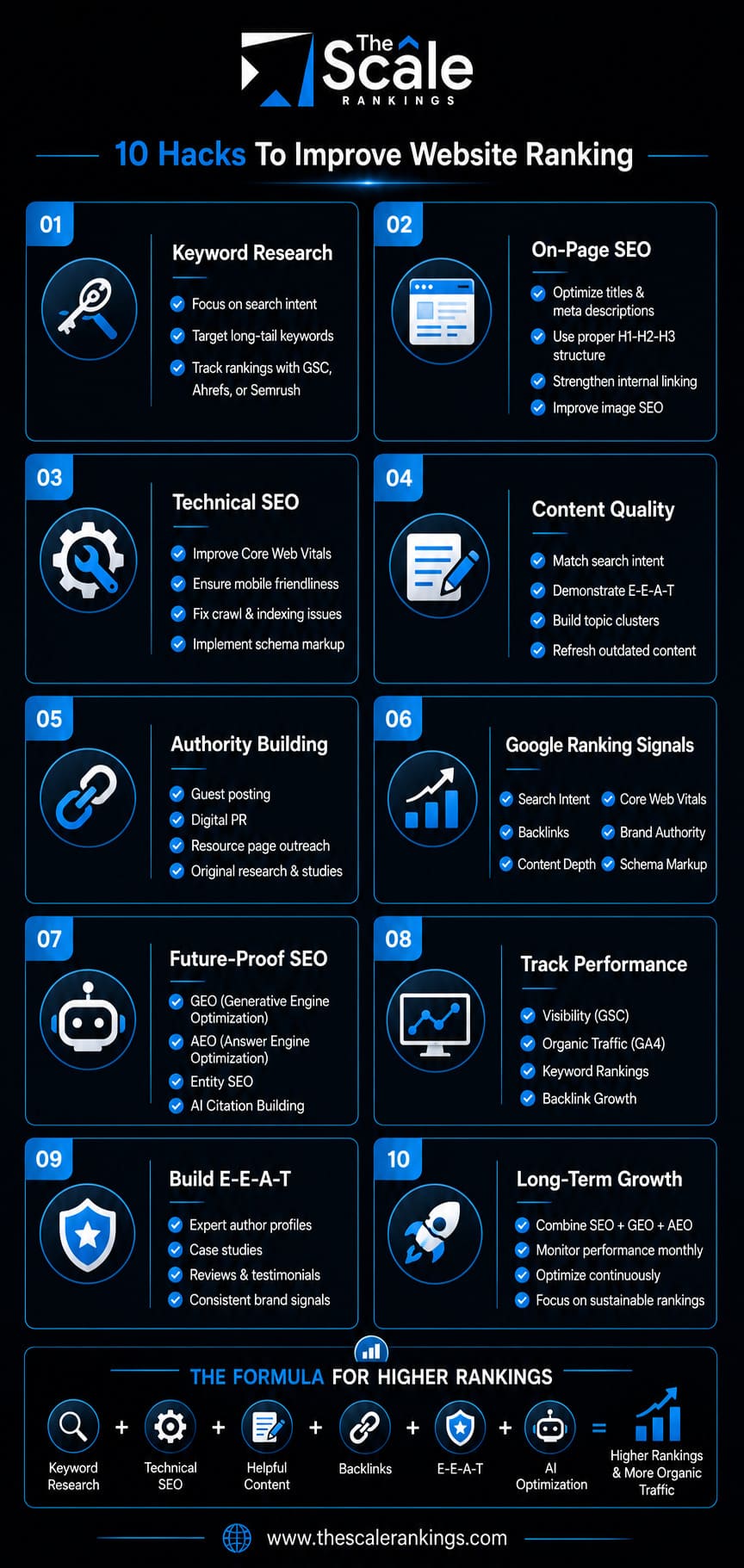
Improving rankings is rarely about one big change. It comes from a series of small, consistent improvements across your content, website structure, technical performance, and authority signals. When these elements work together, they help improve website ranking and make it easier for search engines to understand, trust, and recommend your pages.
The 10 strategies below focus on the areas that have the greatest impact on visibility. Whether you're trying to rank higher on Google, boost website organic traffic, or strengthen your long-term SEO marketing strategy, these are the tactics that deliver sustainable results.
Keyword research is where SEO begins. You cannot improve website SEO ranking if you are targeting the wrong searches. The goal is to understand what your audience is looking for and create content that matches their intent. This is one of the most effective ways to improve website ranking over time.
Tracking SEO keyword ranking helps you measure progress and find opportunities. Use tools like Google Search Console, Ahrefs, or Semrush to monitor performance. Pages ranking between positions 6 and 20 often need only small improvements, such as updated content, stronger titles, or better internal links, to improve search engine rankings.
Long-tail keywords are specific search phrases with lower competition and higher intent. They help you reach users who know exactly what they need. Adding these terms naturally throughout your content is one of the best ways to improve your website rankings and attract more qualified traffic.
On-page SEO is the set of signals you control directly. These best practices for SEO determine how clearly you communicate relevance to search engines and readers. Applied consistently across every page, they build the foundation that sustained rankings require.
Your title tag must include your primary keyword within the first 60 characters and give users a clear reason to click your result over every other one on the page. Meta descriptions don't directly influence rankings, but they drive click-through rate. Write them as 150–160 character value propositions, not keyword dumps.
Header structure (H1 → H2 → H3) signals topic hierarchy to crawlers and makes content navigable for readers. One H1 per page with the primary keyword; H2s for major subtopics; H3s for specific points within them. Use secondary keywords in subheadings where they fit naturally.
Keep URLs short, descriptive, and keyword-containing. /blog/improve-website-ranking outperforms any auto-generated slug. Add descriptive alt text to every image for accessibility and search visibility. Compress images before upload. Large files degrade page speed and rankings.
Strong content and good backlinks will underperform if technical problems prevent Google from properly crawling and indexing your site. This is one of the most common reasons why your website is not ranking, and the most fixable. Diagnosing why your website is not ranking starts here, before touching content or links.
Google's Core Web Vitals measure three user experience signals that directly affect rankings:
Run your site through Google PageSpeed Insights to identify failures. Common fixes: compress images, eliminate render-blocking scripts, and implement lazy loading. Under mobile-first indexing, your mobile experience is what Google evaluates. A degraded mobile version impacts rankings across all devices.
Submit your sitemap.xml via GSC and review the Coverage report regularly for crawl errors and excluded pages. Misconfigured robots.txt files silently block Google from indexing entire sections of a site. Use canonical tags to tell Google which version of duplicate pages is authoritative.
Schema markup makes your content eligible for rich snippets and AI Overviews. HTTPS is non-negotiable. Sites still on HTTP carry a trust deficit that no content strategy can offset. To rank higher on Google, your technical foundation must be clean before any other work compounds on top of it.
Content quality is what earns rankings. Specifically, content that fully satisfies the intent behind a query. Done consistently, it's also the most reliable way to boost website organic traffic over time, because pages that genuinely answer questions earn engagement signals that reinforce their positions.
E-E-A-T is Google's quality filter. It operates at both the page level and the domain level. Practical signals include: expert author bios with verifiable credentials, citations to primary sources, and case studies with specific, measurable outcomes. Thin content includes low substance, no original insight. It is actively penalized, especially in healthcare, finance, and legal categories where E-E-A-T is a ranking requirement, not a bonus. The businesses that consistently improve SEO rankings and organic traffic in these niches treat E-E-A-T as a non-negotiable content standard.
Topical authority is the signal that your site comprehensively covers a subject. It increasingly determines whether Google ranks you across an entire topic area, not just for individual pages. The structure that builds it: one pillar page covering a broad topic in depth, supported by cluster pages on related subtopics, all interlinked. A site with this architecture outperforms a site with isolated, unconnected pages. Even when individual pages are comparable in quality.
Refreshing stale content often produces faster results than publishing new pages. Use GSC to identify pages sitting at positions 6-20. Update statistics, realign content to current search intent, and strengthen internal links. A targeted refresh can push a near-page-one page over the line without the full production cost a new piece requires. For many sites, a systematic refresh program does more to improve SEO rankings and organic traffic in the near term than any new content initiative.
Backlinks remain among the most influential SEO ranking factors. A link from an authoritative, topically relevant domain signals to Google that your content is credible. Quality is everything. One editorially placed link on a high-DR site consistently outperforms hundreds of low-quality directory submissions. Building this kind of profile is one of the most reliable ways to improve website page rank across your entire domain, not just individual pages.
Four approaches that consistently produce results without penalty risk:
Besides, backlinks are one of the oldest SEO ranking factors in Google's algorithm. And one of the most durable. Links that move rankings share three traits: high Domain Rating on the linking site, topical relevance to your niche, and natural anchor text diversity. A backlink profile where every link uses exact-match anchor text looks manipulative. Natural profiles mix branded, partial-match, and generic anchors. Digital PR implies earning coverage through genuinely newsworthy content. It is the most scalable way to build this kind of profile at volume.
Google evaluates every page across three pillars: on-page relevance, off-page authority, and technical health. Understanding which Google ranking factors carry the most weight and how the algorithm has evolved. This separates strategic optimization from guesswork. Businesses that study these factors and align their work accordingly consistently improve search engine rankings faster than those applying generic tactics.
The eight factors with the most measurable impact in 2026:
| Factor | Why It Matters |
| Search Intent Match | Determines relevance |
| E-E-A-T Signals | Builds trust |
| Core Web Vitals | Improves UX |
| Backlinks | Build authority |
| Mobile Usability | Supports indexing |
| Content Depth | Demonstrates expertise |
| Brand Signals | Strengthens credibility |
| Schema Markup | Enhances visibility |
Google has shifted from keyword matching to meaning matching. RankBrain, BERT, and MUM allow it to understand semantic relationships and query context. The practical implication: topical authority now outperforms single-page keyword optimization. Engagement signals include dwell time, CTR, and scroll depth. It also functions as quality feedback. Content that earns sustained attention reinforces its ranking; content that sends users back to Google quickly loses ground.
Traditional organic rankings are no longer the complete picture. Understanding the future of SEO with AI search is now a competitive requirement. This is where most SEO guides stop. It is where this one goes further. Brands that understand the future of SEO with AI search now are building advantages that will be very difficult to close later.
Getting your website to appear in AI search requires four specific optimization disciplines:
The SEO trends that define 2026 converge on multi-platform visibility. Google is one channel. ChatGPT, Perplexity, and Gemini are others. Key priorities: build E-E-A-T signals that AI systems treat as trust filters, develop topical authority across interconnected content, establish consistent brand entity signals across every major platform, and pursue AEO for voice and AI assistant queries alongside traditional search. Brands visible only in conventional results are invisible to a growing share of users who start their research in AI chat interfaces.
Tactics without a framework produce inconsistent results. A coherent SEO marketing strategy connects individual actions to measurable goals and turns SEO from a series of one-off tasks into a compounding system.
Three categories of metrics matter:
Review these monthly. Trends across six months are meaningful; single-month snapshots rarely are. Conversion rate from organic traffic is the metric that ties SEO spend directly to business outcome.
GSC's Performance report surfaces three opportunity types worth prioritizing every month: pages at positions 6–20 that need small improvements to break onto page one; pages with high impressions but low CTR that need stronger titles or meta descriptions; and Coverage errors where pages are excluded from the index entirely. Each excluded page is a ranking opportunity that does not exist until the issue is resolved.
E-E-A-T operates at the domain level as well as the page level. Google and AI systems evaluate whether your entire site is credible enough to rank, not just whether individual pages are well-optimized. This is what improving website page rank means at scale: building authority signals that lift the whole domain, not just isolated pages.
Domain-level trust signals that reinforce E-E-A-T include: expert author profiles with verifiable credentials and published work, third-party coverage in authoritative publications, documented case studies with specific outcomes, consistent NAP information across Google Business Profile and directories, and third-party review platform presence. YMYL categories include healthcare, finance, and legal. These signals are critical. Sites without demonstrable expertise face ranking suppression regardless of their technical or content quality.
Executing all nine strategies consistently while running a business is a full-time job. Few businesses have every discipline. This can be technical SEO, content, link building, AI search optimization, and analytics operating in coordination internally.
The Scale Rankings handles the entire process: technical audits, keyword research, content production, link building, GEO and AEO, and monthly reporting tied to your business goals. Every engagement starts with identifying exactly where your specific gaps are, not with a generic package.
To rank on Google first page for the terms your customers are searching, the most useful first step is a clear diagnosis. A free strategy session does exactly that.
Rankings improve from the right effort, applied consistently, across all the dimensions Google evaluates. The nine strategies in this guide cover every one: keyword targeting, on-page optimization, technical health, content quality, backlinks, ranking signals, AI visibility, strategic measurement, and brand trust.
An SEO marketing strategy that integrates all nine creates a compounding system. Each month's work raises the baseline rather than maintaining it. The businesses that consistently improve search engine rankings over time are the ones that treat SEO as an ongoing investment rather than a one-time project. Their goal is always the same: to rank on the first page for the terms their customers are already searching, and to hold those positions as authority compounds.
To improve your website ranking on Google sustainably, use best practices for SEO as a consistent standard, not a checklist you complete once. With professional SEO services or a disciplined in-house approach, the compounding returns begin from the first month of consistent execution.
The Scale Rankings is your go-to partner for all things SEO. We focus on crafting personalized SEO strategies that deliver real results, from boosting your rankings to increasing organic traffic. With our expertise in on-page SEO, off-page SEO, and technical SEO, we ensure your brand stands out in the digital crowd.
The Scale Rankings ensures to make sure your audience finds exactly what they’re looking for. As one of the best search engine optimization (SEO) companies, we dig into the core of your business, crafting strategies that hit home across industries. Our services include:
 Let’s Chat
Need help with your next SEO project? Our experts are here to help. Reach out to us for a free consultation or more information.
 +1 877 33 SCALE
 [email protected]
 1870 The Exchange SE Ste 220 PMB 47489, Atlanta, GA 30339-2171




 Local SEO
 E-Commerce SEO
 International SEO
 SEO Consulting
 Conversion Rate Optimization
 Content Marketing
 Content Strategy
 Website Content
 Answer Engine Optimization
 Amazon SEO
 Generative Engine Optimization
 AI Citation Building
 Entity SEO