



July 16, 2026 By The Scale Rankings

| SEO ranking factors are the signals a search engine uses to decide which page appears higher in search results. They cover your content, links, your site's technical health, and how people behave once they land on your page. Google and AI-powered search systems use these signals to identify the most relevant, trustworthy, and helpful pages for users. |
Search engine optimization (SEO) is all about improving ranking signals so your website becomes the most useful and trustworthy result. Google confirms that it does not rely on a single ranking factor. Its automated ranking systems evaluate many signals to determine which pages best meet a user's search intent. This includes content quality, relevance, page experience, links, and trust.
The importance of each signal also changes depending on the query, which is why a strategy that works for one keyword may not work for another. As AI-powered search continues to evolve, these same SEO fundamentals remain the foundation for visibility in both traditional search results and AI-generated answers.
TL;DR: SEO Ranking Factors Simplified
|
Google moves your page through several stages, and each stage has a different job. This workflow explains the Google Search engine process, while Google Search ranking systems evaluate your content at every stage to decide where it should appear in search results.
Google algorithm ranking factors lean heavily on trust and real user response. Things like a site-wide authority score, click-based re-ranking that rewards good clicks and punishes quick bounces, and a measure of how much real effort went into a page. You do not need to memorize the names. You just need the takeaway.
If you want a deeper view of where search is heading, read the future of search guide.
How Do Search Engines Work in 2026? (Crawling, Indexing, Ranking & AI Search)
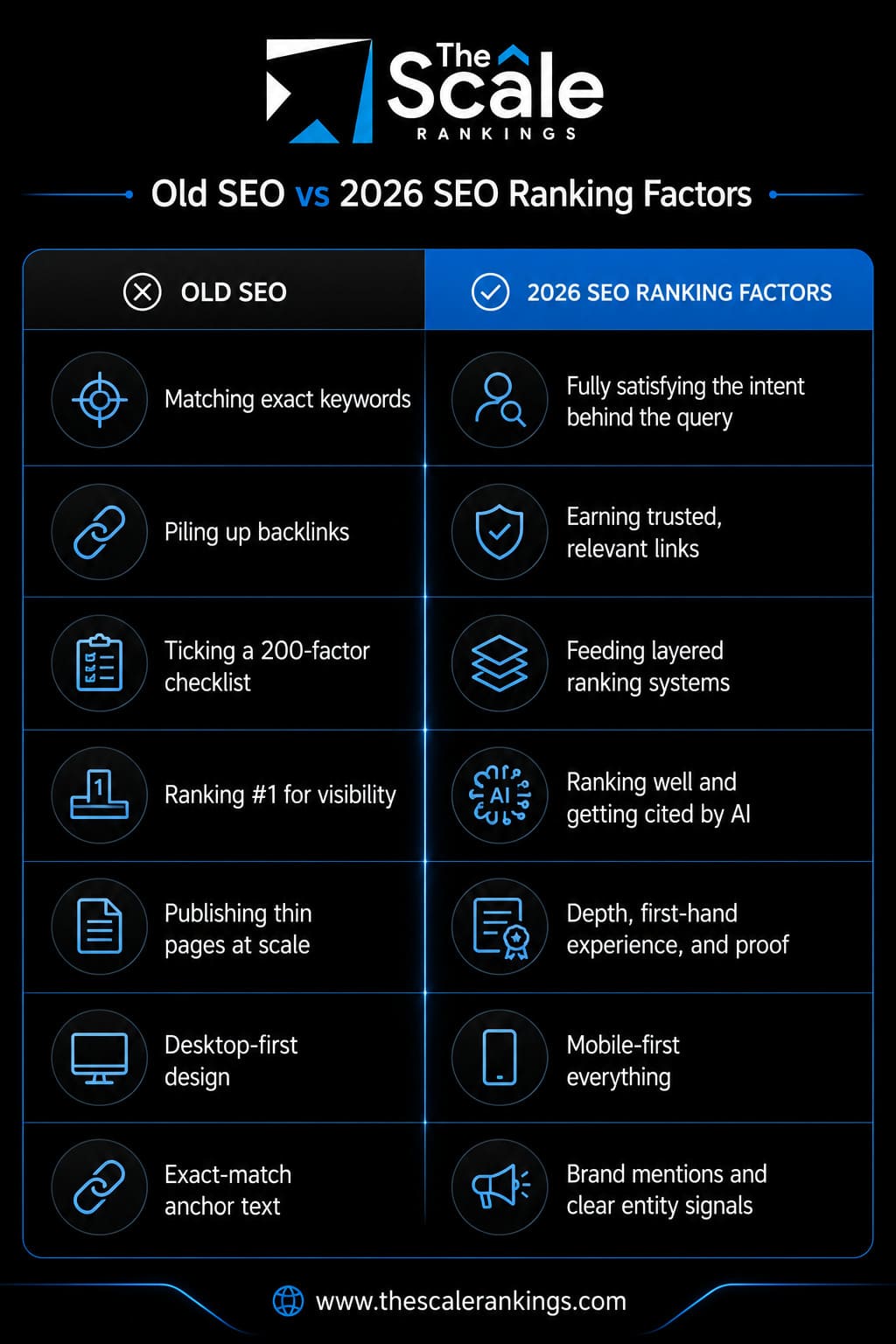
SEO ranking factors in 2026 have five pillars, with the search engine ranking factors within each. This guide also works as your Google ranking factors SEO checklist. You can revisit it every few months to keep your strategy on track.
Before writing, open the top five results and list every question they answer. Then ask what none of them covered and add that. If you sell running shoes and every competitor lists specs, add your own wear-test data after 100 miles. That gap is your competitive advantage. Among the most effective content optimization strategies is adding original insights that competitors have not covered.
Intent is where most pages quietly fail. If your format does not match what searchers want, no amount of search intent optimization will save you. Google decides the dominant intent for keyword relevancy and the content quality signals of pages. The four types of intent are informational, navigational, commercial, and transactional. Google now measures intent satisfaction depth, which asks a simple question: Did the page solve the problem in one visit?
How to do it: Search your target keyword and look at what actually ranks. If the top ten are all listicles, a product page will not break in. Match the format first, then beat it on depth. For example, searching "best CRM software" returns comparison articles, not CRM homepages, because the intent is research, not buying.
Google favors sites that own an expertise topic rather than dabble in many. Covering the content depth in one area deeply signals that you are a real authority, and Google measures how tightly focused a site is. This is why a small site can outrank a giant. Focus beats size.
How to do it: Build a content hub and topical authority. Write one pillar page on your core topic, then five to ten cluster pages on subtopics, and link them all back to the pillar. A personal finance site might have a budgeting pillar with clusters on emergency funds, debt payoff, and retirement accounts. That is the model this very page follows.
Freshness is confirmed, but it is query-dependent. It matters enormously for "best laptops in 2026" and barely at all for "how to tie a shoelace." Google's helpful content update decides which queries deserve fresh results and original data. AI Overviews lean heavily toward recent content, even on evergreen topics. Roughly 70% content cited in AI answers is under three months old.
How to do it: Set a calendar reminder to review your top pages every quarter. Replace statistics older than two years, refresh screenshots, and add a visible "Last updated" date. Do not just change the date without changing the content, because Google is wise to that.
Keywords tell Google what your page is about. Stuffing them tells Google you are gaming the system, and that is a confirmed negative signal. Placement beats repetition. A keyword in the right spot does more work than the same keyword repeated thirty times.
How to do it: Put your main keyword in the title tag near the front, in the H1, in the first 100 words, and in the URL slug. Keep the URL short, like /blog/seo-ranking-factors rather than /blog/2026/01/the-complete-guide-to-seo-ranking-factors-updated. Then use natural variations and related terms throughout the body instead of repeating the exact phrase.
E-E-A-T is the framework Google's human quality raters use, and pages that reflect it consistently do better. Pages with strong E-E-A-T signals had roughly a 30% higher chance of landing in the top three. So how does E-E-A-T affect SEO rankings in real life? It shows up in the details. Here is what each letter means and what proves it:
How to do it: Give every article a named author with a photo, a two-line bio, and their credentials. Link claims to primary sources. Add one detail only someone who did the work would know, such as a line reporting that “A tested client site with 4,000 monthly visitors saw traffic rise 22% in eight weeks”. That single sentence does more for E-E-A-T than a page of adjectives. Want help turning this into a repeatable system? A content marketing team builds it around your business. Start looking for the top search engine optimization services.
If content is the message, technical SEO is the delivery. You can write the best page on the internet, but if Google cannot crawl it or it loads slowly, none of it counts. Technical SEO ranking factors are also one of the easiest things to improve. Nobody notices it when it works, and everybody feels it when it breaks.
Page experience carries real weight. A few industry studies suggest that Core Web Vitals have a meaningful impact on rankings, although Google has never disclosed its exact weighting. These are the website ranking factors most sites get wrong without ever realizing it.
These three metrics measure loading, responsiveness, and visual stability. Google confirmed page speed as a ranking factor years ago, and it now measures it through these numbers. Here is what each one means in plain English, with the target you are aiming for.
How to do it: Run your URL through Google PageSpeed Insights, which is free. For LCP, compress your hero image and serve it as WebP. For CLS, set explicit width and height on every image so the browser reserves the space. For INP, cut heavy JavaScript, especially third-party scripts you forgot you installed. You do not need a perfect score because Google mainly penalizes the slowest experiences.
Google indexes and ranks the mobile version of your site, not the desktop one. This is true even for searches done on a laptop. A site that looks great on a monitor and cramped on a phone is a site with a ranking problem.
How to do it: Open your own page on your phone and try to use it. Can you read the text without pinching? Are the buttons far enough apart to tap without missing? If your desktop version hides content on mobile, that hidden content may carry less weight. Fix the phone experience first.
Google confirmed HTTPS as a ranking signal back in 2014, though it acts as a light tiebreaker rather than a heavy lever. The higher cost is trust. Browsers show a "Not Secure" warning on unencrypted sites, and visitors leave. Get an SSL certificate from your host, which is usually free. Then redirect every HTTP page to its HTTPS version with a 301 redirect, and update internal links so they point to the secure version directly.
Google cannot rank a page it cannot reach. Blocked pages are one of the most common reasons good pages never appear in search results. For this, visit https://www.yourdomain.com/robots.txt in your browser and check that your important pages are not disallowed. Then open Google Search Console, use the URL Inspection tool on a key page, and confirm it says the page is indexed. If it is not, request indexing. Also, fix broken links and redirect chains, which waste the crawl budget Google gives you.
A clean structure helps Google understand which pages matter and helps visitors find things. The deeper a page is buried, the less authority it reaches and the harder it is to discover. Keep every important page within three clicks of the homepage. Structure it as homepage, then category pages, then individual pages. Use your footer for valuable pages that did not fit the main navigation, since footer links appear sitewide and reinforce importance.
Schema is code that tells search engines exactly what your content is. It helps Google understand you, and it powers rich results and highlights in AI Overviews. Pick the schema type that fits the page. Use Article schema for blog posts, FAQPage for Q&A sections, HowTo for tutorials, Product for product pages, and Organization for your homepage. Generate the code with a free schema generator, paste it into the page, then validate it with Google's Rich Results Test to catch errors.
Google's crawler is not the only one that matters now. If ChatGPT, Gemini, Perplexity, or Claude cannot reach your site, they cannot cite you, no matter how good your content is. Plenty of sites block these crawlers by accident, or because a developer added a blanket rule years ago.
For this, open your robots.txt file and look for rules targeting OAI-SearchBot (ChatGPT), PerplexityBot, ClaudeBot, and Google-Extended. If any of them are followed by "Disallow: /", you are invisible to that platform. Remove the rule. This is a five-minute fix that most businesses have never checked.
Fixing these is often the fastest way to unlock rankings you already earned with good content. If you want expert eyes, a technical SEO audit finds the blockers you cannot see. For quick tactical wins, the post on easy ways to improve your website ranking is a solid companion.
Google has confirmed that backlinks are among its strongest signals. Links sit near the very top of the top ranking factors for SEO, and the data backs it up. Analyses show the top result tends to carry around 3.8 times more backlinks than the pages in positions two through ten. What changed is that quality now beats quantity by a wide margin.
One link from a respected industry publication outweighs fifty from directories nobody reads. Google evaluates the authority and trustworthiness of the site pointing at you, and low-quality links can actively hurt. Stop buying links and start earning them. Publish original data, run a small survey of your customers, or build a free tool. Journalists and bloggers link to sources they cannot get elsewhere. Then pitch it to publications in your field.
A link from a site in your industry passes more value than one from an unrelated site. A marketing blog linking to your marketing guide makes sense to Google. A cooking blog linking to it looks random. When you get a link offer, ask one question. Would a real reader of that site plausibly want to click through to my page? If the answer is no, skip it, no matter what the domain metrics say.
Google rewards links from many different sites over many links from one site. A hundred backlinks from a hundred domains beats a hundred backlinks from ten domains. Track referring domains, not raw backlink count, in whichever tool you use. When choosing between another link from a site that already links to you and a first link from a new, relevant site, take the new site.
Google understands brand mentions even without a link, and it works to recognize you as a real, distinct entity. Clear entity signals increasingly separate sites that get cited from sites that get skipped. Keep your business name, address, and details identical everywhere they appear. Add the Organization schema to your homepage with sameAs links pointing to your verified social profiles. Claim your listings on the directories that matter in your field, like G2 or Crunchbase for software. Consistency is what lets Google connect the dots into one confident picture of who you are. If you want to be recognized as a trusted source, entity SEO is the discipline that gets you there.
Google aims to send users to pages that satisfy their search intent. So it watches what happens after the click. These signals are hard to fake, which is exactly why they carry weight. Here are the engagement signals Google is believed to evaluate, and what each one is really telling it.
To fix this, rewrite title tags that describe the page and promise a clear benefit. Add a number or a year where it fits, since specifics get clicked. Compare "SEO Ranking Factors Guide" with "SEO Ranking Factors in 2026: What Actually Moves Rankings." The second one wins. Deliver the answer in the first two sentences instead of making people scroll past three paragraphs of throat-clearing. Break up walls of text. Add a table of contents on long pages so readers can jump to what they need rather than giving up.
A page that fully answers the question keeps people around. Engagement signals reward pages that satisfy intent and punish pages that only pretend to. There is a business angle too. The same things that hold attention also help people convert, which is where conversion rate optimization does its work.
Understanding AI search ranking factors is becoming just as important as understanding traditional Google ranking signals. This is the piece of SEO ranking factors 2026 added that older guides still miss. Zero-click searches, where people get an answer without visiting any site, climbed from 56% to 69% in a single year. And the overlap between the top Google results and the pages AI actually cites has collapsed from around 70% to below 20%. These changes have introduced a new set of AI search visibility ranking factors that reward clear structure, trustworthy information, and direct answers.
So, how do AI Overviews affect SEO ranking factors? They stack a new layer on top of the classic Google ranking factors. The good news is that the same trust and structure signals do double duty. Here is how to earn those citations, with examples.
AI systems pull the passage that answers the question. If your answer is buried in paragraph four, they take a competitor's paragraph one instead. Lead with the answer first, then explain. This matches the AI ranking factors used by modern answer engines when selecting citations. Compare these two openings under a heading like "What is a backlink?"
The second one gets cited. The first one gets skipped. Give the direct answer in the first two sentences of every section, then add the depth underneath.
AI matches your heading to the user's question. A heading phrased as the actual question is far more likely to be pulled into an answer than a clever one. Rewrite vague headings into real questions people type. Change "Link Building Overview" to "What Is a Backlink?" Change "Speed Considerations" to "Does Site Speed Affect Rankings?" Pull the exact phrasing from the People Also Ask box or your Search Console query report.
AI engines cite claims with numbers attached. Vague statements get ignored because they are not worth quoting. Turn every soft claim into a hard one. Instead of "faster sites tend to perform better," write "pages that load in under 2.5 seconds meet Google's LCP threshold." Instead of "AI search is growing," cite the figure and the source. Specificity is what makes a sentence citable.
Long, dense paragraphs are hard for AI to lift cleanly. Short blocks, clear lists, and tables are easy. Keep paragraphs to two to four sentences and one idea each. Use a table whenever you compare options, since AI extracts tables reliably. Use numbered lists for steps. Roughly 80% of pages cited by AI use lists or structured elements.
AI engines lean heavily on sources they did not get from you. Your own site is one voice. A review site, an industry publication, or a Reddit thread is corroboration. Get listed in the "best of" and comparison articles in your category by emailing the editors with your details. Answer questions genuinely on Reddit and Quora, both of which are cited constantly by AI systems. Do not spam links. Be useful, mention your brand only where relevant, and let the citation come to you.
This is the frontier most competitor articles skip. If you want to compete for it, the generative engine optimization service and answer engine optimization service are built for this, and AI citation building helps you earn mentions across AI platforms. To track whether it is working, see the roundup of tools for tracking AI citations.
Some of these are confirmed by Google. Others come from its spam policies and quality guidelines. The SEO ranking factors 2026 punishes hardest are often the ones sitting quietly on your site right now. Here is what drags sites down, and the fix for each.
Work through this list once, and you may recover rankings you never realized you had lost.
People often ask where on-page ends and off-page begins. It is a useful way to sort the factors that affect SEO ranking, because the two sides need different work.
The mistake is treating them as separate projects. They feed each other. Strong on-page content earns off-page links naturally. Strong off-page authority makes your on-page work rank faster. You need both pulling the same way.
If you serve a specific area, a different set of rules applies on top of the usual ones. Google leans on three signals for local search results, and they behave nothing like organic search. These signals form the foundation of Google's business profile ranking factors, making a complete and accurate profile essential for local visibility.
Understanding the difference saves you from optimizing the wrong thing. A perfect blog post will not put you in the map pack.
How to do it: Ask happy customers for reviews and reply to every one, positive or negative. Then make sure your name, address, and phone number match exactly across your website, Google Business Profile, and every directory listing. Google cross-references those details, and a mismatched phone number quietly costs you.
There is no fixed SEO optimization timeline because results depend on your site's current health, competition, and the improvements you prioritize first. People try to fix everything at once, spread themselves thin, and move nothing. The smarter play is to fix things in the order Google's own systems care about them. Ordering the top ranking factors for SEO by impact is how you avoid that trap.
Here is a priority order that works for most sites:
This order mirrors how Google filters pages, from can-it-be-read, to is-it-relevant, to can-it-be-trusted. Weak technical health drags down everything above it, so it goes first.
So, how do you rank higher on Google in 2026 without a huge team? You prioritize. The ranking factors in SEO are the same for you as for the big players, so the same SEO ranking criteria apply. You just work through them in a tighter order. You fix the one bottleneck holding you back right now, then the next one. If you want a prioritized roadmap for your exact site, that is what SEO consulting delivers, and the guide on SEO strategies for startups is a good next read for lean teams.
Meeting SEO ranking criteria is about becoming the clearest, most trustworthy, and most useful answer for the searches you want to rank for. The SEO ranking factors that decide your position all point in the same direction to help the reader, prove you can be trusted, and make it easy for both people and AI to use your page.
Do that, and something useful happens. The signals stop feeling like a checklist and start compounding. Better content earns better links, which help pages rank faster. Faster rankings than feed AI citations. And each win makes the next one easier.
So here is a question worth sitting with. If you could only fix one thing on your site this month, would you know which factor is actually holding you back? Most sites do not, and that is usually the real problem. Ready to find out? Start with a free SEO audit from The Scale Rankings. Our SEO experts can help you create a custom plan through SEO consulting. If you are still weighing your options, the breakdowns on search engine optimization services can help you decide your next move.
The Scale Rankings is your go-to partner for all things SEO. We focus on crafting personalized SEO strategies that deliver real results, from boosting your rankings to increasing organic traffic. With our expertise in on-page SEO, off-page SEO, and technical SEO, we ensure your brand stands out in the digital crowd.
The Scale Rankings ensures to make sure your audience finds exactly what they’re looking for. As one of the best search engine optimization (SEO) companies, we dig into the core of your business, crafting strategies that hit home across industries. Our services include:
 Let’s Chat
Need help with your next SEO project? Our experts are here to help. Reach out to us for a free consultation or more information.
 +1 877 33 SCALE
 [email protected]
 1870 The Exchange SE Ste 220 PMB 47489, Atlanta, GA 30339-2171




 Local SEO
 E-Commerce SEO
 International SEO
 SEO Consulting
 Conversion Rate Optimization
 Content Marketing
 Content Strategy
 Website Content
 Answer Engine Optimization
 Amazon SEO
 Generative Engine Optimization
 AI Citation Building
 Entity SEO